ebooks
What is engineering team health?
Maximizing engineering team health is critical to the success of the business, and there is a strong correlation between healthy teams and productivity. Team health in engineering is determined by a variety of factors including:
- A belief that work is meaningful, evenly distributed, and not wasted
- Strong team collaboration
- Psychological safety
- Alignment on priorities
- Managers’ support of individual and team development
To improve team health and maximize the engineering teams’ impact on the business, engineering leaders need visibility into key stages of the engineering process and the factors, above, that determine team health.
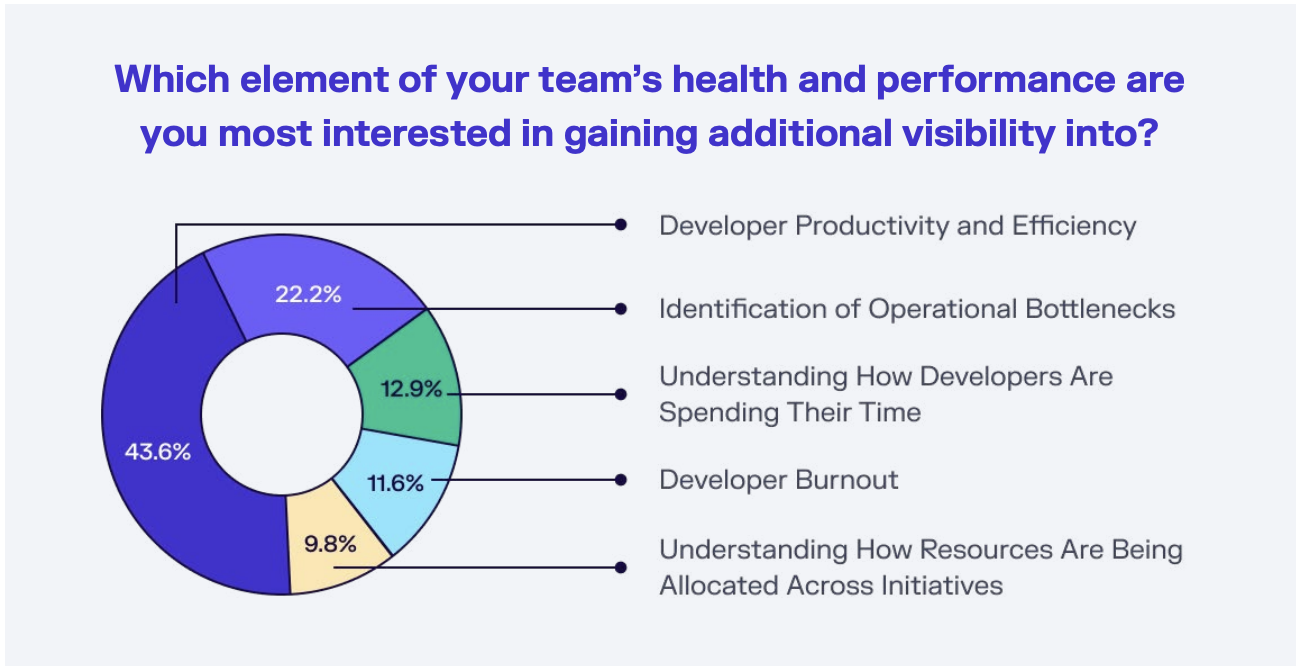
As part of our survey in collaboration with CTO Connection, we asked more than 200 engineering leaders what areas of team health and performance they are most interested in gaining visibility into.
Here’s a breakdown of those responses:
In this ebook, you’ll learn how to gain visibility into engineering team health and performance to improve efficiency and developer experience to maximize engineering impact on the business.
In 2022, IT spending for organizations worldwide exceeded $4.4 trillion, underscoring the essential role of tech in today’s economy. Gartner’s research shows that investment in technology is key to business success, spurring a heightened focus on the software engineering organizations behind that technology.
Engineering organizations are now under greater pressure to maximize ROI, effectively allocate resources, communicate with stakeholders on progress, and deliver quality software quickly. To achieve this, engineering leaders need visibility into engineering processes, where resources are going, and how their teams are working.
The challenge of visibility in engineering
In the past, leaders have relied on homegrown solutions and surveys to assess the state of the engineering organization. These solutions can be error-prone and time consuming, requiring leaders to manually gather information from a variety of sources like project management tools and version control systems.
To gain critical context and dependable data, leaders should leverage a Software Engineering Intelligence (SEI) platform. An SEI platform ingests, cleans, links, and analyzes data from teams’ existing systems, surfacing those insights via alerts, custom reporting, and intuitive visualizations. This gives leaders the visibility they need to evaluate tradeoffs, mitigate risk, enhance communication, boost engineering efficiency, and improve value delivery.
Gartner predicts that 70% of organizations will have an SEI platform by 2026, up from 5% in 2023.
(Source: Innovation Insight for Software Engineering Intelligence Platforms, March, 2023)
How can engineering leaders best evaluate which SEI platform is the best option for their organization?
We’ve put together a comprehensive buyer’s guide outlining what leaders should look for in an SEI platform, including key features and capabilities.

We recommend assessing SEI platforms on the following categories:
- Process and Team Health: An SEI platform should provide a multidimensional picture of team health, while adapting to variations in team process.
- Allocations and Business Value: It’s imperative that an SEI platform help leaders accurately assess resource allocation and quantify engineering impact.
- Efficiency and Predictable Delivery: The right SEI platform should help leaders improve their team’s ability to deliver code consistently, predictably, and at high quality.
- Team Effectiveness: An SEI platform will offer insight into whether interruptions, wasted work, or other factors are impacting engineering’s ability to deliver value.
- Data Hygiene and Analysis: The best SEI platform will deliver trustworthy insights while working in tandem with the tools and workflows a team is already using.
- Scalability and Customization: An SEI platform should be able to meet the unique needs of complex, large, and ever-evolving organizations.
- Security: The best SEI platforms will prioritize the security of your data.
Code Climate’s enterprise-level insights platform is the only one to offer enterprise-grade security and scalability. From day one, Code Climate maximizes engineering impact with trusted and actionable insights for leaders and teams at all levels — from capacity and delivery to quality, culture, and costs.
As outlined in the guide, Code Climate's platform provides unique advantages in four key areas:
- Clear Focus on Improving the Efficiency and Output of Engineering Teams: Code Climate's platform provides critical visibility into development processes, including insights for coaching and for improving the overall health and efficiency of an engineering organization.
- Security and Scalability for Large, Complex Organizations: Code Climate adapts to our customers’ needs, and our security and scalability capabilities are built to handle the largest enterprises.
- Personalized Customer Experience: Code Climate offers a superior customer experience from Day 1, with white-glove support, thorough technical onboarding, multiple training options, and a consultative approach to change management.
- Customizations That Adapt to How Our Customers Work: Code Climate's platform is highly customizable, adapting to the way our customers work. The platform offers autonomy for each of your engineering teams so that they can best leverage metrics to improve performance.
Download the complete guide to choosing an SEI platform and find out more about the advantages of SEI, including what to look for when evaluating each of the key capabilities, and a detailed breakdown of how Code Climate measures up.

The most successful engineering leaders incorporate objective data into their leadership strategies. Numbers can’t substitute for a CTO’s experience and instincts, but when it comes to decision-making, leaders can use metrics in software engineering to inform their decisions and align with stakeholders.
Different leaders optimize for a different set of metrics depending on company priorities and the needs of their engineering teams. Yet, if you’re introducing metrics to your team, or refining your approach to metrics, there are key measurements worth considering.
At Code Climate, we’ve worked with thousands of organizations, from startups to enterprises, and we know that there are a few key metrics that have proven time and again to be valuable, even if they’re just a starting point!

Whether you’re just starting to incorporate data into your leadership, or are refining your approach to measurement, these 10 metrics are important ones to consider.
They can help you:
- Get a handle on your organization’s Time to Market,
- Ensure your team is adhering to CI/CD best practices,
- Measure the quality of your code, and
- Assess the efficacy of your planning processes.
To find out which 10 metrics you need to know, how to apply them effectively and resolve bottlenecks, download the ebook.

When evaluating their team’s health, engineering leaders might look to anecdotal data or rely on instinct. While valuable, these only tell part of the story.
By incorporating metrics into your leadership strategies, you can gain more precise insight into how your teams work. Data provides objective evidence that, if thoughtfully interpreted, can help leaders effectively manage teams to produce better software more efficiently.
Within a business, most departments — including marketing, finance, and HR — use some form of metrics to inform critical decisions. Engineering can also reap the benefits of data: these numbers can provide fact-based support when leaders are looking to create alignment or generate buy-in from key stakeholders. Data also offers engineering leaders a starting point for 1-on-1s, standups, and retros with developers — with metrics, meetings, and coaching conversations remaining objective and rooted in fact.
The idea of tracking and measuring developer productivity can feel like micromanaging, or worse, surveillance, and engineering leaders might be hesitant to introduce metrics to the team. In this ebook, we cover key strategies for introducing metrics in positive ways that avoid blame and promote psychological safety. (Hint: metrics give you insight about the work, not the developers themselves).
You’ll also find:
- How metrics improved delivery for engineering teams and addressed biases for real organizations
- Which metrics to track and how often
- How metrics can both reinforce and challenge your assumptions — and why both are good things
For a deeper dive into the fundamentals of engineering metrics, download our ebook.
Want to learn more about how to best address your team’s challenges? Request a consultation.
Effective engineering leaders today deftly balance the needs of their organization with the needs of their developers. Tasked with making strategic decisions, coaching their teams, and driving process improvements to meet business objectives and key results, leaders are often distanced from the actual work of writing code. As such, leaders must empower their team members to excel, and engineering intelligence data can help in a number of ways.
Find out how data can help you cultivate an engineering environment that drives success in our new ebook, The Engineering Leader’s Guide to Empowering Excellence with Data.
Focusing on four key areas—removing blockers, minimizing micromanagement, personalizing coaching, and fostering a culture of psychological safety—our ebook will help you gain actionable insights from data, rather than gut feelings, to achieve a developer-focused work environment.
With the right data, you can determine when to step in to lend support, and when to step back and encourage autonomy, so you can empower your team members to go above and beyond. Used thoughtfully, data can help you build stronger, more successful teams and drive continuous improvement.
An empowered team is a successful team. Download our ebook (for free!) today.
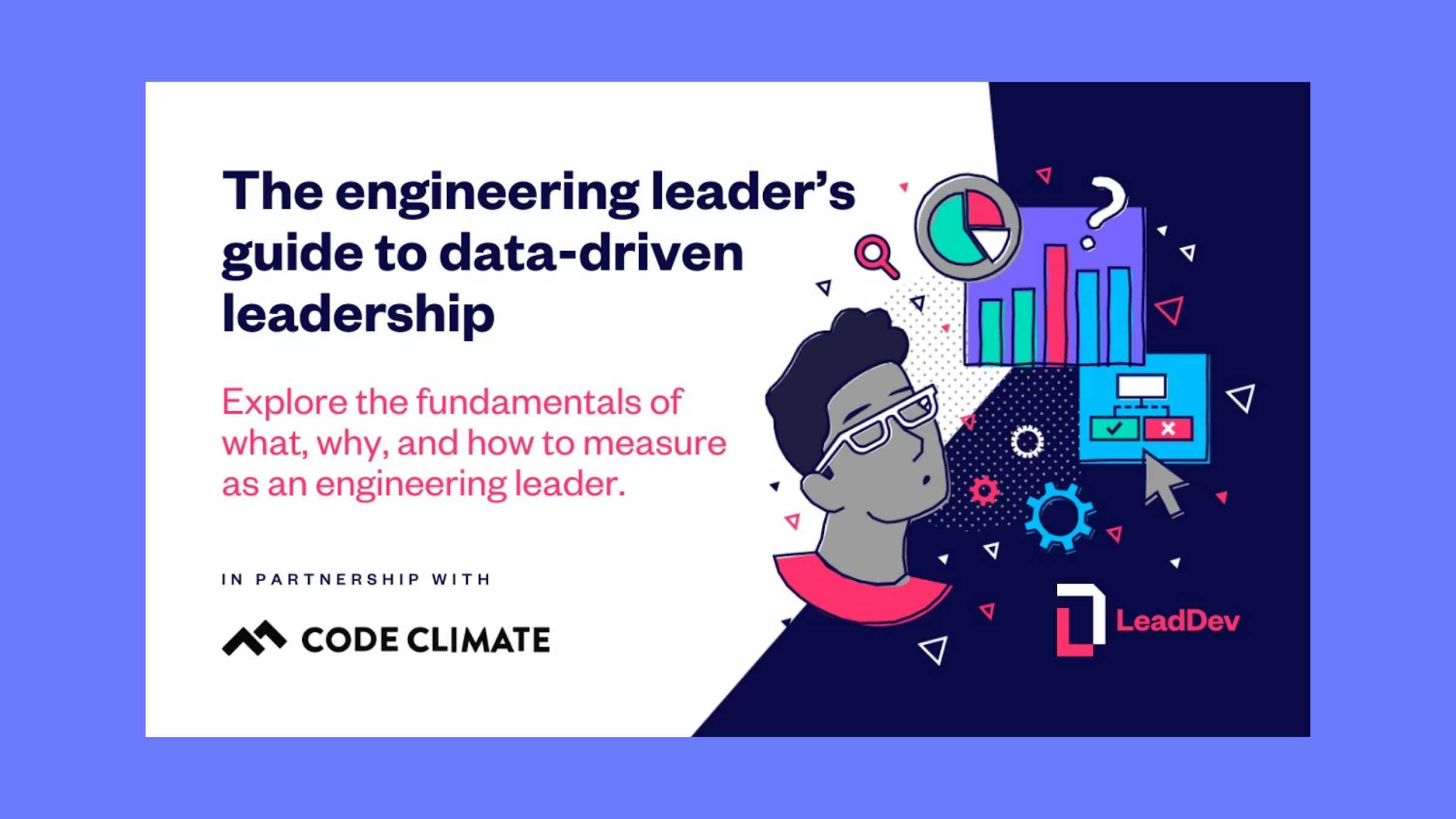
Engineering metrics can be a powerful tool for tracking and communicating engineering progress, debugging processes, boosting team performance, and much more – but they must be wielded with care. When misused, metrics can backfire, creating confusion and resentment.
To help engineering leaders successfully leverage metrics, Code Climate has partnered with LeadDev on a series of blog posts and webinars that explore the fundamentals of data-driven leadership. Drawing on the expertise of engineering leaders from a range of industries, we highlight real-world perspectives on the what, why, and how of measuring as an engineering leader. We touch on everything from selecting the best metrics to track for your organization, to introducing metrics successfully, and specific use cases, like using metrics to run more impactful standups.
Here are some key insights:
- “I’ve found that metrics are valuable in helping zero in on what might be getting in the team’s way. Instead of treating them as a way to judge performance, I believe metrics are most useful in bringing to light areas of opportunity.” Leslie Cohn-Wein, Engineering Manager, Netlify
- “First and foremost, I use metrics to help me identify what the biggest bottlenecks are across different teams. Without metrics, I’d be left to make this judgment based on hearsay instead of methodology. The second reason I use metrics is to understand changes over time, particularly as we undergo organizational changes or make investments in specific areas.” Abi Noda, Developer Experience Expert
- “Cycle Time is a metric that I consistently come back to — it’s a great proxy for engineering speed, and can be a useful high-level look at whether certain key decisions are having the desired impact. If we’re moving slower than we had been, I can then isolate parts of the engineering pipeline and investigate where exactly things are going off track.” James McGill, VP of Engineering, Code Climate
- “The outcomes of productive standups ripple throughout the engineering team. By discussing specific metrics in standups, you can tell if your team is moving forward. You can ensure that the risks are being addressed from an objective, quantifiable standpoint rather than opinion.” Khan Smith, VP of Product, Code Climate
To dig deeper into what engineering leaders are doing today with metrics, check out the full series.
Ready to get started with engineering metrics in your organization? Contact our product specialists.
“Don’t see management as a promotion, see it as a shift in role, and acknowledge that it will be a bit uncomfortable for you, and give yourself space to be okay with that.” – Smruti Patel, Engineering Manager at Stripe
Many engineering leaders move into management unprepared for precisely that reason — it requires a shift in mindset and a new set of skills. To ease that transition for new and aspiring managers, and to help seasoned managers level up, Code Climate and Codecademy for Business interviewed engineering leaders about the key components of leadership success. We spoke to VPs and Managers at companies like Netflix, Intuit, GitHub, and Stripe to find out about their most successful management strategies and the skills that they deem to be essential.
Their best advice is compiled in our ebook, How 10 Engineering Leaders Build High-Performance Teams.
Highlights include:
“Having leaders on your team that are not managers is actually very useful because for you as a manager, that means you don’t have to do everything…leadership by influence or suggestion is actually a lot more powerful.” – Mathias Meyer, Engineering Leadership Coach, www.paperplanes.de
“I start my management relationships with the foundation of trust, respect, and accountability. A powerful way to show trust and respect for your team is by welcoming everyone’s opinions, ideas and feedback.” – Alexandra Paredes, VP of Engineering at Code Climate
“Don’t pretend like you have all the answers. Do that figuring out in front of the team because it’ll make them trust you more, not less.” – Nitika Daga, Engineering Manager at Stitch Fix
Download it now for wisdom from:
- Tara Ellis, Manager, UI Engineering at Netflix
- Brooks Swinnerton, Senior Engineering Manager at GitHub
- Gergely Nemeth, Group Engineering Manager at Intuit
- Lena Reinhard, Vice President of Product Engineering at CircleCI
- Mathias Meyer, Engineering Leadership Coach, www.paperplanes.de
- Anchal Dube, Senior Engineering Manager at Zocdoc
- Andrew Heine, Engineering Manager at Figma
- Smruti Patel, Engineering Manager at Stripe
- Nitika Daga, Engineering Manager at Stitch Fix
- Alexandra Paredes, VP of Engineering at Code Climate
One critical engineering metric can help you innovate faster, outrun your competition, and retain top talent: Cycle Time. It’s your team’s speedometer, and it’s the key to everything from developer satisfaction to predictable sprints. And Cycle Time has implications beyond engineering — it’s also an important indicator of business success.
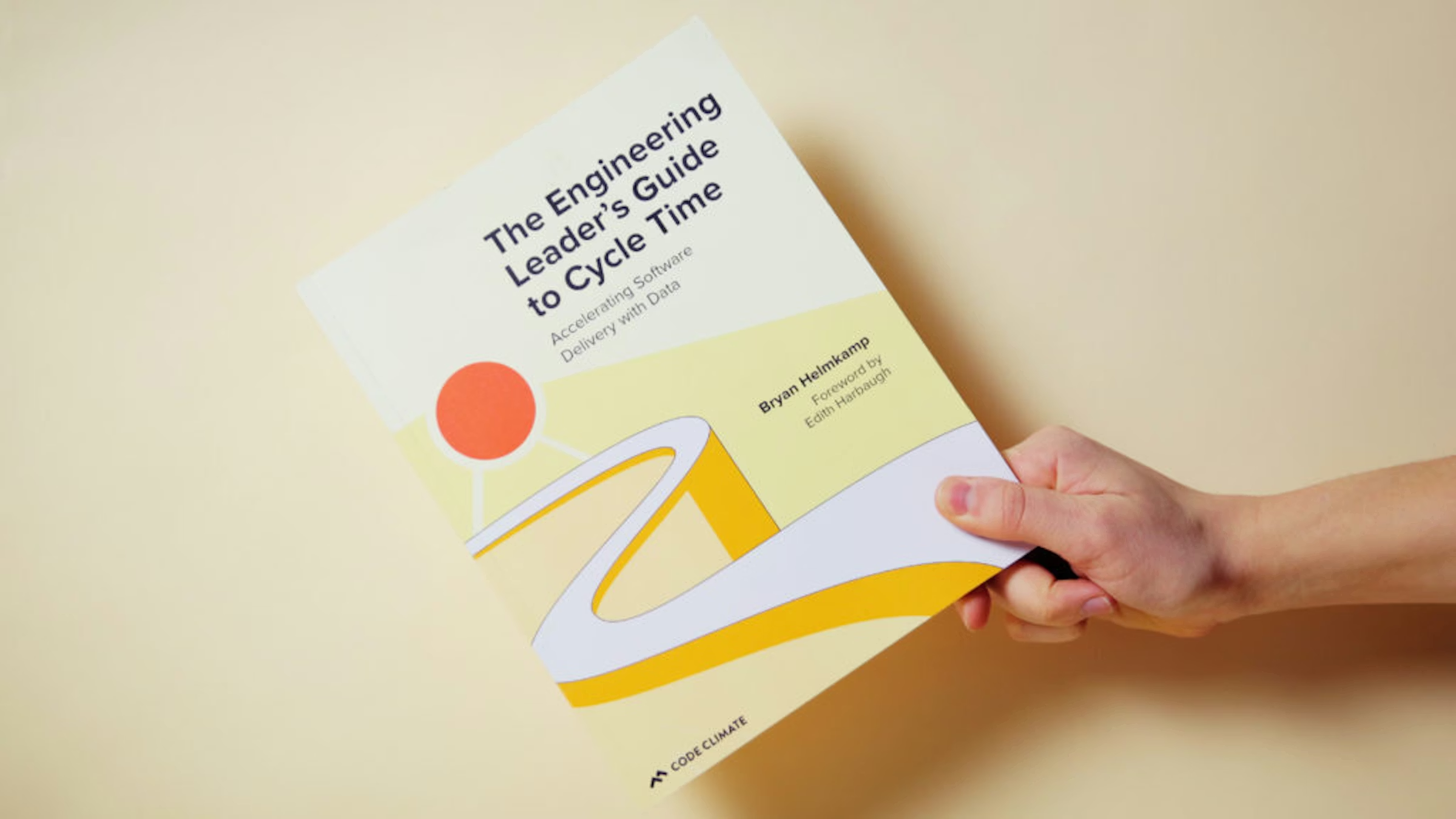
That’s why we’re excited to announce the release of our new book, The Engineering Leader’s Guide to Cycle Time. For those looking to boost their team’s efficiency and productivity, we offer a data-driven approach, backed by research, case studies, and our own experience as an industry-leading Engineering Intelligence platform.
The book dives into the components of this critical metric, breaking down the development pipeline into distinct stages to highlight common bottlenecks and opportunities for acceleration. The foreword, by Edith Harbaugh, CEO and Co-Founder of LaunchDarkly, places Cycle Time in context, explaining how it’s integral to the latest shift in software development methodology — the shift towards CI/CD.
Download it now (it’s free!) for a breakdown of the most important engineering metrics, strategic advice on increasing engineering speed, and real-world advice from senior engineering leaders.