Resources & Insights
Featured Article
Navigating the world of software engineering or developer productivity insights can feel like trying to solve a complex puzzle, especially for large-scale organizations. It's one of those areas where having a cohesive strategy can make all the difference between success and frustration. Over the years, as I’ve worked with enterprise-level organizations, I’ve seen countless instances where a lack of strategy caused initiatives to fail or fizzle out.
In my latest webinar, I breakdown the key components engineering leaders need to consider when building an insights strategy.
Why a Strategy Matters
At the heart of every successful software engineering team is a drive for three things:
- A culture of continuous improvement
- The ability to move from idea to impact quickly, frequently, and with confidence
- A software organization delivering meaningful value
These goals sound simple enough, but in reality, achieving them requires more than just wishing for better performance. It takes data, action, and, most importantly, a cultural shift. And here's the catch: those three things don't come together by accident.
In my experience, whenever a large-scale change fails, there's one common denominator: a lack of a cohesive strategy. Every time I’ve witnessed a failed attempt at implementing new technology or making a big shift, the missing piece was always that strategic foundation. Without a clear, aligned strategy, you're not just wasting resources—you’re creating frustration across the entire organization.
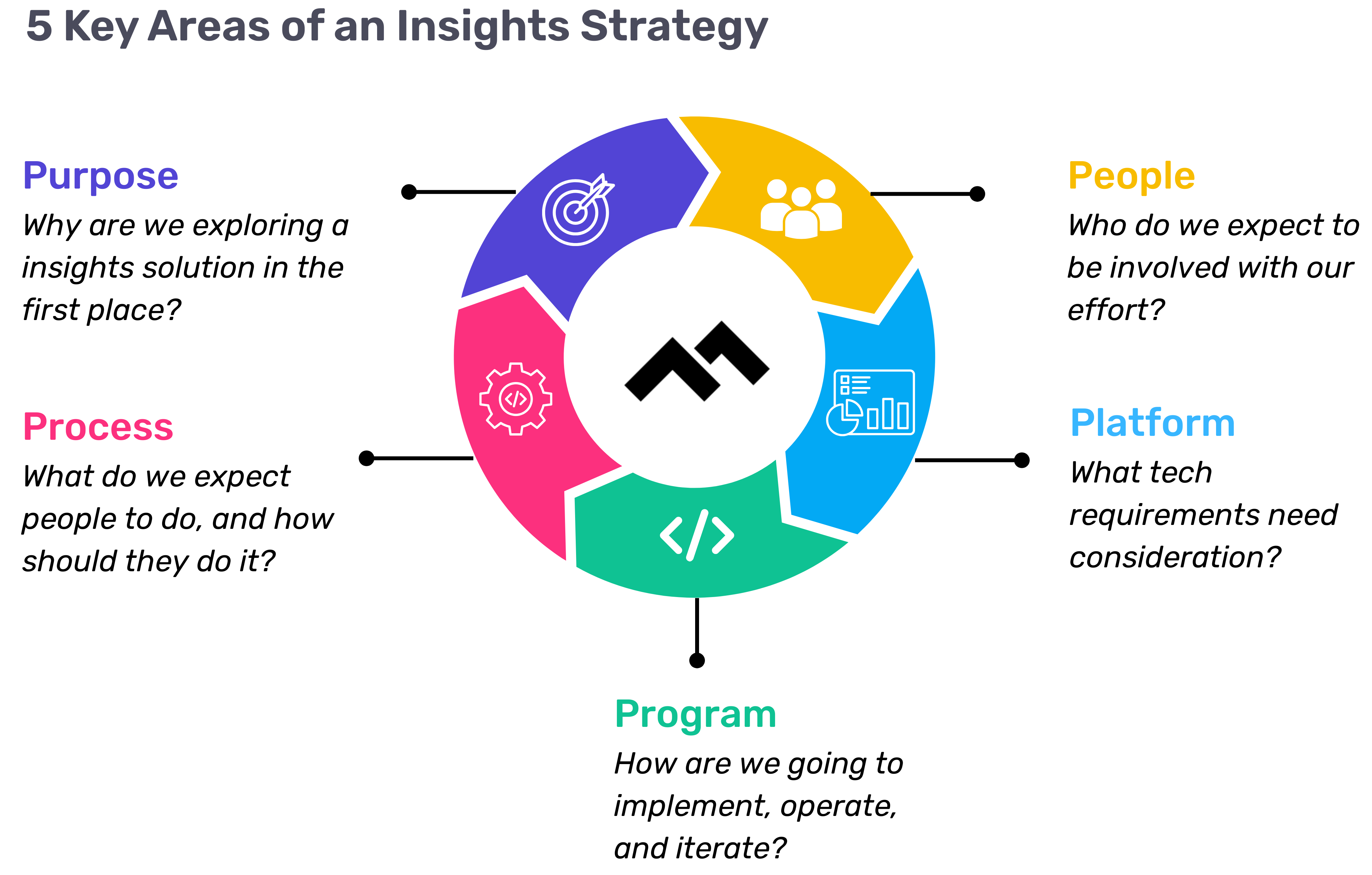
Sign up for a free, expert-led insights strategy workshop for your enterprise org.
Step 1: Define Your Purpose
The first step in any successful engineering insights strategy is defining why you're doing this in the first place. If you're rolling out developer productivity metrics or an insights platform, you need to make sure there’s alignment on the purpose across the board.
Too often, organizations dive into this journey without answering the crucial question: Why do we need this data? If you ask five different leaders in your organization, are you going to get five answers, or will they all point to the same objective? If you can’t answer this clearly, you risk chasing a vague, unhelpful path.
One way I recommend approaching this is through the "Five Whys" technique. Ask why you're doing this, and then keep asking "why" until you get to the core of the problem. For example, if your initial answer is, “We need engineering metrics,” ask why. The next answer might be, “Because we're missing deliverables.” Keep going until you identify the true purpose behind the initiative. Understanding that purpose helps avoid unnecessary distractions and lets you focus on solving the real issue.
Step 2: Understand Your People
Once the purpose is clear, the next step is to think about who will be involved in this journey. You have to consider the following:
- Who will be using the developer productivity tool/insights platform?
- Are these hands-on developers or executives looking for high-level insights?
- Who else in the organization might need access to the data, like finance or operations teams?
It’s also crucial to account for organizational changes. Reorgs are common in the enterprise world, and as your organization evolves, so too must your insights platform. If the people responsible for the platform’s maintenance change, who will ensure the data remains relevant to the new structure? Too often, teams stop using insights platforms because the data no longer reflects the current state of the organization. You need to have the right people in place to ensure continuous alignment and relevance.
Step 3: Define Your Process
The next key component is process—a step that many organizations overlook. It's easy to say, "We have the data now," but then what happens? What do you expect people to do with the data once it’s available? And how do you track if those actions are leading to improvement?
A common mistake I see is organizations focusing on metrics without a clear action plan. Instead of just looking at a metric like PR cycle times, the goal should be to first identify the problem you're trying to solve. If the problem is poor code quality, then improving the review cycle times might help, but only because it’s part of a larger process of improving quality, not just for the sake of improving the metric.
It’s also essential to approach this with an experimentation mindset. For example, start by identifying an area for improvement, make a hypothesis about how to improve it, then test it and use engineering insights data to see if your hypothesis is correct. Starting with a metric and trying to manipulate it is a quick way to lose sight of your larger purpose.
Step 4: Program and Rollout Strategy
The next piece of the puzzle is your program and rollout strategy. It’s easy to roll out an engineering insights platform and expect people to just log in and start using it, but that’s not enough. You need to think about how you'll introduce this new tool to the various stakeholders across different teams and business units.
The key here is to design a value loop within a smaller team or department first. Get a team to go through the full cycle of seeing the insights, taking action, and then quantifying the impact of that action. Once you've done this on a smaller scale, you can share success stories and roll it out more broadly across the organization. It’s not about whether people are logging into the platform—it’s about whether they’re driving meaningful change based on the insights.
Step 5: Choose Your Platform Wisely
And finally, we come to the platform itself. It’s the shiny object that many organizations focus on first, but as I’ve said before, it’s the last piece of the puzzle, not the first. Engineering insights platforms like Code Climate are powerful tools, but they can’t solve the problem of a poorly defined strategy.
I’ve seen organizations spend months evaluating these platforms, only to realize they didn't even know what they needed. One company in the telecom industry realized that no available platform suited their needs, so they chose to build their own. The key takeaway here is that your platform should align with your strategy—not the other way around. You should understand your purpose, people, and process before you even begin evaluating platforms.
Looking Ahead
To build a successful engineering insights strategy, you need to go beyond just installing a tool. An insights platform can only work if it’s supported by a clear purpose, the right people, a well-defined process, and a program that rolls it out effectively. The combination of these elements will ensure that your insights platform isn’t just a dashboard—it becomes a powerful driver of change and improvement in your organization.
Remember, a successful software engineering insights strategy isn’t just about the tool. It’s about building a culture of data-driven decision-making, fostering continuous improvement, and aligning all your teams toward achieving business outcomes. When you get that right, the value of engineering insights becomes clear.
Want to build a tailored engineering insights strategy for your enterprise organization? Get expert recommendations at our free insights strategy workshop. Register here.Register here.
Andrew Gassen has guided Fortune 500 companies and large government agencies through complex digital transformations. He specializes in embedding data-driven, experiment-led approaches within enterprise environments, helping organizations build a culture of continuous improvement and thrive in a rapidly evolving world.

Navigating the world of software engineering or developer productivity insights can feel like trying to solve a complex puzzle, especially for large-scale organizations. It's one of those areas where having a cohesive strategy can make all the difference between success and frustration. Over the years, as I’ve worked with enterprise-level organizations, I’ve seen countless instances where a lack of strategy caused initiatives to fail or fizzle out.
In my latest webinar, I breakdown the key components engineering leaders need to consider when building an insights strategy.
Why a Strategy Matters
At the heart of every successful software engineering team is a drive for three things:
- A culture of continuous improvement
- The ability to move from idea to impact quickly, frequently, and with confidence
- A software organization delivering meaningful value
These goals sound simple enough, but in reality, achieving them requires more than just wishing for better performance. It takes data, action, and, most importantly, a cultural shift. And here's the catch: those three things don't come together by accident.
In my experience, whenever a large-scale change fails, there's one common denominator: a lack of a cohesive strategy. Every time I’ve witnessed a failed attempt at implementing new technology or making a big shift, the missing piece was always that strategic foundation. Without a clear, aligned strategy, you're not just wasting resources—you’re creating frustration across the entire organization.
Sign up for a free, expert-led insights strategy workshop for your enterprise org.
Step 1: Define Your Purpose
The first step in any successful engineering insights strategy is defining why you're doing this in the first place. If you're rolling out developer productivity metrics or an insights platform, you need to make sure there’s alignment on the purpose across the board.
Too often, organizations dive into this journey without answering the crucial question: Why do we need this data? If you ask five different leaders in your organization, are you going to get five answers, or will they all point to the same objective? If you can’t answer this clearly, you risk chasing a vague, unhelpful path.
One way I recommend approaching this is through the "Five Whys" technique. Ask why you're doing this, and then keep asking "why" until you get to the core of the problem. For example, if your initial answer is, “We need engineering metrics,” ask why. The next answer might be, “Because we're missing deliverables.” Keep going until you identify the true purpose behind the initiative. Understanding that purpose helps avoid unnecessary distractions and lets you focus on solving the real issue.
Step 2: Understand Your People
Once the purpose is clear, the next step is to think about who will be involved in this journey. You have to consider the following:
- Who will be using the developer productivity tool/insights platform?
- Are these hands-on developers or executives looking for high-level insights?
- Who else in the organization might need access to the data, like finance or operations teams?
It’s also crucial to account for organizational changes. Reorgs are common in the enterprise world, and as your organization evolves, so too must your insights platform. If the people responsible for the platform’s maintenance change, who will ensure the data remains relevant to the new structure? Too often, teams stop using insights platforms because the data no longer reflects the current state of the organization. You need to have the right people in place to ensure continuous alignment and relevance.
Step 3: Define Your Process
The next key component is process—a step that many organizations overlook. It's easy to say, "We have the data now," but then what happens? What do you expect people to do with the data once it’s available? And how do you track if those actions are leading to improvement?
A common mistake I see is organizations focusing on metrics without a clear action plan. Instead of just looking at a metric like PR cycle times, the goal should be to first identify the problem you're trying to solve. If the problem is poor code quality, then improving the review cycle times might help, but only because it’s part of a larger process of improving quality, not just for the sake of improving the metric.
It’s also essential to approach this with an experimentation mindset. For example, start by identifying an area for improvement, make a hypothesis about how to improve it, then test it and use engineering insights data to see if your hypothesis is correct. Starting with a metric and trying to manipulate it is a quick way to lose sight of your larger purpose.
Step 4: Program and Rollout Strategy
The next piece of the puzzle is your program and rollout strategy. It’s easy to roll out an engineering insights platform and expect people to just log in and start using it, but that’s not enough. You need to think about how you'll introduce this new tool to the various stakeholders across different teams and business units.
The key here is to design a value loop within a smaller team or department first. Get a team to go through the full cycle of seeing the insights, taking action, and then quantifying the impact of that action. Once you've done this on a smaller scale, you can share success stories and roll it out more broadly across the organization. It’s not about whether people are logging into the platform—it’s about whether they’re driving meaningful change based on the insights.
Step 5: Choose Your Platform Wisely
And finally, we come to the platform itself. It’s the shiny object that many organizations focus on first, but as I’ve said before, it’s the last piece of the puzzle, not the first. Engineering insights platforms like Code Climate are powerful tools, but they can’t solve the problem of a poorly defined strategy.
I’ve seen organizations spend months evaluating these platforms, only to realize they didn't even know what they needed. One company in the telecom industry realized that no available platform suited their needs, so they chose to build their own. The key takeaway here is that your platform should align with your strategy—not the other way around. You should understand your purpose, people, and process before you even begin evaluating platforms.
Looking Ahead
To build a successful engineering insights strategy, you need to go beyond just installing a tool. An insights platform can only work if it’s supported by a clear purpose, the right people, a well-defined process, and a program that rolls it out effectively. The combination of these elements will ensure that your insights platform isn’t just a dashboard—it becomes a powerful driver of change and improvement in your organization.
Remember, a successful software engineering insights strategy isn’t just about the tool. It’s about building a culture of data-driven decision-making, fostering continuous improvement, and aligning all your teams toward achieving business outcomes. When you get that right, the value of engineering insights becomes clear.
Want to build a tailored engineering insights strategy for your enterprise organization? Get expert recommendations at our free insights strategy workshop. Register here.Register here.
Andrew Gassen has guided Fortune 500 companies and large government agencies through complex digital transformations. He specializes in embedding data-driven, experiment-led approaches within enterprise environments, helping organizations build a culture of continuous improvement and thrive in a rapidly evolving world.
All Articles

Our latest post comes from Giles Bowkett. Giles recently wrote a book, Rails As She Is Spoke, which explores Rails’ take on OOP and its implications. It’s an informative and entertaining read, and you should buy it.
A few days ago I wrote a blog post arguing that rails developers should take DCI seriously. Be careful what you wish for! A tumultuous brouhaha soon ensued on Twitter. I can’t necessarily take the credit for that, but I’m glad it happened, because one of the people at the center of the cyclone, Rails creator David Heinemeier Hansson, wrote a good blog post on ActiveSupport::Concern, which included a moment of taking DCI seriously.
[…] breaking up domain logic into concerns is similar in some ways to the DCI notion of Roles. It doesn’t have the run-time mixin acrobatics nor does it have the “thy models shall be completely devoid of logic themselves” prescription, but other than that, it’ll often result in similar logic extracted using similar names.
DCI (data, context, and interaction) is a paradigm for structuring object-oriented code. Its inventor, Trygve Reenskaug, also created MVC, an object-oriented paradigm every Rails developer should be familiar with. Most Rubyi mplementations use mixins quite a lot, and there is indeed some similarity there.
However, there’s a lot more to DCI than just mixins, and since I’ve already gone into detail about it elsewhere, as have many others, I won’t get into that here. I’m very much looking forward to case studies from people who’ve used it seriously. Likewise, there are a lot of good reasons to feel cautious about using mixins, either for Rails concerns or for DCI, but that discussion’s ongoing and deserves (and is receiving) several blog posts of its own.
What I want to talk about is this argument in Hansson’s blog post:
I find that concerns are often just the right amount of abstraction and that they often result in a friendlier API. I far prefer current_account.posts.visible_to(current_user) to involving a third query object. And of course things like Taggable that needs to add associations to the target object are hard to do in any other way. It’s true that this will lead to a proliferation of methods on some objects, but that has never bothered me. I care about how I interact with my code base through the source.
I added the emphasis to the final sentence because I think it’s far more important than most people realize.
To explain, I want to draw an example from my new book Rails As She Is Spoke, which has a silly title but a serious theme, namely the ways in which Rails departs from traditional OOP, and what we can learn from that. The example concerns the familiar method url_for. But I should say “methods,” because the Rails code base (as of version 3.2) contains five different methods named url_for.
The implementations for most of these methods are hideous, and they make it impossible not to notice the absence of a Url class anywhere in the Rails code base — a truly bizarre bit of domain logic for a Web framework not to model — yet these same, hideously constructed methods enable application developers to use a very elegant API:
url_for controller: foo, action: bar, additional: whatnot
Consider again what Hansson said about readable code:
I care about how I interact with my code base through the source.
I may be reading too much into a single sentence here, but after years of Rails development, I strongly believe that Rails uses this statement about priorities as an overarching design principle. How else do you explain a Web framework that does not contain a Url class within its own internal domain logic, yet provides incredible conveniences like automated migrations and generators for nearly every type of file you might need to create?
The extraordinary internal implementation of ActiveRecord::Base, and its extremely numerous modules, bends over backwards to mask all the complexity inherent in instantiating database-mapping objects. It does much, much less work to make its own internal operations easy to understand, or easy to reason about, or easy to subclass, and if you want to cherry-pick functionality from ActiveRecord::Base, your options span a baffling range from effortless to impossible.
Consider a brief quote from this recent blog post on the params object in Rails controllers:
In Ruby, everything is an object and this unembarrassed object-orientation gives Ruby much of its power and expressiveness. […] In Rails, however, sadly, there are large swathes which are not object oriented, and in my opinion, these areas tend to be the most painful parts of Rails.
I agree with part of this statement. I think it’s fair to say that Ruby takes its object-oriented nature much more seriously than Rails does. I also agree that customizing Rails can be agonizingly painful, whenever you dip below the framework’s beautifully polished surface into the deeper realms of its code, which is sometimes object-oriented and sometimes not. But if you look at this API:
url_for controller: foo, action: bar, additional: whatnot
It doesn’t look like object-oriented code at all. An object-oriented version would look more like this:
Url.new(:foo, :bar, additional: whatnot)
The API Rails uses looks like Lisp, minus all the aggravating parentheses.
(url_for ((controller, 'foo), (action, 'bar), (additional, whatnot)))
That API is absolutely not, in my opinion, one of “the most painful parts of Rails.” It’s one of the least painful parts of Rails. I argue in my book that Rails owes a lot of its success to creating a wonderful user experience for developers — making it the open source equivalent of Apple — and I think this code is a good example.
Rails disregards object orientation whenever being object-oriented stands in the way of a clean API, and I actually think this is a very good design decision, with one enormous caveat: when Rails first debuted, Rails took a very firm position that it was an opinionated framework very highly optimized for one (and only one) particular class of Web application.
If (and only if) every Rails application hews to the same limited range of use cases, and never strays from the same narrow path of limited complexity, then (and onlythen) it makes perfect sense to prioritize the APIs which developers see over their ability to reason about the domain logic of their applications and of the framework itself.
Unfortunately, the conditions of my caveat do not pertain to the overwhelming majority of Rails apps. This is why Rails 3 abandoned the hard line on opinionated software for a more conciliatory approach, which is to say that Rails is very highly optimized for a particular class of Web application, but sufficiently modular to support other types of Web applications as well.
If you take this as a statement about the characteristics of Rails 3, it’s outrageously false, but if you take it as a design goal for Rails 3 and indeed (hopefully) Rails 4, it makes a lot of sense and is a damn good idea.
In this context, finding “just the right amount of abstraction” requires more than just defining the most readable possible API. It also requires balancing the most readable possible API with the most comprehensible possible domain model. There’s an analogy to human writing: you can’t just write beautiful sentences and call it a day. If you put beautiful sentences on pages at random, you might have poetry, if you get lucky, but you won’t have a story.
This is an area where DCI demolishes concerns, because DCI provides an entire vocabulary for systematic decomposition. If there’s any guiding principle for decomposing models with concerns, I certainly don’t recall seeing it, ever, even once, in my 7 years as a Rails developer. As far as I can tell the closest thing is: “Break the class into multiple files if…”
- There are too many lines of code.
- It’s Tuesday.
- It’s not Tuesday.
DCI gives developers something more fine-grained.
I’m not actually a DCI zealot; I’m waiting until I’ve built an app with DCI and had it running for a while before I make any strident or definitive statements. The Code Climate blog itself featured some alternative solutions to the overburdened models problem, and these solutions emphasize classes over mixins. You could do worse than to follow them to the letter. Other worthwhile alternatives exist as well; there is no silver bullet.
However, Rails concerns are just one way to decompose overburdened models. Concerns are appropriate for some apps and inappropriate for others, and I suspect the same is true of DCI. Either way, if you want to support multiple types of applications, with multiple levels and types of complexity, then making a blanket decision about “just the right amount of abstraction” is pretty risky, because that decision may in fact function at the wrong level of abstraction itself.
It doesn’t take a great deal of imagination to understand that different apps feature different levels of complexity, and you should choose which technique you use for managing complexity based on how much complexity you’re going to be managing. As William Gibson said, “the street finds its own uses for things,” and I think most Rails developers use Rails to build apps that are more complex than the apps Rails is optimized for. I’ve certainly seen apps where that was true, and in those apps, concerns did not solve the problem.
It’s possible this means people should be using Merb instead of Rails, although that train appears to have left the station (and of course it left the station on Rails).

Applying the Unix Philosophy to Object-Oriented Design
Today I’m thrilled to present a guest post from my friend John Pignata. John is Director of Engineering Operations at GroupMe.
In 1964, Doug McIlroy, an engineer at Bell Labs, wrote an internal memo describing some of his ideas for the Multics operating system. The surviving tenth page summarizes the four items he felt were most important. The first item on the list reads:
“We should have some ways of coupling programs like [a] garden hose – screw in another segment when it becomes necessary to massage data in another way.”
This sentence describes what ultimately became the Unix pipeline: the chaining together of a set of programs such that the output of one is fed into the next as input. Every time we run a command like tail -5000 access.log | awk '{print $4}' | sort | uniq -c we’re benefiting from the legacy of McIlroy’s garden hose analogy. The pipeline enables each program to expose a small set of features and, through the interface of the standard streams, collaborate with other programs to deliver a larger unit of functionality.
It’s mind-expanding when a Unix user figures out how to snap together their system’s various small command-line programs to accomplish tasks. The pipeline renders each command-line tool more powerful as a stage in a larger operation than it could have been as a stand-alone utility. We can couple together any number of these small programs as necessary and build new tools which add specific features as we need them. We can now speak Unix in compound sentences.
Without the interface of the standard streams to allow programs to collaborate, Unix systems might have ended up with larger programs with duplicative feature sets. In Microsoft Windows, most programs tend to be their own closed universes of functionality. To get word count of a document you’re writing on a Unix system, you’d run wc -w document.md. On a system running Windows you’d likely have to boot the entire Microsoft Word application in order to get a word count of document.docx. The count functionality of Word is locked in the context of use of editing a Word document.
Just as Unix and Windows are composed of programs as units of functionality, our systems are composed of objects. When we build chunky, monolithic objects that wrap huge swaths of procedural code, we’re building our own closed universes of functionality. We’re trapping the features we’ve built within a given context of use. Our objects are obfuscating important domain concepts by hiding them as implementation details.
In coarse-grained systems, each single object fills multiple roles increasing their complexity and resistance to change. Extending an object’s functionality or swapping out an implementation for another sometimes involves major shotgun surgery. The battle against complexity is fought within the definition of every object in your system. Fine-grained systems are composed of objects that are easier to understand, to modify, and to use.
Some years after that memo, McIlroy summarized the Unix philosophy as: “write programs that do one thing and do it well. Write programs to work together.” Eric Raymond rephrased this in The Art of Unix Programming as the Rule of Modularity: “write simple parts connected by clean interfaces.” This philosophy is a powerful strategy to help us manage complexity within our systems. Like Unix, our systems should consist of many small components each of which are focused on a specific task and work with each other via their interfaces to accomplish a larger task.
Everything But the Kitchen Sink
Let’s look at an example of an object that contains several different features. The requirement represented in this code is to create an old-school web guestbook for our home page. For anyone who missed the late nineties, like its physical analog a web guestbook was a place for visitors to acknowledge a visit to a web page and to leave public comments for the maintainer.
When we start the project the requirements are straightforward: save a name, an IP address, and a comment from any visitor that fills out the form and display those contents in an index view. We scaffold up a controller, generate a migration, a new model, sprinkle web design in some ERB templates, high five, and call it a day. This is a Rails system, I know this.
Over time our requirements begin growing and we slowly start adding new features. First, in real-life operations we realize that spammers are posting to the form so we want to build a simple spam filter to reject posts containing certain words. We also realize we want some kind of rate-limiting to prevent visitors from posting more than one message per day. Finally, we want to post to Twitter when a visitor signs our guestbook because if we’re going to be anachronistic with our code example, let’s get really weird with it.
require "set"

class GuestbookEntry < ActiveRecord::Base
  SPAM_TRIGGER_KEYWORDS = %w(viagra acne adult loans xxx mortgage).to_set
  RATE_LIMIT_KEY = "guestbook"
  RATE_LIMIT_TTL = 1.day

  validate :ensure_content_not_spam, on: :create
  validate :ensure_ip_address_not_rate_limited, on: :create

  after_create :post_to_twitter
  after_create :record_ip_address

  private

  def ensure_content_not_spam
    flagged_words = SPAM_TRIGGER_KEYWORDS & Set.new(content.split)

    unless flagged_words.empty?
      errors[:content] << "Your post has been rejected."
    end
  end

  def ensure_ip_address_not_rate_limited
    if $redis.exists(RATE_LIMIT_KEY)
      errors[:base] << "Sorry, please try again later."
    end
  end

  def post_to_twitter
    client = Twitter::Client.new(Configuration.twitter_options)
    client.update("We had a visitor! #{name} said #{content.first(50)}")
  end

  def record_ip_address
    $redis.setex("#{RATE_LIMIT_KEY}:#{ip_address}", RATE_LIMIT_TTL, "1")
  end
end
class GuestbookEntry < ActiveRecord::Base
SPAM_TRIGGER_KEYWORDS = %w(viagra acne adult loans xxx mortgage).to_set
RATE_LIMIT_KEY = "guestbook"
RATE_LIMIT_TTL = 1.day
validate :ensure_content_not_spam, on: :create
validate :ensure_ip_address_not_rate_limited, on: :create
after_create :post_to_twitter
after_create :record_ip_address
private
def ensure_content_not_spam
flagged_words = SPAM_TRIGGER_KEYWORDS & Set.new(content.split)
unless flagged_words.empty?
errors[:content] << "Your post has been rejected."
end
end
def ensure_ip_address_not_rate_limited
if $redis.exists(RATE_LIMIT_KEY)
errors[:base] << "Sorry, please try again later."
end
end
def post_to_twitter
client = Twitter::Client.new(Configuration.twitter_options)
client.update("We had a visitor! #{name} said #{content.first(50)}")
end
def record_ip_address
$redis.setex("#{RATE_LIMIT_KEY}:#{ip_address}", RATE_LIMIT_TTL, "1")
end
end
These features are oversimplified but set that aside for the purposes of this example. The above code shows us a hodgepodge of entwined features. Like the Microsoft Word example of the word count feature, the features we’ve built are locked within the context of creating a GuestbookEntry.
This kind of approach has several real-world implications. For one, the tests for this object likely exercise some of these features in the context of saving a database object. We don’t need to roundtrip to our database in order to validate that our rate limiting code is working, but since we’ve hung it off an after_create callback that’s likely what we might do because that’s the interface our application is using. These tests also likely littered with unrelated details and setup due to the coupling to unrelated but neighboring behavior and data.
At a glance it’s difficult to untangle which code relates to what feature. When looking at the code we have to think about at each line to discern which of the object’s behavior that line is principally concerned with. Clear naming helps us in this example but in a system where each behavior was represented by a domain object, we’d be able to assume that a line of code related to the object’s assigned responsibility.
Lastly, it’s easy for us to glance over the fact that we have, for example, the acorn of a user content spam filter in our system because it’s a minor detail of another object. If this were its own domain concept it would be much clearer that it was a first-class role within the system.
Applying the Unix Philosophy
Let’s look at this implementation through the lens of the Rule of Modularity. The above code fails the “simple parts, clean interfaces” sniff test. In our current factoring, we can’t extend or change these features without diffusing more details about them into the GuestbookEntry object. The interface by which our model uses this behavior through internal callbacks trigged through the object’s lifecycle. There are no external interfaces to these features despite the fact that each has their own behavior and data. This object now has several reasons to change.
Let’s refactor these features by extracting this behavior to independent objects to see how these shake out as stand-alone domain concepts. First we’ll extract the code in our spam check implementation into its own object.
require "set"

class UserContentSpamChecker
  TRIGGER_KEYWORDS = %w(viagra acne adult loans xrated).to_set

  def initialize(content)
    @content = content
  end

  def spam?
    flagged_words.present?
  end

  private

  def flagged_words
    TRIGGER_KEYWORDS & @content.split
  end
end
class UserContentSpamChecker
TRIGGER_KEYWORDS = %w(viagra acne adult loans xrated).to_set
def initialize(content)
@content = content
end
def spam?
flagged_words.present?
end
private
def flagged_words
TRIGGER_KEYWORDS & @content.split
end
end
Features like this have serious sprawl potential. When we first see the problem of abuse we’re likely we respond with the simplest thing that could work. There’s usually quite a bit of churn in this code as our combatants expose new weaknesses in our implementation. The rate of change of our spam protection strategy is inherently different than that of our GuestbookEntry persistence object. Identifying our UserContentSpamChecker as its own dedicated domain concept and establishing it as such will allow us to more easily maintain and extend this functionality independently of where it’s being used.
Next we’ll extract our rate limiting code. Some small changes are required to decouple it fully from the guestbook such as the addition of a namespace.
class UserContentRateLimiter
  DEFAULT_TTL = 1.day

  def initialize(ip_address, namespace, options = {})
    @ip_address = ip_address
    @namespace  = namespace
    @ttl        = options.fetch(:ttl, DEFAULT_TTL)
    @redis      = options.fetch(:redis, $redis)
  end

  def exceeded?
    @redis.exists?(key)
  end

  def record
    @redis.setex(key, @ttl, "1")
  end

  private

  def key
    "rate_limiter:#{@namespace}:#{@ip_address}"
  end
end
DEFAULT_TTL = 1.day
def initialize(ip_address, namespace, options = {})
@ip_address = ip_address
@namespace = namespace
@ttl = options.fetch(:ttl, DEFAULT_TTL)
@redis = options.fetch(:redis, $redis)
end
def exceeded?
@redis.exists?(key)
end
def record
@redis.setex(key, @ttl, "1")
end
private
def key
"rate_limiter:#{@namespace}:#{@ip_address}"
end
end
Now that we have a stand-alone domain object, more advanced requirements for this rate limiting logic will only change this one object. Our tests can exercise this feature in isolation apart from any potential consumer of its functionality. This will not only speed up tests, but help future readers of the code in reading the tests to understand the feature more quickly.
Finally we’ll extract our call to the Twitter gem. It’s tiny, but there’s good reason to keep it separate from our GuestbookEntry. Since Twitter and the gem are third-party APIs, we’d like to isolate the coupling to an adapter object that we use to hide the nitty-gritty details of sending a tweet.
class Tweeter
  def post(content)
    client.update(content)
  end

  private

  def client
    @client ||= Twitter::Client.new(Configuration.twitter_options)
  end
end
def post(content)
client.update(content)
end
private
def client
@client ||= Twitter::Client.new(Configuration.twitter_options)
end
end
Now that we have these smaller components, we can change our GuestbookEntryobject to make use of them. We’ll replace the extracted logic with calls to the objects we’ve just created.
class GuestbookEntry < ActiveRecord::Base
  validate :ensure_content_not_spam, on: :create
  validate :ensure_ip_address_not_rate_limited, on: :create

  after_create :post_to_twitter
  after_create :record_ip_address

  private

  def ensure_content_not_spam
    if UserContentSpamChecker.new(content).spam?
      errors[:content] << "Post rejected."
    end
  end

  def ensure_ip_address_not_rate_limited
    if rate_limiter.exceeded?
      errors[:base] << "Please try again later."
    end
  end

  def post_to_twitter
    Tweeter.new.post("New visitor! #{name} said #{content.first(50)}")
  end

  def record_ip_address
    rate_limiter.record
  end

  def rate_limiter
    @rate_limiter ||= UserContentRateLimiter.new(ip_address, :guestbook)
  end
end
validate :ensure_content_not_spam, on: :create
validate :ensure_ip_address_not_rate_limited, on: :create
after_create :post_to_twitter
after_create :record_ip_address
private
def ensure_content_not_spam
if UserContentSpamChecker.new(content).spam?
errors[:content] << "Post rejected."
end
end
def ensure_ip_address_not_rate_limited
if rate_limiter.exceeded?
errors[:base] << "Please try again later."
end
end
def post_to_twitter
Tweeter.new.post("New visitor! #{name} said #{content.first(50)}")
end
def record_ip_address
rate_limiter.record
end
def rate_limiter
@rate_limiter ||= UserContentRateLimiter.new(ip_address, :guestbook)
end
end
This new version is only a couple of lines shorter than our original implementation but it knows much less about its constituent parts. Many of the details of the “how” these features are implemented have found a dedicated home in our domain with our model calling those collaborators to accomplish the larger task of creating a GuestbookEntry. These features are now independently testable and individually addressable. They are no longer locked in the context of creating a GuestbookEntry. At the meager cost of a few more files and some more code we now have simpler objects and a better set of interfaces. These objects can be changed with less risk of ripple effects and their interfaces can be called by other objects in the system.
Wrapping Up
“Good code invariably has small methods and small objects. I get lots of resistance to this idea, especially from experienced developers, but no one thing I do to systems provides as much help as breaking it into more pieces.” – Kent Beck, Smalltalk Best Practice Patterns
The Unix philosophy illustrates that small components that work together through an interface can be extraordinarily powerful. Nesting an aspect of your domain as an implementation detail of a specific model conflates responsibilities, bloats code, makes tests less isolated and slower, and hides concepts that should be first-class in your system.
Don’t let your domain concepts be shy. Promote them to full-fledged objects to make them more understandable, isolate and speed up their tests, reduce the likelihood that changes in neighboring features will have ripple effects, and provide the concepts a place to evolve apart from the rest of the system. The only thing we know with certainty about the futures of our systems is that they will change. We can design our systems to be more amenable to inevitable change by following the Unix philosophy and building clean interfaces between small objects that have one single responsibility.

One of the most common questions I received following my 7 Patterns to Refactor Fat ActiveRecord Models post was “Why are you using instances where class methods will do?”. I’d like to address that. Simply put:
I prefer object instances to class methods because class methods resist refactoring.
To illustrate, let’s look at an example background job for syncing data to a third-party analytics service:
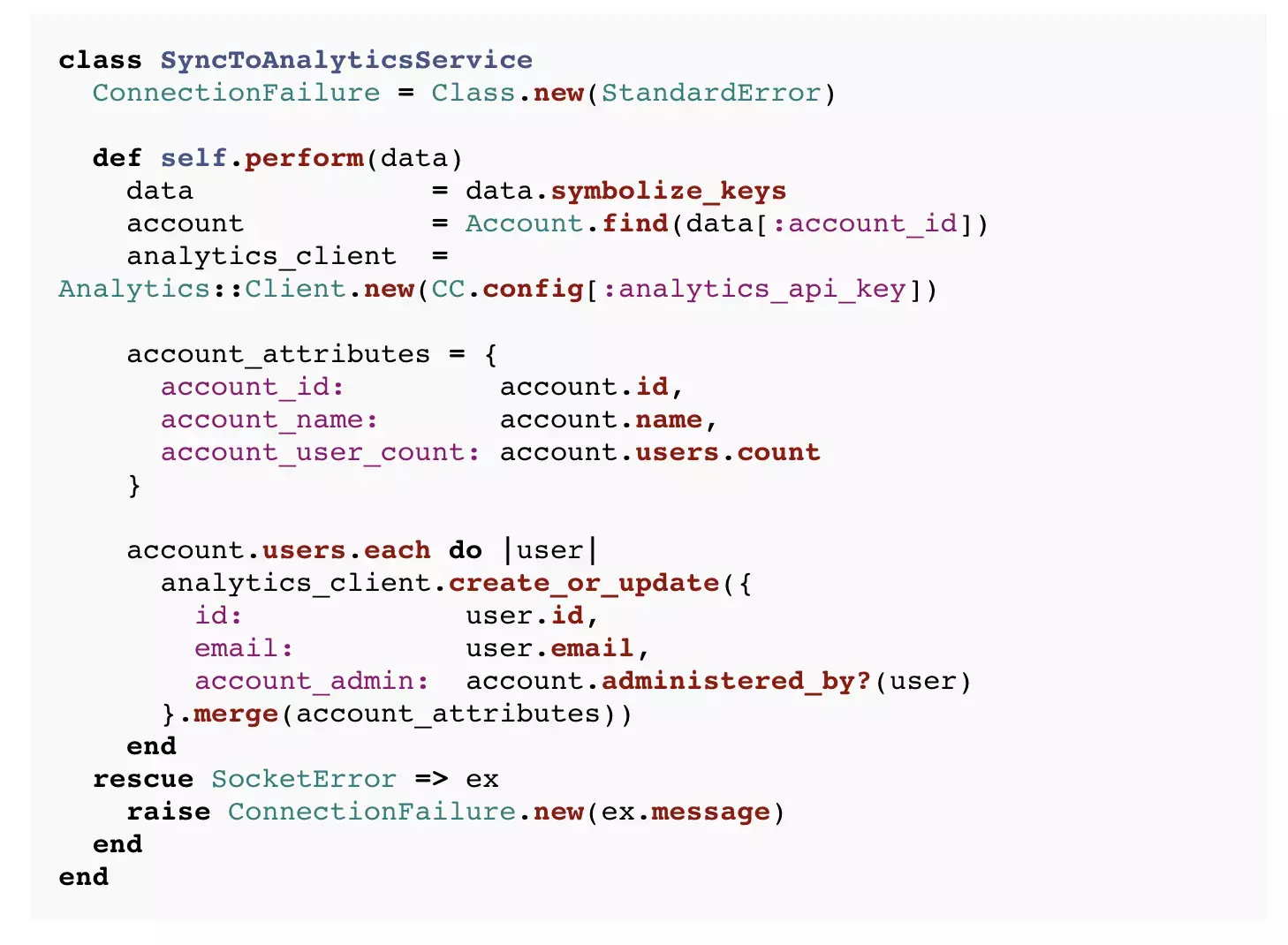
The job iterates over each user sending a hash of attributes as an HTTP POST. If a SocketError is raised, it gets wrapped as a SyncToAnalyticsService::ConnectionFailure, which ensures it gets categorized properly in our error tracking system.
The SyncToAnalyticsService.perform method is pretty complex. It certainly has multiple responsibilities. The Single Responsibility Principle (SRP) can be thought of as fractal, applying at a finer grained level of detail to all of applications, modules, classes and methods. SyncToAnalyticsService.perform is not a Composed Method because not all of the operations of the method are at the same level of abstraction.
One solution would be to apply Extract Method a few times. You’d end up with something like this:

This is a little better the original, but doesn’t feel right. It’s certainly not object oriented. It feels like a weird hybrid of procedural and functional programming, stuck in an object-based world. Additionally, you can’t easily declare the extracted methods private because they are at the class level. (You’d have to switch to an ugly class << self form.)
If I came across the original SyncToAnalyticsService implementation, I wouldn’t be eager to refactor only to end up with the above result. Instead, suppose we started with this:
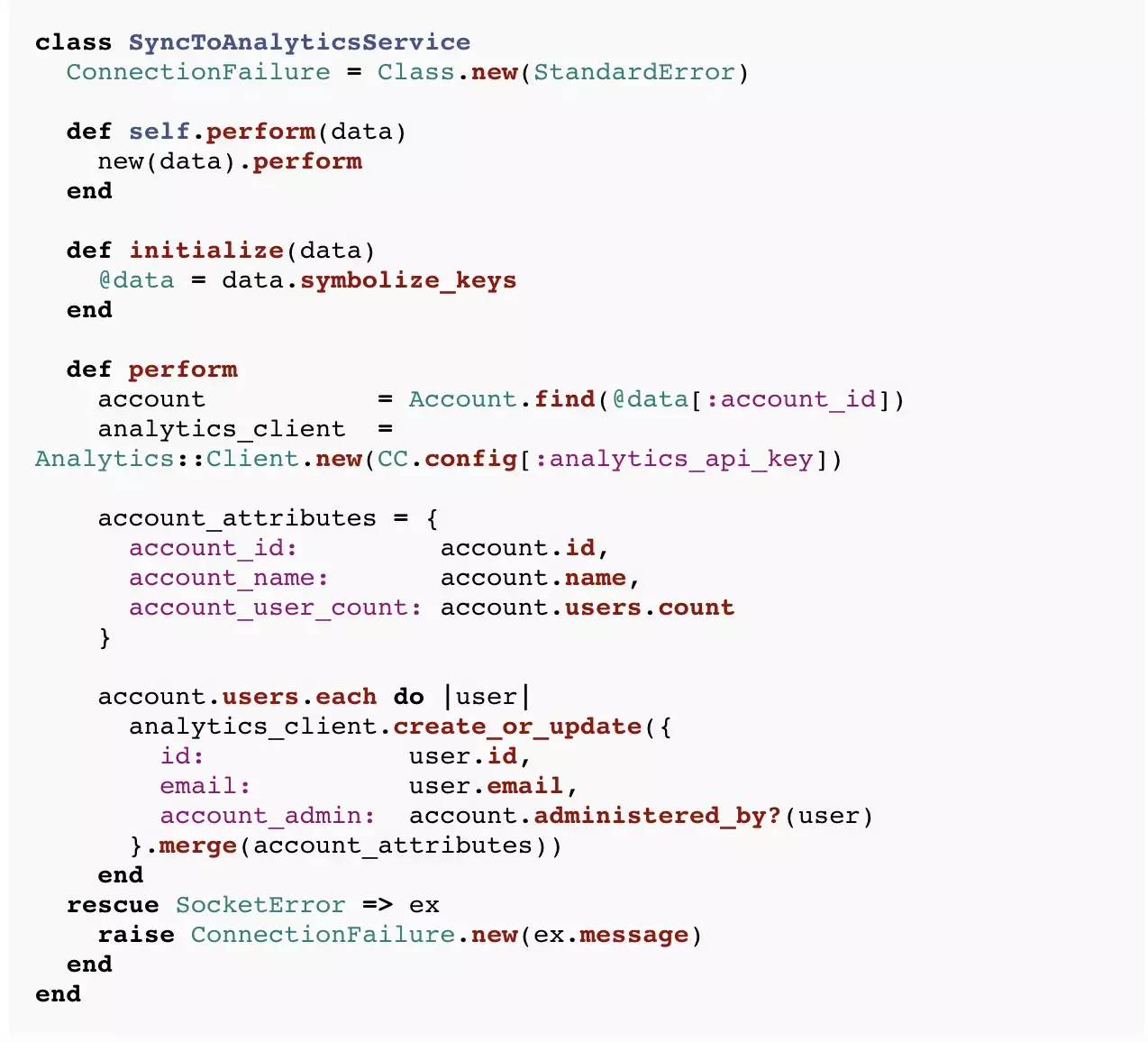
Almost identical, but this time the functionality is in an instance method rather than a class method. Again, applying Extract Method we might end up with something like this:
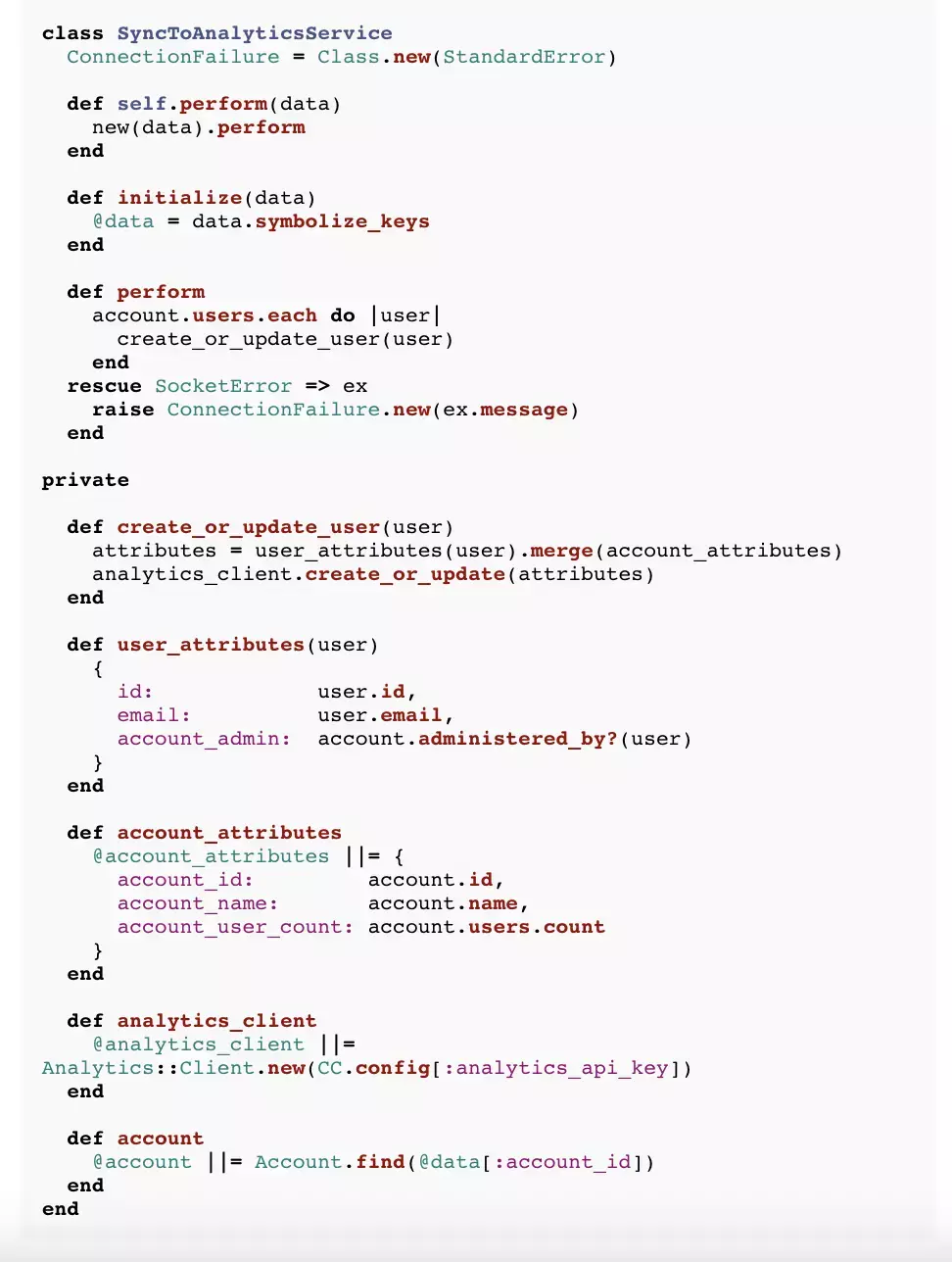
Instead of adding class methods that have to pass around intermediate variables to get work done, we have methods like #account_attributes which memoize their results. I love this technique. When breaking down a method, extracting intermediate variables as memoized accessors is one of my favorite refactorings. The class didn’t start with any state, but as it was decomposed it was helpful to add some.
The result feels much cleaner to me. Refactoring to this feels like a clear win. There is now state and logic encapsulated together in an object. It’s easier to test because you can separate the creation of the object (Given) from the invokation of the action (When). And we’re not passing variables like the Account and Analytics::Client around everywhere.
Also, every piece of code that uses this logic won’t be coupled to the (global) class name. You can’t easily swap in new a class, but you can easily swap in a new instance. This encourages building up additional behavior with composition, rather than needing to re-open and expand classes for every change.
Refactoring note: I’d probably leave this class implemented as the last source listing shows. However, if the logic becomes more complex, this job is begging for a class to sync a single user to be split out.
So how does this relate to the premise of this article? I’m unlikely to see the opportunities for refactoring a class method because decomposing them produces ugly code. Starting with the instance form makes your refactoring options clear, and reduces friction to taking action on them. I’ve observed this effect many times in my own coding and also anecdotally across many Ruby teams over the years.
Objections
YAGNI (You Aren’t Going To Need It)
YANGI is an important principle, but misapplied in this case. If you open these classes in your editor, neither form is more or less complicated than the other. Saying “YAGNI an object here” is sort of like saying “YAGNI to indent with two spaces instead of a single tab.” The variants are only different stylistically. Applying YAGNI to object oriented design only make sense if there’s a difference in understandability (e.g. using one class versus two).
It Uses an Extra Object
Some people object on the basis that the instance form creates an additional object. That’s true, but in practice it doesn’t matter. Rails requests and background jobs create thousands upon thousands of Ruby objects. Optimizing object creation to lessen the stress on the Ruby garbage collector is a legitimate technique, but do it where it counts. You can only find out where it counts by measuring. It’s inconceivable that the single additional object that the instance variant creates will have a measurable impact on the performance of your system. (If you have a counter example with data, I’d love to hear about it.)
It’s Cumbersome to Call
Finally, some object that it is just easier to type:

That is true. In that case I simply define a convenience class method that builds the object and delegates down. In fact, that is one of the few cases I think class methods are okay. You can have your cake and eat it too, in this regard.
Wrapping Up
Begin with an object instance, even if it doesn’t have state or multiple methods right away. If you come back to change it later, you (and your team) will be more likely to refactor. If it never changes, the difference between the class method approach and the instance is negligible, and you certainly won’t be any worse off.
There are very few cases where I am comfortable with class methods in my code. They are either convenience methods, wrapping the act of initializing an instance and invoking a method on it, or extremely simple factory methods (no more than two lines), to allow collaborators to more easily construct objects.
What do you think? Which form do you prefer and why? Are there any pros/cons that I missed? Post a comment and let me know what you think!
P.S. If this sort of thing interests you, and you want to read more articles like it, you might like the Code Climate newsletter (see below). It’s just one email a month, and includes content about refactoring and object design with a Ruby focus.
Thanks to Doug Cole, Don Morrison and Josh Susser for reviewing this post.

When teams use Code Climate to improve the quality of their Rails applications, they learn to break the habit of allowing models to get fat. “Fat models” cause maintenance issues in large apps. Only incrementally better than cluttering controllers with domain logic, they usually represent a failure to apply the Single Responsibility Principle (SRP). “Anything related to what a user does” is not a single responsibility.
Early on, SRP is easier to apply. ActiveRecord classes handle persistence, associations and not much else. But bit-by-bit, they grow. Objects that are inherently responsible for persistence become the de facto owner of all business logic as well. And a year or two later you have a User class with over 500 lines of code, and hundreds of methods in it’s public interface. Callback hell ensues.
As you add more intrinsic complexity (read: features!) to your application, the goal is to spread it across a coordinated set of small, encapsulated objects (and, at a higher level, modules) just as you might spread cake batter across the bottom of a pan. Fat models are like the big clumps you get when you first pour the batter in. Refactor to break them down and spread out the logic evenly. Repeat this process and you’ll end up with a set of simple objects with well defined interfaces working together in a veritable symphony.
You may be thinking:
“But Rails makes it really hard to do OOP right!”
I used to believe that too. But after some exploration and practice, I realized that Rails (the framework) doesn’t impede OOP all that much. It’s the Rails “conventions” that don’t scale, or, more specifically, the lack of conventions for managing complexity beyond what the Active Record pattern can elegantly handle. Fortunately, we can apply OO-based principles and best practices where Rails is lacking.
Don’t Extract Mixins from Fat Models
Let’s get this out of the way. I discourage pulling sets of methods out of a large ActiveRecord class into “concerns”, or modules that are then mixed in to only one model. I once heard someone say:
“Any application with an app/concerns directory is concerning.”
And I agree. Prefer composition to inheritance. Using mixins like this is akin to “cleaning” a messy room by dumping the clutter into six separate junk drawers and slamming them shut. Sure, it looks cleaner at the surface, but the junk drawers actually make it harder to identify and implement the decompositions and extractions necessary to clarify the domain model.
Now on to the refactorings!
1. Extract Value Objects
Value Objects are simple objects whose equality is dependent on their value rather than an identity. They are usually immutable. Date, URI, and Pathname are examples from Ruby’s standard library, but your application can (and almost certainly should) define domain-specific Value Objects as well. Extracting them from ActiveRecords is low hanging refactoring fruit.
In Rails, Value Objects are great when you have an attribute or small group of attributes that have logic associated with them. Anything more than basic text fields and counters are candidates for Value Object extraction.
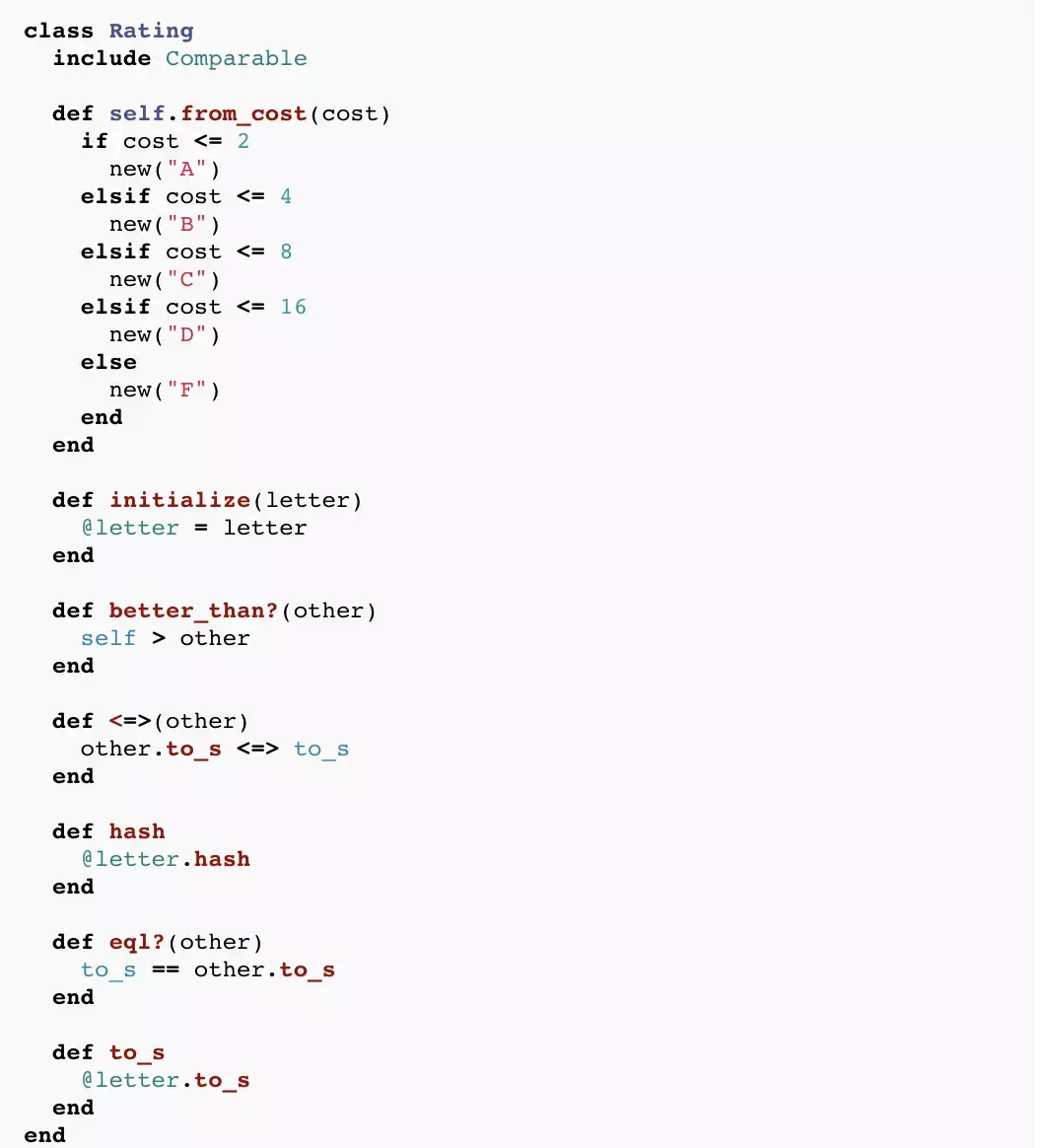
For example, a text messaging application I worked on had a PhoneNumber Value Object. An e-commerce application needs a Money class. Code Climate has a Value Object named Rating that represents a simple A - F grade that each class or module receives. I could (and originally did) use an instance of a Ruby String, but Rating allows me to combine behavior with the data:
Every ConstantSnapshot then exposes an instance of Rating in its public interface:
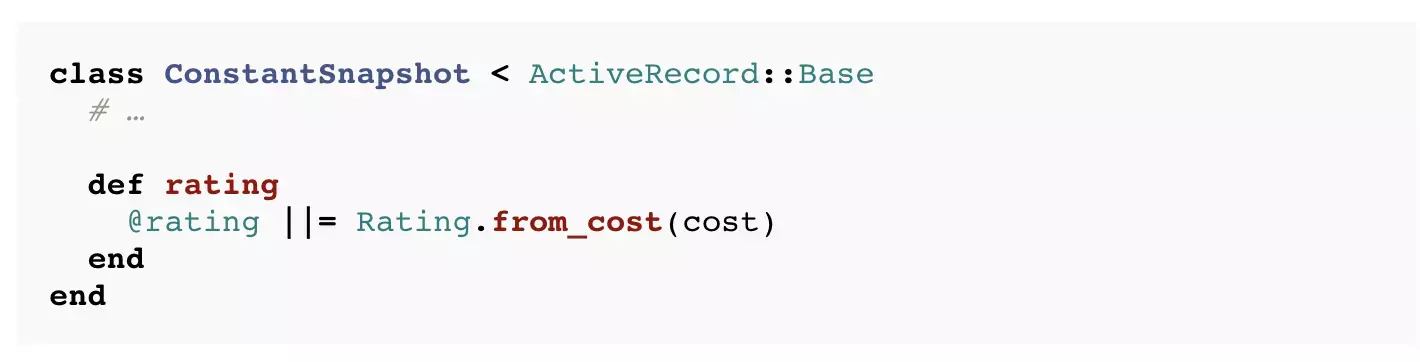
Beyond slimming down the ConstantSnapshot class, this has a number of advantages:
- The
#worse_than?and#better_than?methods provide a more expressive way to compare ratings than Ruby’s built-in operators (e.g.<and>). - Defining
#hashand#eql?makes it possible to use aRatingas a hash key. Code Climate uses this to idiomatically group constants by their ratings usingEnumberable#group_by. - The
#to_smethod allows me to interpolate aRatinginto a string (or template) without any extra work. - The class definition provides a convenient place for a factory method, returning the correct
Ratingfor a given “remediation cost” (the estimated time it would take to fix all of the smells in a given class).
2. Extract Service Objects
Some actions in a system warrant a Service Object to encapsulate their operation. I reach for Service Objects when an action meets one or more of these criteria:
- The action is complex (e.g. closing the books at the end of an accounting period)
- The action reaches across multiple models (e.g. an e-commerce purchase using
Order,CreditCardandCustomerobjects) - The action interacts with an external service (e.g. posting to social networks)
- The action is not a core concern of the underlying model (e.g. sweeping up outdated data after a certain time period).
- There are multiple ways of performing the action (e.g. authenticating with an access token or password). This is the Gang of Four Strategy pattern.
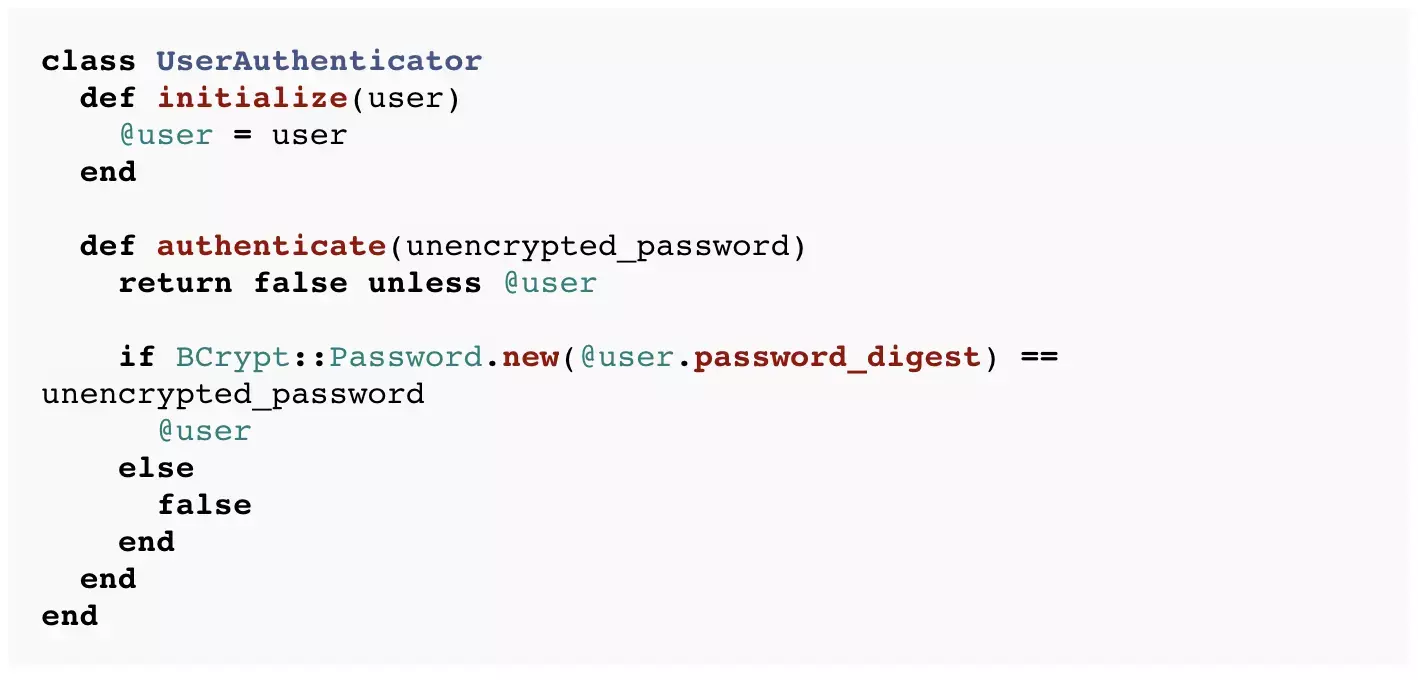
As an example, we could pull a User#authenticate method out into a UserAuthenticator:
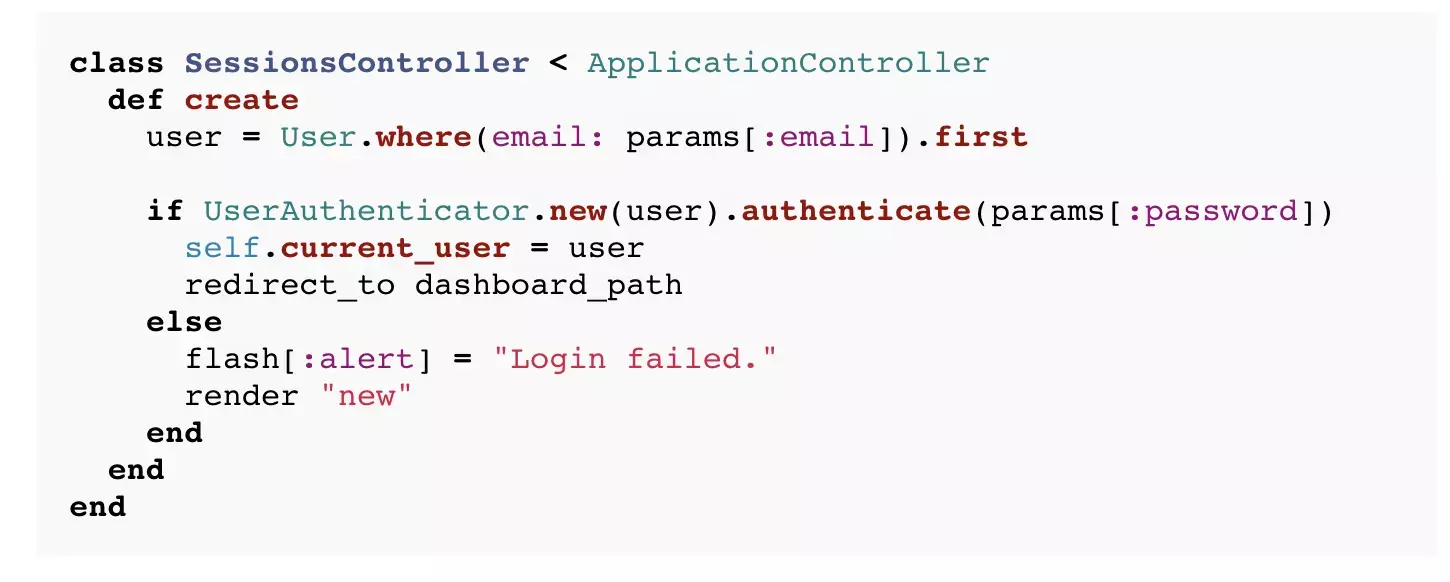
And the SessionsController would look like this:
3. Extract Form Objects
When multiple ActiveRecord models might be updated by a single form submission, a Form Object can encapsulate the aggregation. This is far cleaner than using accepts_nested_attributes_for, which, in my humble opinion, should be deprecated. A common example would be a signup form that results in the creation of both a Company and a User:

I’ve started using Virtus in these objects to get ActiveRecord-like attribute functionality. The Form Object quacks like an ActiveRecord, so the controller remains familiar:
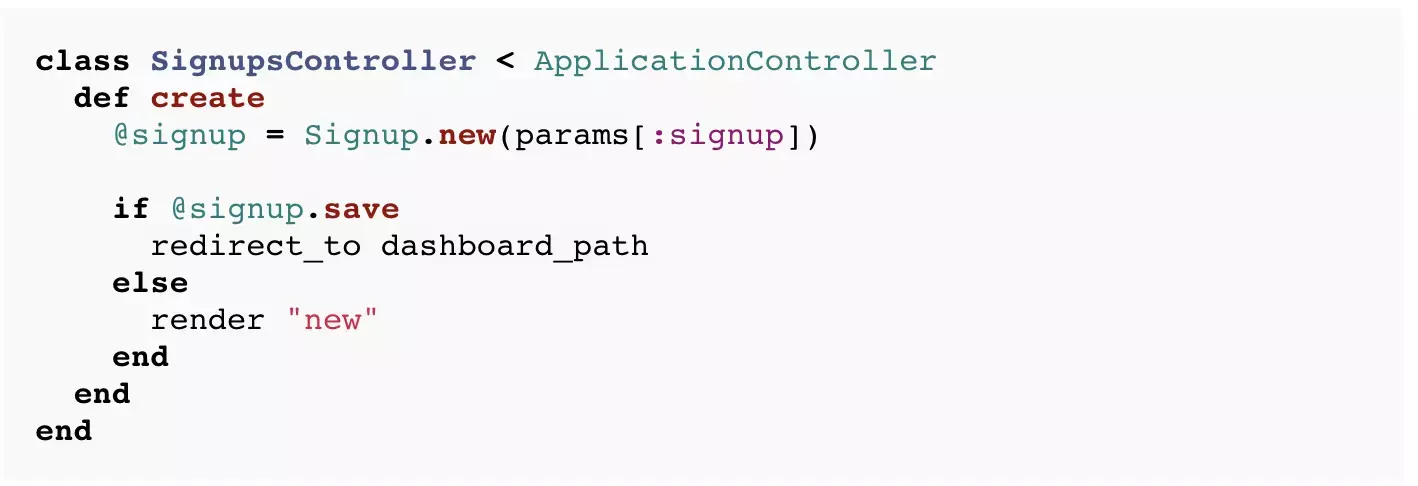
This works well for simple cases like the above, but if the persistence logic in the form gets too complex you can combine this approach with a Service Object. As a bonus, since validation logic is often contextual, it can be defined in the place exactly where it matters instead of needing to guard validations in the ActiveRecord itself.
4. Extract Query Objects
For complex SQL queries littering the definition of your ActiveRecord subclass (either as scopes or class methods), consider extracting query objects. Each query object is responsible for returning a result set based on business rules. For example, a Query Object to find abandoned trials might look like this:
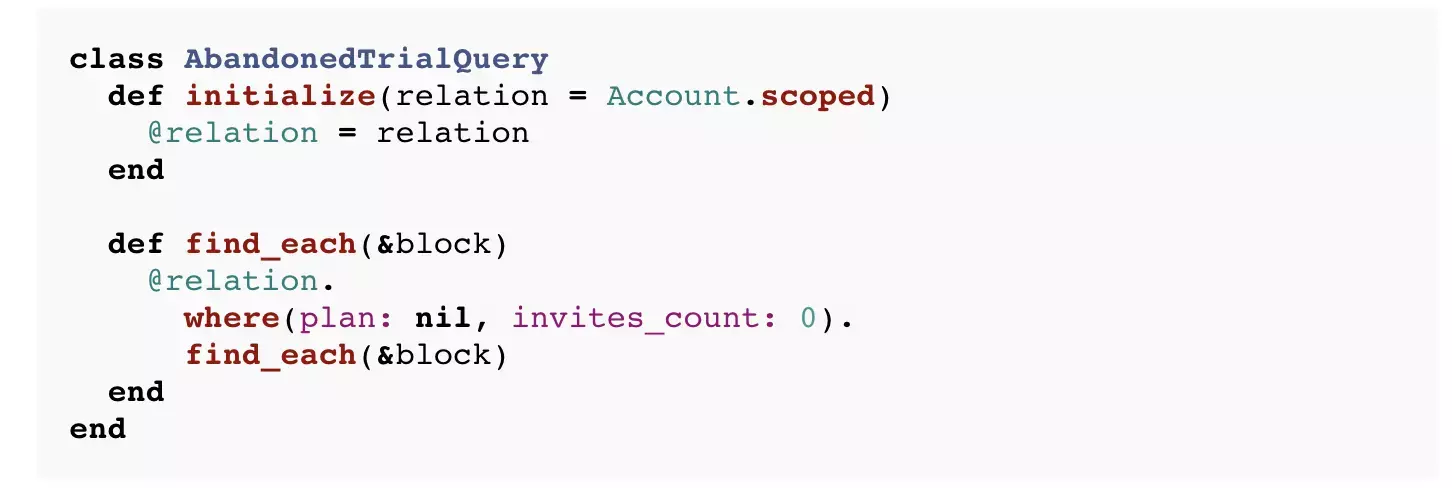
You might use it in a background job to send emails:

Since ActiveRecord::Relation instances are first class citizens as of Rails 3, they make a great input to a Query Object. This allows you to combine queries using composition:

Don’t bother testing a class like this in isolation. Use tests that exercise the object and the database together to ensure the correct rows are returned in the right order and any joins or eager loads are performed (e.g. to avoid N + 1 query bugs).
5. Introduce View Objects
If logic is needed purely for display purposes, it does not belong in the model. Ask yourself, “If I was implementing an alternative interface to this application, like a voice-activated UI, would I need this?”. If not, consider putting it in a helper or (often better) a View object.
For example, the donut charts in Code Climate break down class ratings based on a snapshot of the codebase (e.g. Rails on Code Climate) and are encapsulated as a View:
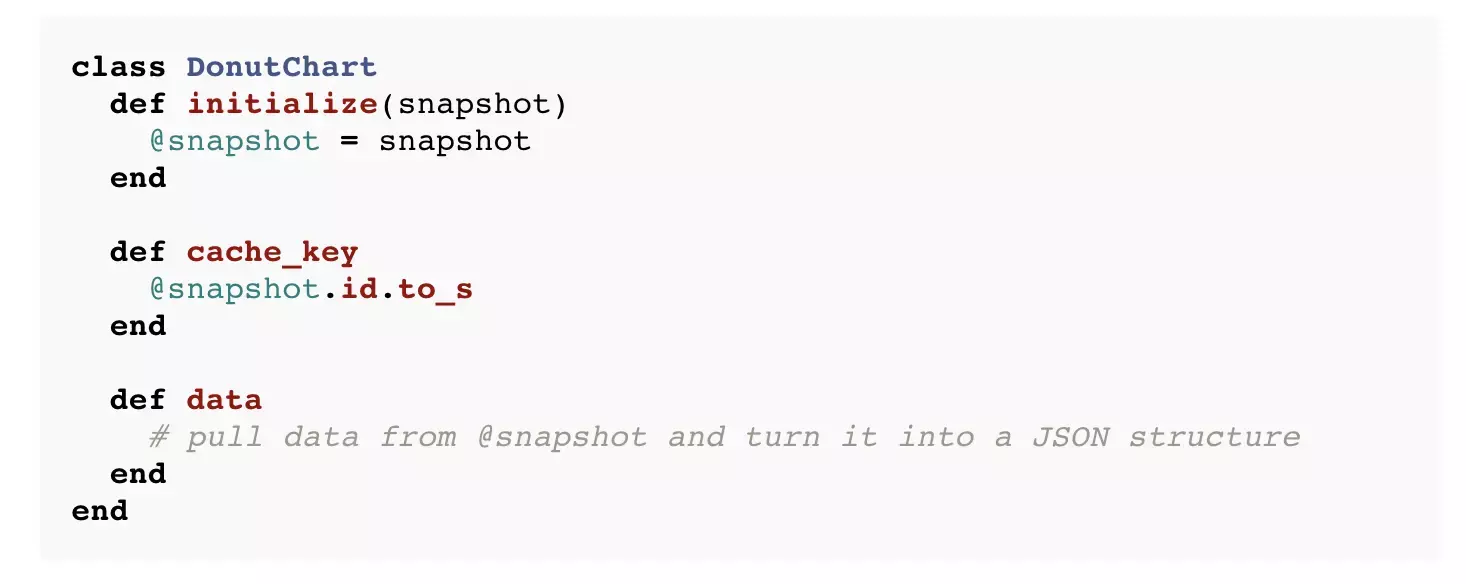
I often find a one-to-one relationship between Views and ERB (or Haml/Slim) templates. This has led me to start investigating implementations of the Two Step View pattern that can be used with Rails, but I don’t have a clear solution yet.
Note: The term “Presenter” has caught on in the Ruby community, but I avoid it for its baggage and conflicting use. The “Presenter” term was introduced by Jay Fields to describe what I refer to above as “Form Objects”. Also, Rails unfortunately uses the term “view” to describe what are otherwise known as “templates”. To avoid ambiguity, I sometimes refer to these View objects as “View Models”.
6. Extract Policy Objects
Sometimes complex read operations might deserve their own objects. In these cases I reach for a Policy Object. This allows you to keep tangential logic, like which users are considered active for analytics purposes, out of your core domain objects. For example:
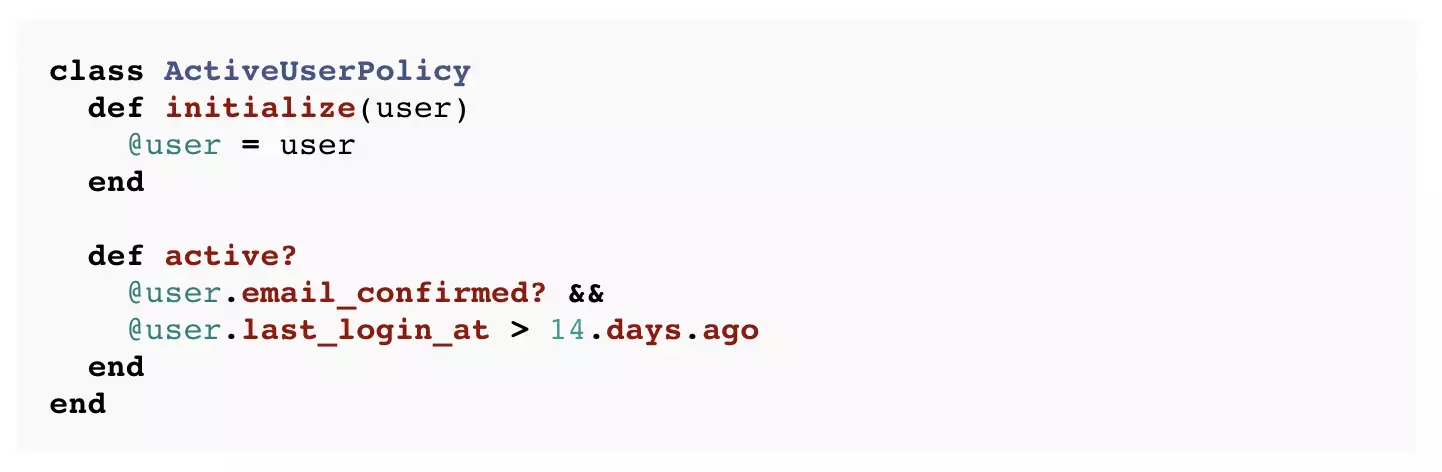
This Policy Object encapsulates one business rule, that a user is considered active if they have a confirmed email address and have logged in within the last two weeks. You can also use Policy Objects for a group of business rules like an Authorizer that regulates which data a user can access.
Policy Objects are similar to Service Objects, but I use the term “Service Object” for write operations and “Policy Object” for reads. They are also similar to Query Objects, but Query Objects focus on executing SQL to return a result set, whereas Policy Objects operate on domain models already loaded into memory.
7. Extract Decorators
Decorators let you layer on functionality to existing operations, and therefore serve a similar purpose to callbacks. For cases where callback logic only needs to run in some circumstances or including it in the model would give the model too many responsibilities, a Decorator is useful.
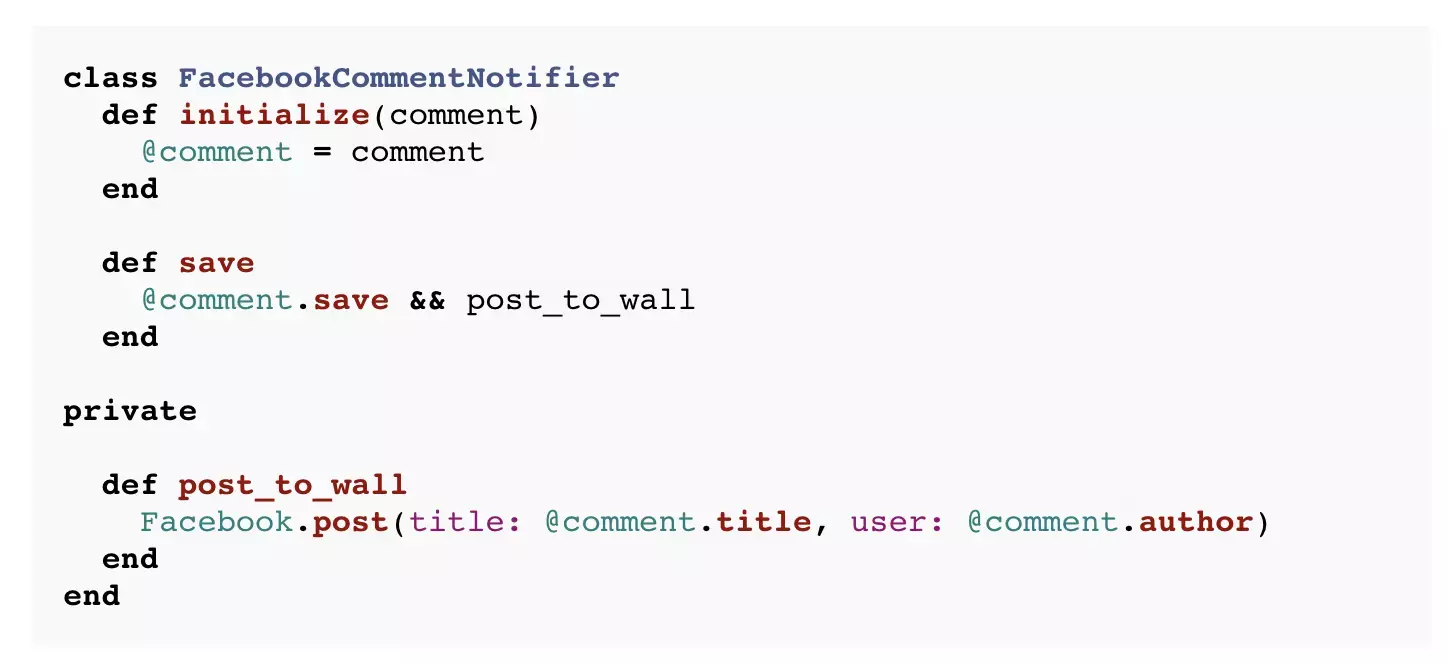
Posting a comment on a blog post might trigger a post to someone’s Facebook wall, but that doesn’t mean the logic should be hard wired into the Comment class. One sign you’ve added too many responsibilities in callbacks is slow and brittle tests or an urge to stub out side effects in wholly unrelated test cases.
Here’s how you might extract Facebook posting logic into a Decorator:
And how a controller might use it:
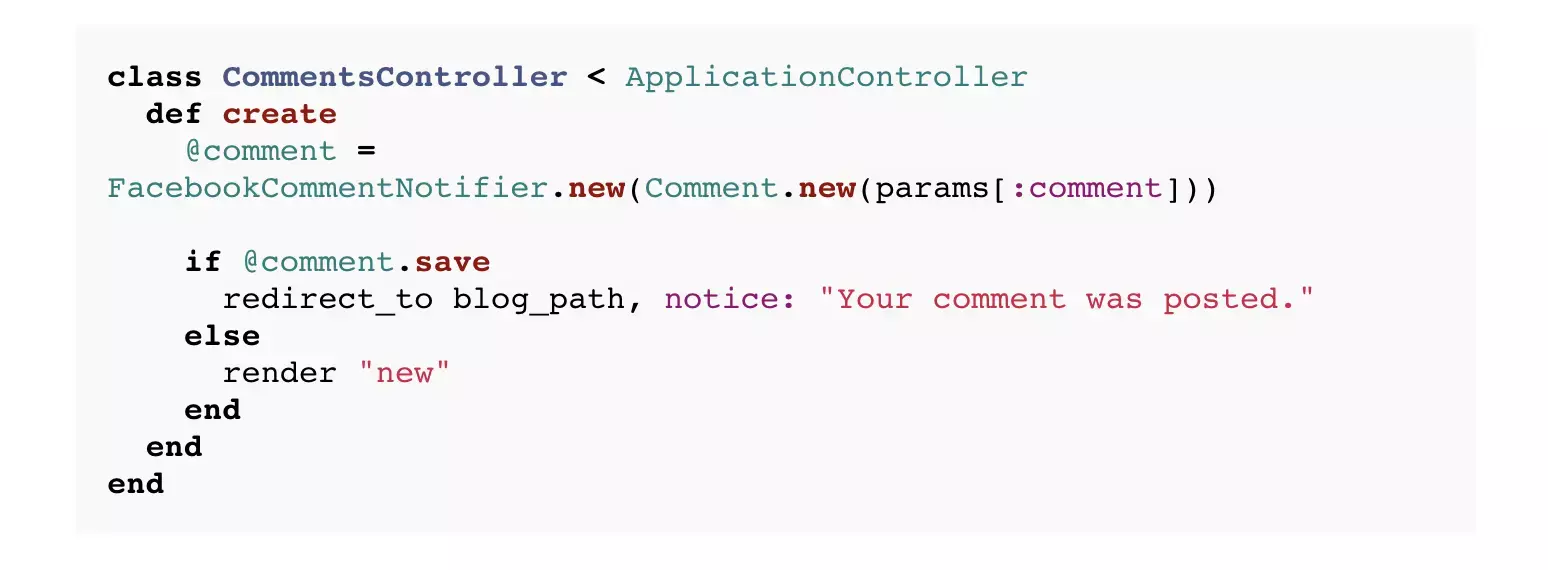
Decorators differ from Service Objects because they layer on responsibilities to existing interfaces. Once decorated, collaborators just treat the FacebookCommentNotifier instance as if it were a Comment. In its standard library, Ruby provides a number of facilities to make building decorators easier with metaprogramming.
Wrapping Up
Even in a Rails application, there are many tools to manage complexity in the model layer. None of them require you to throw out Rails. ActiveRecord is a fantastic library, but any pattern breaks down if you depend on it exclusively. Try limiting your ActiveRecords to persistence behavior. Sprinkle in some of these techniques to spread out the logic in your domain model and the result will be a much more maintainable application.
You’ll also note that many of the patterns described here are quite simple. The objects are just “Plain Old Ruby Objects” (PORO) used in different ways. And that’s part of the point and the beauty of OOP. Every problem doesn’t need to be solved by a framework or library, and naming matters a great deal.
What do you think of the seven techniques I presented above? What are your favorites and why? Have I missed any? Let me know in the comments!
P.S. If you found this post useful, you may want to subscribe to our email newsletter (see below). It’s low volume, and includes content about OOP and refactoring Rails applications like this.
Further Reading
- Crazy, Heretical, and Awesome: The Way I Write Rails Apps
- ActiveRecord (and Rails) Considered Harmful
Thank you to Steven Bristol, Piotr Solnica, Don Morrison, Jason Roelofs, Giles Bowkett, Justin Ko, Ernie Miller, Steve Klabnik, Pat Maddox, Sergey Nartimov and Nick Gauthier for reviewing this post.

Today I’m excited to announce that Code Climate is free for open source projects. Many open source projects were added during the closed beta, and you can see them all on the new Explore page. (To learn more about what Code Climate provides and how it works, check out the homepage.)
This has been in the plans since the beginning and was one of the common requests since the launch for private accounts. It feels great to finally have it out the door. My hope is that Code Climate becomes as valuable a tool to Ruby open source development as Travis CI.
Code quality is especially important for OSS because of the large number of contributors they attract. Now quality metrics can complement a suite of automated tests to help ensure you’re shipping rock solid releases. Look out for more features around this coming soon.
Popular projects on Code Climate
You might be interested in taking a look at:
How to add repositories
To add any Ruby app or library that is hosted in a public GitHub repository, visit the Add GitHub Repository page. Just provide the name of the repo (e.g. thoughtbot/paperclip) and your email address. Code Climate will clone the project, analyze it, and shoot you an email when the metrics are ready. This only takes a few minutes.

Matz has said he wants Ruby to be the “80% language”, the ideal tool for 80% of software development. After switching from TextMate to Sublime Text 2 (ST2) a few months ago, I believe it’s the “80% editor”. You should switch to it, especially if you’re using TextMate.
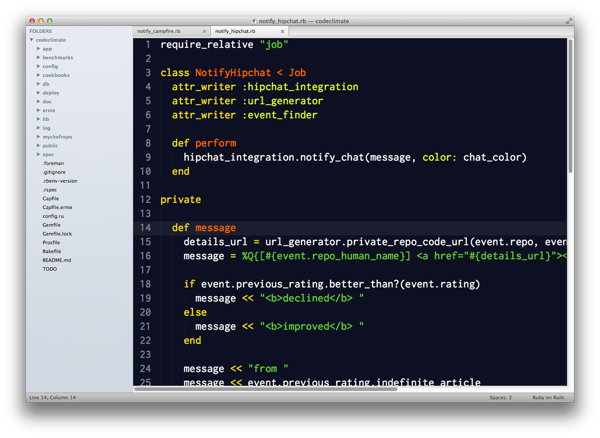
Why Sublime Text 2?
- Speed. It’s got the responsiveness of Vim/Emacs but in a full GUI environment. It doesn’t freeze/beachball. No need to install a special plugin just to have a workable “Find In Project” solution.
- Polish. Some examples: Quit with one keystroke and windows and unsaved buffers are retained when you restart. Searching for files by name includes fuzzy matching and directory names. Whitespace is trimmed and newlines are added at the end of files. Configuration changes are applied instantly.
- Split screen. I never felt like I missed this that much with TextMate, but I really appreciate it now. It’s ideal for having a class and unit test side-by-side on a 27-inch monitor.
- Extensibility. The Python API is great for easily building your own extensions. There’s lots of example code in the wild to learn from. (More about this later.) ST2 support TextMate snippets and themes out-of-the-box.
- Great for pair programming. TextMate people feel right at home. Vim users can use Vintage mode. When pairing with Vim users, they use command mode when they are driving. I just switch out of command mode and everything “just works”. (It also works on Linux, if that’s your thing.)
- Updates. This is mainly just a knock on TextMate, but it’s comforting to see new dev builds pushed every couple weeks. The author also seems to be quite responsive in the user community. A build already shipped with support for retina displays, which I believe is scheduled for a TextMate release in 2014.
Getting Started
I’ve helped a handful of new ST2 users get setup over the past few months. Here are the steps I usually follow to take a new install from good to awesome:
- Install the
sublcommand line tool. Assuming ~/bin is in your path:
ln -s "/Applications/Sublime Text 2.app/Contents/SharedSupport/bin/subl" ~/bin/subl
- It works like
mate, but has more options. Checksubl --help. - Install Package Control. Package Control makes it easy to install/remove/upgrade ST2 packages.Open the ST2 console with Ctrl+` (like Quake). Then paste this Python code from this page and hit enter. Reboot ST2. (You only need to do this once. From now on you’ll use Package Control to manage ST2 packages.)
- Install the Soda theme. This dramatically improves the look and feel of the editor. Use Package Control to install the theme:
* Press ⌘⇧P to open the Command Palette. * Select "Package Control: Install Package" and hit Enter. * Type "Theme - Soda" and hit Enter to install the Soda package.
- Start with a basic Settings file. You can use mine, which will activate the Soda Light theme. Reboot Sublime Text 2 so the Soda theme applies correctly. You can browse the default settings that ship with ST2 by choosing “Sublime Text 2” > “Preferences…” > “Settings – Default” to learn what you can configure.
- Install more packages. My essentials are SCSS, RSpec, DetectSyntax and Git. DetectSyntax solves the problem of ensuring your RSpec, Rails and regular Ruby files open in the right mode.
- Install CTags. CTags let you quickly navigate to code definitons (classes, methods, etc.). First:
$ brew install ctags - Then use Package Control to install the ST2 package. Check out the default CTags key bindings to see what you can do.
Leveling Up with Custom Commands
Sublime Text 2 makes it dead simple to write your own commands and key bindings in Python. Here are some custom bindings that I use:
- Copy the path of the current file to the clipboard. Source
- Close all tabs except the current one (reduces “tab sprawl”). Source
- Switch between test files and class definitions (much faster than TextMate). Source
- Compile CoffeeScript to JavaScript and display in a new buffer. Source
New key bindings are installed by dropping Python class files in ~/Library/Application Support/Sublime Text 2/Packages/User and then binding them from Default (OSX).sublime-keymap in the same directory. The ST2 Unofficial Documentation has more details.
Neil Sarkar, my colleague, wrote most of the code for all of the above within a few weeks of switching to ST2.
Running RSpec from Sublime Text 2
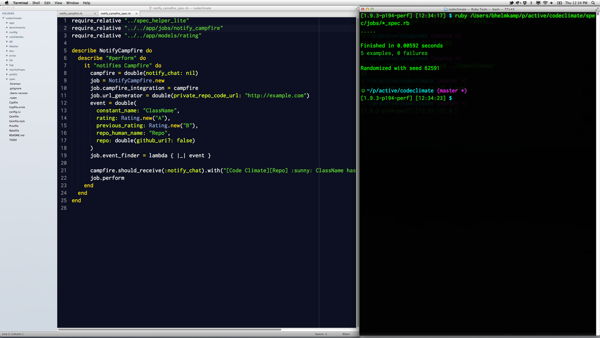
This is my favorite part of my Sublime Text 2 config. I’ll admit: Out of the box (even with the RSpec package installed), ST2 sucks for running tests. Fortunately, Neil wrote a Python script that makes running RSpec from Sublime Text 2 much better than running it from TextMate via the RSpec bundle.
With this script installed, you can bind ⌘R to run the current file and ⌘⇧R to run the current test. The tests will run in Terminal. This is great for a number of reasons:
- You can use any RSpec formatter and get nice, colored output.
- Adding calls to
debuggerorbinding.pryworks. No need to change how you run your tests when you want to debug. - Window management. It’s smart enough to reuse the Terminal window for new test runs if you don’t close it. I put my Terminal window on the right 40% of my monitor.
This has really improved my TDD workflow when working on individual classes.
More Resources
- Be sure to check out Brandon Keeper’s post on getting started with ST2.
- This article on NetTuts has some good tips. (Although it’s a little out of date.)
- My entire ST2 user directory is on GitHub, as is Neil’s.
- You can search for ST2 packages here. Don’t be afraid to dive into their source – it’s usually quite approachable.
If you’ve tried Sublime Text 2, what did you think? What packages, key bindings, etc. are your favorites? What do you miss most from other editors?

GORUCO 2012, NYC’s premier Ruby conference, is around the corner and it’s going to be great. (I may be biased, as I help organize the conference, but it’s still true!) We have some fantastic speakers this year, and I’m especially looking forward to three talks that focus on different aspects of code quality:
- “Maintaining Balance while Reducing Duplication – Part 2” by David Chelimsky. This is a follow up to David’s excellent talk from RubyConf 2010 that explored the DRY Principle (Don’t Repeat Yourself) in depth and illustrated how it can be misapplied. The inherent tensions between different OO design principles is particularly interesting to me.
- “Sensible Testing” by Justin Leitgeb. Justin really impressed me with his lightning talk at a recent NYC.rb about Ruby mixins and their problems. With this talk, I think he’ll do a great job exploring testing strategies for Rails apps in a practical, nuanced way. I wouldn’t be surprised if the Testing Pyramid comes up, which more developers should take to heart. TATFT is great mnemonic, but applying it well over a large codebase and a long period of time requires a great deal of consideration.
- “Hexagonal Rails” by Matt Wynne. Alistair Cockburn has been talking about Hexagonal Architecture (which he now calls “Ports and Adapters”) for years as a way to structure applications for better maintainability. It’s always been enticing to me, but it’s never been clear how to apply it to a Rails application. Matt has started exploring just that on his blog and I’m thrilled he’ll be giving a full-length talk on it at GORUCO. Personally, I hope he covers the implications on the model layer at least as much as controllers/views, and perhaps how this architecture might relate to the Anemic Domain Model antipattern described by Martin Fowler. (If not, I’ll ask him during Q&A. Hah.)
And before you ask, yes, the good folks at Confreaks will be recording the talks and we hope to have them posted within a few weeks of the conference (if not sooner).
If you’re attending GORUCO this year, definitely stop me and say “Hello!” (Either during the day, or aboard the ::ahem:: yacht during the evening.)
Full disclosure: I had the honor of being a member of the GORUCO Program Committee this year that selected the speakers, so it may not be a complete coincidence that my interests are well represented. 🙂

A common question teams run into while building a Rails app is “What code should go in the lib/ directory?”. The generated Rails README proclaims:
lib – Application specific libraries. Basically, any kind of custom code that doesn’t belong under controllers, models, or helpers. This directory is in the load path.
That’s not particularly helpful. By using the word “libraries” in the definition, it’s recursive. And what does “application specific” mean? Isn’t all the code in my Rails app “application specific” by definition?
So teams are left to work out their own conventions. If you quizzed the members of most teams, I’d bet they’d give different answers to the “What goes in lib/?” question.
Antipattern: Anything that’s not an ActiveRecord
As we know from the secret to Rails object oriented design, well crafted applications grow many plain old Ruby object that don’t inherit from anything (and certainly not the framework). However, the most common antipattern is pushing any classes that are not ActiveRecord models into lib/. This tremendously harmful to fostering a well designed application.
Treat non-ActiveRecord classes as first class citizens. Requiring these classes be stored in a lib/ junk drawer away from the rest of the domain model creates enough friction that they tend not be created at all.
Pattern: Store code that is not domain specific in lib/
As an alternative, I recommend any code that is not specific to the domain of the application goes in lib/. Now the issue is how to define “specific to the domain”. I apply a litmus test that almost always provides a clear answer:
If instead of my app, I were building a social networking site for pet turtles (let’s call it MyTurtleFaceSpace) is there a chance I would use this code?
Now things get easier. Let’s look at some examples:
- An
OnboardingReportclass goes inapp/. This depends on the specific steps the users must go through to get started with the application. - A
SSHTunnelclass used for deployment goes inlib/. MyTurtleFaceSpace needs to be deployed too. - Custom Resque extensions go in
lib/. Any site may use a background processing system. - A
ShippingRatesImportergoes inapp/if it imports a data format the company developed internally. On the other hand, aFedExRateImporterwould probably go inlib/. - A
GPGEncrypterclass goes inlib/. Turtles need privacy too.
Some developers find it distasteful to have classes like OnboardingReport and ShippingRatesImporter living in app/models/. This doesn’t bother me as I consider them to be part of the broadly defined “domain model”, but I’ll often introduce modules like Reports and Importers to group these classes which avoids them cluttering up the root of the app/models/ directory.
I’m sure there are other patterns for dividing code between lib/ and app/. What rule of thumb does your team follow? What are the pros and cons?