
Leadership
Navigating the world of software engineering or developer productivity insights can feel like trying to solve a complex puzzle, especially for large-scale organizations. It's one of those areas where having a cohesive strategy can make all the difference between success and frustration. Over the years, as I’ve worked with enterprise-level organizations, I’ve seen countless instances where a lack of strategy caused initiatives to fail or fizzle out.
In my latest webinar, I breakdown the key components engineering leaders need to consider when building an insights strategy.
Why a Strategy Matters
At the heart of every successful software engineering team is a drive for three things:
- A culture of continuous improvement
- The ability to move from idea to impact quickly, frequently, and with confidence
- A software organization delivering meaningful value
These goals sound simple enough, but in reality, achieving them requires more than just wishing for better performance. It takes data, action, and, most importantly, a cultural shift. And here's the catch: those three things don't come together by accident.
In my experience, whenever a large-scale change fails, there's one common denominator: a lack of a cohesive strategy. Every time I’ve witnessed a failed attempt at implementing new technology or making a big shift, the missing piece was always that strategic foundation. Without a clear, aligned strategy, you're not just wasting resources—you’re creating frustration across the entire organization.
Sign up for a free, expert-led insights strategy workshop for your enterprise org.
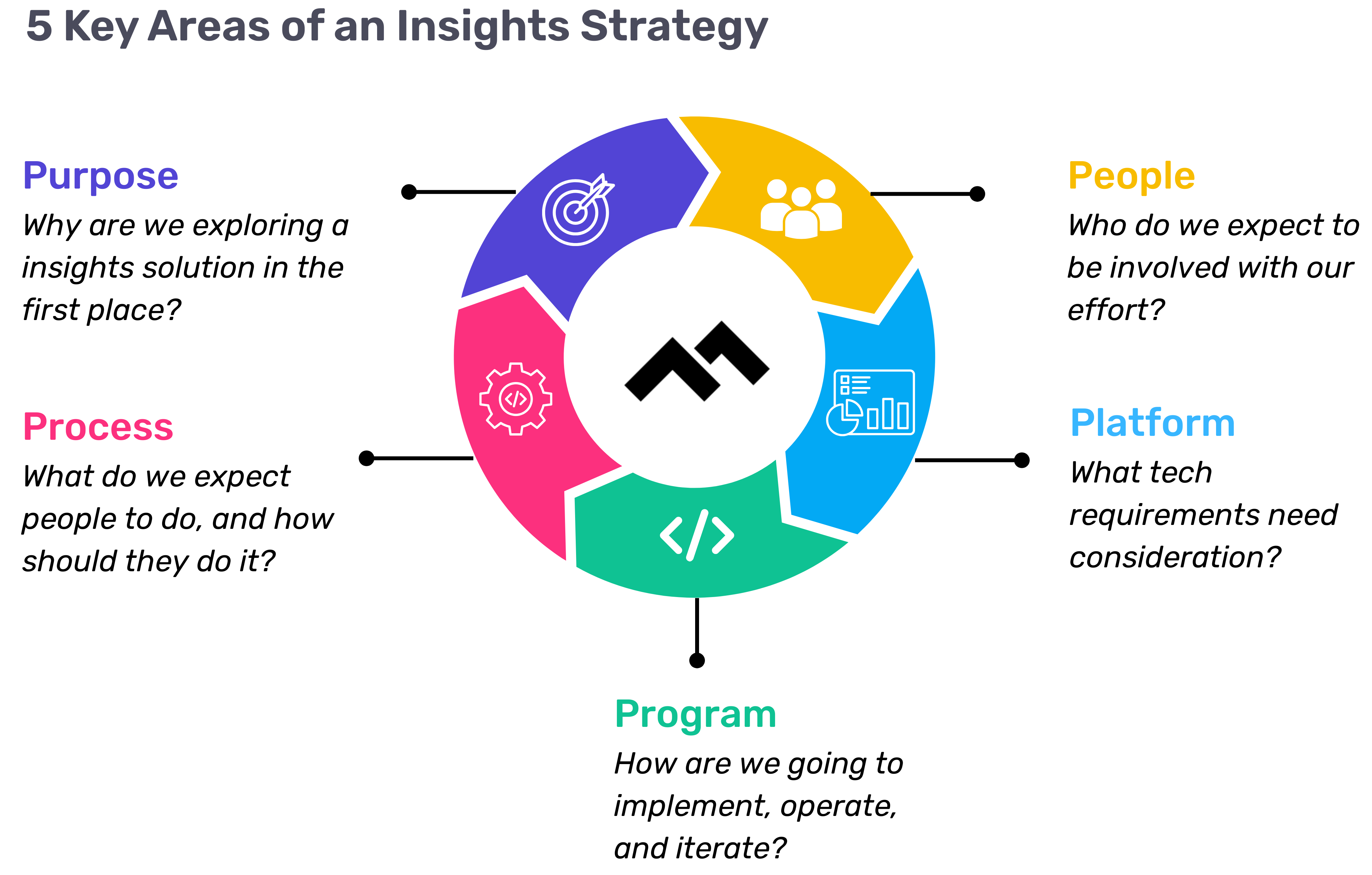
Step 1: Define Your Purpose
The first step in any successful engineering insights strategy is defining why you're doing this in the first place. If you're rolling out developer productivity metrics or an insights platform, you need to make sure there’s alignment on the purpose across the board.
Too often, organizations dive into this journey without answering the crucial question: Why do we need this data? If you ask five different leaders in your organization, are you going to get five answers, or will they all point to the same objective? If you can’t answer this clearly, you risk chasing a vague, unhelpful path.
One way I recommend approaching this is through the "Five Whys" technique. Ask why you're doing this, and then keep asking "why" until you get to the core of the problem. For example, if your initial answer is, “We need engineering metrics,” ask why. The next answer might be, “Because we're missing deliverables.” Keep going until you identify the true purpose behind the initiative. Understanding that purpose helps avoid unnecessary distractions and lets you focus on solving the real issue.
Step 2: Understand Your People
Once the purpose is clear, the next step is to think about who will be involved in this journey. You have to consider the following:
- Who will be using the developer productivity tool/insights platform?
- Are these hands-on developers or executives looking for high-level insights?
- Who else in the organization might need access to the data, like finance or operations teams?
It’s also crucial to account for organizational changes. Reorgs are common in the enterprise world, and as your organization evolves, so too must your insights platform. If the people responsible for the platform’s maintenance change, who will ensure the data remains relevant to the new structure? Too often, teams stop using insights platforms because the data no longer reflects the current state of the organization. You need to have the right people in place to ensure continuous alignment and relevance.
Step 3: Define Your Process
The next key component is process—a step that many organizations overlook. It's easy to say, "We have the data now," but then what happens? What do you expect people to do with the data once it’s available? And how do you track if those actions are leading to improvement?
A common mistake I see is organizations focusing on metrics without a clear action plan. Instead of just looking at a metric like PR cycle times, the goal should be to first identify the problem you're trying to solve. If the problem is poor code quality, then improving the review cycle times might help, but only because it’s part of a larger process of improving quality, not just for the sake of improving the metric.
It’s also essential to approach this with an experimentation mindset. For example, start by identifying an area for improvement, make a hypothesis about how to improve it, then test it and use engineering insights data to see if your hypothesis is correct. Starting with a metric and trying to manipulate it is a quick way to lose sight of your larger purpose.
Step 4: Program and Rollout Strategy
The next piece of the puzzle is your program and rollout strategy. It’s easy to roll out an engineering insights platform and expect people to just log in and start using it, but that’s not enough. You need to think about how you'll introduce this new tool to the various stakeholders across different teams and business units.
The key here is to design a value loop within a smaller team or department first. Get a team to go through the full cycle of seeing the insights, taking action, and then quantifying the impact of that action. Once you've done this on a smaller scale, you can share success stories and roll it out more broadly across the organization. It’s not about whether people are logging into the platform—it’s about whether they’re driving meaningful change based on the insights.
Step 5: Choose Your Platform Wisely
And finally, we come to the platform itself. It’s the shiny object that many organizations focus on first, but as I’ve said before, it’s the last piece of the puzzle, not the first. Engineering insights platforms like Code Climate are powerful tools, but they can’t solve the problem of a poorly defined strategy.
I’ve seen organizations spend months evaluating these platforms, only to realize they didn't even know what they needed. One company in the telecom industry realized that no available platform suited their needs, so they chose to build their own. The key takeaway here is that your platform should align with your strategy—not the other way around. You should understand your purpose, people, and process before you even begin evaluating platforms.
Looking Ahead
To build a successful engineering insights strategy, you need to go beyond just installing a tool. An insights platform can only work if it’s supported by a clear purpose, the right people, a well-defined process, and a program that rolls it out effectively. The combination of these elements will ensure that your insights platform isn’t just a dashboard—it becomes a powerful driver of change and improvement in your organization.
Remember, a successful software engineering insights strategy isn’t just about the tool. It’s about building a culture of data-driven decision-making, fostering continuous improvement, and aligning all your teams toward achieving business outcomes. When you get that right, the value of engineering insights becomes clear.
Want to build a tailored engineering insights strategy for your enterprise organization? Get expert recommendations at our free insights strategy workshop. Register here.Register here.
Andrew Gassen has guided Fortune 500 companies and large government agencies through complex digital transformations. He specializes in embedding data-driven, experiment-led approaches within enterprise environments, helping organizations build a culture of continuous improvement and thrive in a rapidly evolving world.
Output is not the same as impact. Flow is not the same as effectiveness. Most of us would agree with these statements—so why does the software industry default to output and flow metrics when measuring success? It’s a complex issue with multiple factors, but the elephant in the room is this: mapping engineering insights to meaningful business impact is far more challenging than measuring developer output or workflow efficiency.
Ideally, data should inform decisions. The problem arises when the wrong data is used to diagnose a problem that isn’t the real issue. Using misaligned metrics leads to misguided decisions, and unfortunately, we see this happen across engineering organizations of all sizes. While many companies have adopted Software Engineering Intelligence (SEI) platforms—whether through homegrown solutions or by partnering with company that specializes in SEI like Code Climate—a clear divide has emerged. Successful and mature organizations leverage engineering insights to drive real improvements, while others collect data without extracting real value—or worse, make decisions aimed solely at improving a metric rather than solving a real business challenge.
From our experience partnering with large enterprises with complex structures and over 1,000 engineers, we’ve identified three key factors that set high-performing engineering organizations apart.
1. Treating Software Engineering Insights as a Product
When platform engineering first emerged, early innovators adopted the mantra of “platform as a product” to emphasize the key principles that drive successful platform teams. The same mindset applies to Software Engineering Intelligence (SEI). Enterprise organizations succeed when they treat engineering insights as a product rather than just a reporting tool.
Data shouldn’t be collected for the sake of having it—it should serve a clear purpose: helping specific users achieve specific outcomes. Whether for engineering leadership, product teams, or executive stakeholders, high-performing organizations ensure that engineering insights are:
- Relevant – Focused on what each audience actually needs to know.
- Actionable – Providing clear next steps, not just numbers.
- Timely – Delivered at the right moment to drive decisions.
Rather than relying on pre-built dashboards with generic engineering metrics, mature organizations customize reporting to align with team priorities and business objectives.
For example, one of our healthcare customers is evaluating how AI coding tools like GitHub Copilot and Cursor might impact their hiring plans for the year. They have specific questions to answer and are running highly tailored experiments, making a custom dashboard essential for generating meaningful, relevant insights. With many SEI solutions, they would have to externalize data into another system or piece together information from multiple pages, increasing overhead and slowing down decision-making.
High-performing enterprise organizations don’t treat their SEI solution as static. Team structures evolve, business priorities shift, and engineering workflows change. Instead of relying on one-size-fits-all reporting, they continuously refine their insights to keep them aligned with business and engineering goals. Frequent iteration isn’t a flaw—it’s a necessary feature, and the best organizations design their SEI operations with this in mind.
2. The Value of Code is Not the Code
Many software engineering organizations focus primarily on code-related metrics, but writing code is just one small piece of the larger business value stream—and rarely the area with the greatest opportunities for improvement. Optimizing code creation can create a false sense of progress at best and, at worst, introduce unintended bottlenecks that negatively impact the broader system.
High-performing engineering organizations recognize this risk and instead measure the effectiveness of the entire system when evaluating the impact of changes and decisions. Instead of focusing solely on PR cycle time or commit activity, top-performing teams assess the entire journey:
- Idea generation – How long does it take to move from concept to development?
- Development process – Are teams working efficiently? Are bottlenecks slowing down releases?
- Deployment & adoption – Once shipped, how quickly is the feature adopted by users?
- Business outcomes – Did the feature drive revenue, retention, or efficiency improvements?
For example, reducing code review time by a few hours may seem like an efficiency win, but if completed code sits for six weeks before deployment, that improvement has little real impact. While this may sound intuitive, in practice, it’s far more complicated—especially in matrixed or hierarchical organizations, where different teams own different parts of the system. In these environments, it’s often difficult, though not impossible, for one group to influence or improve a process owned by another.
One of our customers, a major media brand, had excellent coding metrics yet still struggled to meet sprint goals. While they were delivering work at the expected rate and prioritizing the right items, the perception of “failed sprints” persisted, creating tension for engineering leadership. After further analysis, we uncovered a critical misalignment: work was being added to team backlogs after sprints had already started, without removing any of the previously committed tasks. This shift in scope wasn’t due to engineering inefficiency—it stemmed from the business analysts' prioritization sessions occurring after sprint commitments were made. A simple rescheduling of prioritization ceremonies—ensuring that business decisions were finalized before engineering teams committed to sprint goals. This small yet system-wide adjustment significantly improved delivery consistency and alignment—something that wouldn’t have been possible without examining the entire end-to-end process.
3. Shifting from Tactical Metrics to Strategy
There are many frameworks, methodologies, and metrics often referenced as critical to the engineering insights conversation. While these can be useful, they are not inherently valuable on their own. Why? Because it all comes down to strategy. Focusing on managing a specific engineering metric or framework (i.e. DORA or SPACE) is missing the forest for the trees. Our most successful customers have a clear, defined, and well-communicated strategy for their software engineering insights program—one that doesn’t focus on metrics by name. Why? Because unless a metric is mapped to something meaningful to the business, it lacks the context to be impactful.
Strategic engineering leaders at large organizations focus on business-driven questions, such as:
- Is this engineering investment improving customer experience?
- Are we accelerating revenue growth?
- Is this new approach or tool improving cross-functional collaboration?
Tracking software engineering metrics like cycle time, PR size, or deployment frequency can be useful indicators, but they are output metrics—not impact metrics. Mature organizations go beyond reporting engineering speed and instead ask: "Did this speed up product releases in a way that drove revenue?"
While challenging to measure, this is where true business value lies. A 10% improvement in cycle time may indicate progress, but if sales remain flat, did it actually move the needle? Instead of optimizing isolated metrics, engineering leaders should align their focus with overarching business strategy. If an engineering metric doesn’t directly map to a key strategic imperative, it’s worth reevaluating whether it’s the right thing to measure.
One of our retail customers accelerated the release of a new digital capability, allowing them to capture additional revenue a full quarter earlier than anticipated. Not only did this directly increase revenue, but the extended timeline of revenue generation created a long-term financial impact—a result that finance teams, investors, and the board highly valued. The team was able to trace their decisions back to insights derived from their engineering data, proving the direct connection between software delivery and business success.
Understanding the broader business strategy isn’t optional for high-performing engineering organizations—it’s a fundamental requirement. Through our developer experience surveys, we’ve observed a significant difference between the highest-performing organizations and the rest as it relates to how well developers understand the business impact they are responsible for delivering. Organizations that treat engineers as task-takers, isolated from business impact, consistently underperform—even if their coding efficiency is exceptional. The engineering leaders at top-performing organizations prioritize alignment with strategy and avoid the distraction of tactical metrics that fail to connect to meaningful business outcomes.
Learn how to shift from micro engineering adjustments to strategic business impact. Request a Code Climate Diagnostic.
Technology is evolving very quickly but I don't believe it's evolving as quickly as expectations for it. This has become increasingly apparent to me as I've engaged in conversations with Code Climate's customers, who are senior software engineering leaders across different organizations. While the technology itself is advancing rapidly, the expectations placed on it are evolving at an even faster pace, possibly twice as quickly.
New Technology: AI, No-Code/Low-Code, and SEI Platforms
There's Generative AI, such as Copilot, the No-code/Low-code space, and the concept of Software Engineering Intelligence (SEI) platforms, as coined by Gartner®. The promises associated with these tools seem straightforward:
- Generative AI aims to accelerate, improve quality, and reduce costs.
- No-code and Low-code platforms promise faster and cheaper software development accessible to anyone.
- SEI platforms such as Code Climate enhance productivity measurement for informed decisions leading to faster, efficient, and higher-quality outcomes.
However, the reality isn’t as straightforward as the messaging may seem:
- Adopting Generative AI alone can lead to building the wrong things faster.
- No-code or Low-code tools are efficient until you hit inherent limitations, forcing cumbersome workarounds that reduce maintainability and create new challenges compared to native code development.
- As for SEI platforms, as we've observed with our customers, simply displaying data isn't effective if you lack the strategies to leverage it.
When I joined Code Climate a year ago, one recurring question from our customers was, "We see our data, but what's the actionable next step?" While the potential of these technologies is compelling, it's critical to address and understand their practical implications. Often, business or non-technical stakeholders embrace the promises while engineering leaders, responsible for implementation, grapple with the complex realities.
Navigating New Technology Expectations and Realities
Software engineering leaders now face increased pressure to achieve more with fewer resources, often under metrics that oversimplify their complex responsibilities. It's no secret that widespread layoffs have affected the technology industry in recent years. Despite this, the scope of their responsibilities and the outcomes expected from them by the business haven't diminished. In fact, with the adoption of new technologies, these expectations have only increased.
Viewing software development solely in terms of the number of features produced overlooks critical aspects such as technical debt or the routine maintenance necessary to keep operations running smoothly. Adding to that, engineering leaders are increasingly pressured to solve non-engineering challenges within their domains. This disconnect between technical solutions and non-technical issues highlights a fundamental gap that can't be bridged by engineering alone—it requires buy-in and understanding from all stakeholders involved.
This tension isn't new, but it's becoming front-and-center thanks to the promises of new technologies mentioned above. These promises create higher expectations for business leaders, which, in turn, trickle down to engineering leaders who are expected to navigate these challenges, which trickle down to the teams doing the work. Recently, I had a conversation with a Code Climate customer undergoing a significant adoption of GitHub Copilot, a powerful tool. This particular leader’s finance team told her, "We bought this new tool six months ago and you don't seem to be operating any better. What's going on?" This scenario reflects the challenges many large engineering organizations face.
Navigating New Technology Challenges and Taking Action
Here's how Code Climate is helping software engineering leaders take actionable steps to address challenges with new technology:
- Acknowledging the disconnect with non-technical stakeholders, fostering cross-functional alignment and realistic expectations. Facilitating open discussions between technology and business leaders, who may never have collaborated before, is crucial for progress.
- Clearly outlining the broader scope of engineering challenges beyond just writing code—evaluating processes like approval workflows, backlog management, and compliance mandates. This holistic view provides a foundation for informed discussions and solutions.
- Establishing a shared understanding and language for what constitutes a healthy engineering organization is essential.
In addition, we partner with our enterprise customers to experiment and assess the impact of new technologies. For instance, let's use the following experiment template to justify the adoption of Copilot:
We believe offering Copilot to _______ for [duration] will provide sufficient insights to inform our purchasing decision for a broader, organization-wide rollout.
We will know what our decision is if we see ______ increase/decrease.
Let’s fill in the blanks:
We believe offering Copilot to one portfolio of 5 teams for one quarter will provide sufficient insights to inform our purchasing decision for a broader, organization-wide rollout.
We will know what our decision is if we see:
- An increase in PR Throughput
- A decrease in Cycle Time
- No negative impact to Rework
- No negative impact to Defect Rate
Andrew Gassen leads Code Climate's enterprise customer organization, partnering with engineering leaders for organization-wide diagnostics to identify critical focus areas and provide customized solutions. Request a consultation to learn more.
By 2025, McKinsey anticipates that the majority of enterprise employees will leverage data to improve decision-making and automate activities. This doesn’t come as a surprise to folks who have witnessed first-hand how important data is for modern enterprises. Engineering data, in particular, provides valuable insights into team performance and enables businesses to make informed decisions to improve the flow of work.
While many companies will use data in the next year, not all will be at the same stage in their journey — some will have just begun looking at their organization’s data, while others will already have a culture of analytical rigor and data-driven decision-making in place. As businesses mature in their data journey, what they measure and how they act on it evolves; it takes time to get comfortable working with data.
At Code Climate, we’ve had the honor of guiding leading enterprises on this journey and have identified five common stages organizations go through, as well as key milestones and goals that characterize each stage. Most companies begin by using data to inform basic decisions before they are able to leverage it to systematically improve predictability, team health, and efficiency. The organizations that are most mature in their use of data continue to find new ways to prioritize learning, embrace measurement, and celebrate successes, even when they appear to have achieved them. Here’s a look at the five phases of the data journey and how engineering leaders can use metrics to improve productivity and performance at each stage.
Stage 1: Introduce data-driven processes and decision-making
Introducing data-driven processes and decision-making is the first step in instilling analytical rigor and replacing gut feelings with objective data. In this foundational stage, organizations begin to set, measure, and automate reporting for team goals and objectives and key results (OKRs). Establishing goals and measuring progress against them is key to driving a culture of continuous improvement.
Organizations beginning to utilize data will need to start the work of mapping engineering outcomes back to business objectives, and choosing relevant goals. For example, if an organization is looking to reduce disruptions due to incidents and bugs, engineering may want to focus on improving a metric like Change Failure Rate, which measures the percentage of deployments causing failures in production. If there’s a critical feature that engineering is working to get to market, it may be more important to look at something like Cycle Time, which serves as a measure of engineering speed. At this stage, some enterprises also combine engineering and business metrics in a business intelligence (BI) tool to get a comprehensive view of the organization's performance.
As long as business objectives remain top-of-mind, it can also be instructive to look at big-picture measures of speed, output, and quality across teams. This can help highlight areas for improvement and reveal best practices that can be useful if adopted throughout the organization.
In order to access their data and attendant insights, many organizations leverage a Software Engineering Intelligence (SEI) platform like Code Climate, which automatically cleans, links, and normalizes data gleaned from the tools engineers are already using. An SEI platform provides visibility into engineering practices to help leaders boost productivity and efficiency, improve team health, and maximize engineering impact. Code Climate's platform integrates with common BI tools via an API to facilitate seamless data collection and analysis.
Stage 2: Gain critical visibility and predictability
Once organizations have introduced data-driven processes, they can leverage insights from engineering data to identify areas in need of improvement, like flawed code review processes or poor communication. Having visibility into what teams and individuals are working on also provides insights into workload distribution and potential bottlenecks. It helps teams prioritize tasks, make informed decisions, and align efforts with organizational goals. Proactively revealing unplanned engineering work helps manage and allocate resources to minimize disruptions and delays.
At this stage, having standardized measures enables unification of reporting across business units, making it possible to get a holistic view of engineering performance and facilitate data-driven decision-making at both the team and organizational levels. It also helps engineering organizations understand performance across teams to identify top performers and areas for improvement. For example, metrics like PR Throughput, Cycle Time, and Time to First Review help large organizations, like Faire, identify changes in team performance that might signal issues to be addressed. Faire has leveraged these insights to help teams hit record output levels per person, increasing PR Throughput by 60% and Push Count by 65% in a single year, all while nearly quadrupling the size of their engineering team.
Stage 3: Use engineering metrics to optimize team health
Once a team has created a productive culture around data and understands what data can reveal about its organization, it can then take on the more nuanced work of using data to improve team health. It's not until developers feel safe with metrics and understand how they can be used that this will be done well, but once an organization is ready, data can be a critical tool for coaching, setting goals, and instituting best practices.
At this stage, engineering managers can use metrics to better coach their teams and identify areas for improvement. Analyzing engineering metrics will reveal top-performing teams and individuals, allowing leaders to set best practices, share knowledge, and provide support where needed. Standardizing code reviews based on data helps maintain code quality and proactively identify potential roadblocks or areas of improvement. Additionally, engineering metrics enable organizations to measure new hires’ contributions and ramp time to assess their progress and integration into the team.
Stage 4: Improve the SDLC with software engineering efficiency metrics
Even the highest-performing organizations battle through bottlenecks and blockers to deliver quality code. Engineering leaders need visibility to identify recurrent slowdowns and inefficiencies so they can improve processes and help their teams become more efficient.
When developers see how data can help them improve, they can then work together to better team processes as well. Tracking key value stream metrics and other data points makes it possible for teams to accelerate software delivery by identifying areas of friction and working together to resolve them. Using an SEI platform provides a centralized view of metrics across the SDLC, enabling teams to gain insights and make informed decisions at each stage. Analyzing the different stages of the engineering process helps identify opportunities to reduce excess work and increase efficiency. For example, when the commercial real estate technology company, VTS, set Cycle Time as a north star metric, engineering teams could then isolate key segments of the development process with their corresponding metrics, for example, measuring Review Speed or Review Cycles as a way to gain deeper insight into the Code Review Process. They were also able to reinforce efficiency-focused best practices, like keeping PR Sizes small. Ultimately, they were able to boost their speed 30%, while also doubling their deployment frequency.
Using an SEI platform helps leaders ingest, link, and clean data from the engineering tools their teams are already using, so they can view metrics from across the SDLC. Doing this allows them to monitor the four DORA metrics — Deployment Frequency, Mean Lead Time for Changes, Mean Time to Recover, and Change Failure Rate — and other engineering metrics to benchmark to industry standards for software delivery and DevOps maturity.
Stage 5: Empower teams to build a culture of excellence
Top-performing organizations prioritize learning, embrace measurement, and celebrate successes so they can continue to excel. With coaching and process improvements in place, organizations will benefit from formalizing their project of continuous improvement. The previous four stages of the engineering data journey culminate in achieving this level of maturity.
At this stage, organizations often create a role or team dedicated to engineering excellence and enablement. This is often the phase when teams can best leverage frameworks to help them achieve continuous improvement, collaboration, and high performance.
Empowering teams to build a culture of excellence requires that managers have the tools to measure and improve their teams. With an SEI platform, engineering leaders can enhance planning accuracy, benchmark performance against top-performing organizations, embrace management frameworks like DORA and effectively communicate successes and impact to stakeholders. By implementing these practices, organizations foster a culture of continuous learning, growth, and excellence in their engineering teams, which leads to shipping more — and better — products.
To find out more about how an SEI platform can support you in your data journey, request a consultation.
Mapping Engineering Goals to Business Outcomes
When an engineer is deep in code, fixing a bug or completing a review, it can be hard to connect the dots between these actions and what seem like unrelated company objectives. In traditionally structured organizations, the business sets goals for engineering based on its understanding of the market, customer needs, and the numbers it must achieve to appease investors. Without a clear understanding of how engineering activities impact business objectives, it’s difficult for engineering leaders to make informed strategic decisions, keep teams aligned, advocate for resources, or communicate successes. Engineering leaders must understand these business objectives, map their work to them, and clearly communicate them to engineering teams and non-technical stakeholders.
Start With Why
Often, engineering is seen as a cost center, but in reality, it’s the main driver of revenue in many modern companies. When leaders help their teams understand the “why” behind their work, engineers can let go of the expectation that they must be busy and replace it with the expectation that they must create value. After all, building something right doesn’t matter if it’s not the right thing.
So, how do engineering leaders ensure that their teams’ work is aligned with the business's goals?
Discover Business Outcomes Driven by Engineering Work
Imagine a retail business that sells sporting goods. They want to allow shoppers to easily bundle gloves, sunglasses, baseball bats, and other baseball gear on their e-commerce site. To do this, engineering is tasked with building a widget that offers shoppers pre-defined selections, provides recommendations based on data about the shopper, and reveals an increased discount as more items are bundled. The goal is to have this feature live in February to capture sales for the spring sports season.
To understand the work that will go into this project and balance it with other priorities, engineering leaders should ask the following questions.
- What happens if it doesn’t get done? In this case, if the project isn’t done in February, the business risks missing its Q1 revenue targets. If it’s not completed according to spec, it may have other consequences depending on what changed. And if it’s not completed at all, the company may experience lower sales volume over a longer period of time.
- How does it benefit customers? The customers who care about a baseball gear bundle are likely parents of youth baseball players. The problem it solves for them is that it makes shopping easier, and it’s worth solving now because parents want an easy way to buy new gear at the beginning of the season.
- What happens if it gets completed earlier or better? There are no benefits to completing this project ahead of time, because before February, it will still be basketball season and parents won’t yet be shopping for baseball gear. However, if it’s completed with better quality, it may result in a higher checkout success rate, larger cart sizes, more sales, and ultimately more revenue. The final question in this set is what happens if it’s implemented differently. In this case, it depends on what changed.
All of these questions are intended to spark a conversation between engineering and business partners so they can understand the full scope of the request and produce the best possible outcome.
Frame Engineering Work According to Outcomes
By asking the questions above, the engineering team can learn three important things to guide their approach to the project.
- The deadline matters, but going faster doesn’t. To deliver this feature on time, engineering should keep speed-related metrics consistent, but they don’t need to improve them to achieve the goal.
- Levers can be used to optimize the result and prioritize the work. Finding ways to increase the cart size or the success rate at checkout can produce even better results for the business.
- There is a financial goal associated with this work. It’s clear to everyone on the team how their work impacts the business. If additional resources are needed to deliver the feature, it’s reasonable for engineering to pause other projects or ask to add members to the team.
At the beginning of the project, the engineering leader should look at other work in progress and complete a simple cost-benefit analysis to properly prioritize work. They may discover that another project, which is focused on redesigning the mobile app, has a low number of weekly coding days because the team is investing in research. Since it’s still in the research phase, the team doesn’t yet know the financial impact of a mobile redesign. However, they do know the expected impact of the baseball bundle widget, so shifting resources to it from the mobile redesign will redirect those resources to generating revenue instead of investing in a long-term project with an unclear return.
As the widget progresses, engineering metrics may reveal other changes that need to be made in order to meet the project’s requirements. For example, a high amount of Rework may indicate that work isn’t being planned properly, resulting in duplicated effort and wasted time. Or a large PR Size combined with slow Review Cycles may reveal that one person is handling all the PR reviews, so folks are batching up large amounts of work in each PR.
With an understanding of the tradeoffs inherent in the project, and the knowledge that a delayed or poor-quality widget would significantly impact revenue, an engineering leader would likely decide to make a change to resolve these issues. They might, for example, consider adding a dedicated project manager (PM) to the team to help improve the flow of work. A cost-benefit analysis will show that adding a dedicated PM can improve Traceability, Rework, and developer productivity, allowing the team to release the baseball bundle widget on time. This can result in a net gain of the projected sales from the bundle in Q1 due to increased cart size and checkout success.
Measure and Communicate the Success of Engineering Goals
The right data and context help developers connect the dots between their work and company objectives. Even bug fixes and code reviews carry a different weight when they’re seen in the context of a larger goal, like delivering the baseball bundle widget on time to meet Q1 revenue targets. Asking the questions outlined above and gathering insights in a Software Engineering Intelligence (SEI) Platform helps leaders map engineering work to business outcomes and clearly communicate them across the board.
Engineering leaders are under pressure to maximize their teams’ impact and tie outcomes to business goals, but to do this effectively, they need to shift how they measure and articulate their work and success. While change, especially in engineering, can be difficult to implement, many enterprise engineering organizations are moving toward a data-driven culture. Leaders can leverage actionable insights from data to move beyond gut feelings and make informed decisions that improve efficiency and overall organizational performance.
Let’s examine the key benefits of data-driven engineering and explore how leaders can create an environment for this important transition.
Key Benefits of Data-Driven Engineering
Embracing a data-driven engineering culture is essential for engineering leaders who want to drive success in their organizations. The following benefits consistently emerge when organizations place data front and center in engineering processes:
- Critical visibility and predictability
- Speed and efficiency within the software delivery life cycle (SDLC)
- Better productivity and team health
There are three types of metrics that are important to consider: process metrics, industry metrics and standards, and team health metrics.
Process metrics: Tracking and analyzing process metrics — such as Time to Open, Time to Merge, and Defect Rate — at the team level can provide valuable insights into the efficiency and quality of the development process. By monitoring these metrics, engineering leaders can identify bottlenecks, optimize workflows, and improve overall predictability.
Data also plays a vital role in enhancing the SDLC. Engineering leaders need to measure and optimize key aspects of the SDLC, such as code review time, or build and deployment cycle time. These metrics enable leaders to identify areas for improvement, streamline processes, and achieve faster and more efficient software development.
Industry metrics and standards: Well-defined, consistent metrics provide a common language to help understand how teams vary across the organization, how performance is trending over time, and how it compares to industry benchmarks. Consider DORA metrics, which are a common industry standard for understanding and communicating a high-level view of team and organizational health. The four DORA metrics — Change Failure Rate, Mean Time to Recovery, Deploy Frequency, and Mean Lead Time for Changes — help leaders understand how teams perform to make informed decisions.
Team health metrics: With data, team members can more easily track their progress against goals and identify areas of improvement or excellence. Fostering an organizational culture dedicated to coaching and career progress, where employees are empowered to choose their own paths and focus training based on data over gut feeling, enhances employee experiences. For instance, managers can use individual contributor data to identify engineers who might be struggling with a project or facing burnout. Or those who might be taking on more than a fair share of code reviews. Contributor data can also reveal rising stars for career advancement and promotion opportunities.
Leading a Data-Driven Cultural Change
Implementing change in enterprise engineering teams can be a challenging and complex process. It can be difficult and overwhelming to introduce new methods or tools — especially if it seems like the old processes are working. Creating a data-driven culture must be driven by leaders who clearly communicate, provide context, and champion the cause.
The Power of Communication
Engineers should be involved in change discussions — not only will this make it easier to achieve buy-in, but it will also have a positive impact on the outcomes of changes. Open communication creates trust between a leader and the team while ensuring everyone is on the same page. It also prevents misinterpretation and gives engineers the necessary information to adjust to a more data-driven culture. Leaders can achieve this by being transparent in the data they collect and the purpose behind it. Likewise, leaders must address engineers’ concerns and ensure their comfort with the proposed changes by listening to their feedback and making needed adjustments.
Contextualizing Team Performance
To fully understand team performance, leaders need to contextualize any data by considering various factors that are unique to each team. For instance, a production issue may arise for an infrastructure team, affecting performance metrics. Meanwhile, a feature delivery team may be more concerned with high throughput and rarely impacted by production issues and software bugs. By examining multiple data sources, gathering qualitative information from team members, and pairing key metrics, leaders can gain richer insights. They can also determine any external factors that contribute to the team’s performance while avoiding conclusions that would be unfair. These evaluations and contextualizations address their strengths and weaknesses, highlighting areas for improvement that team-focused initiatives can address.
Committing to and Championing the Change
The third point to note is the importance of leadership in committing to and championing the new processes that align with wider business goals. Once leaders have established the necessary changes, they should use data to demonstrate the positive impact that these changes will have on team performance and outcomes. Communication of progress and success to team members can improve organizational support.
Leaders should promote transparency in data collection and risk reduction to encourage team members’ comfort with the proposed changes. Contextualizing data makes it easier to separate factors that affect performance, and championing the change reinforces long-term engagement. Once the appropriate culture is in place, engineers must know how to put it into practice.
Harnessing Data to Improve Developer Experience
A data-driven culture is vital for high-performing engineering organizations. By fostering a culture of data-driven decision-making, they can harness the power of data to make informed decisions, optimize processes, and improve overall organizational performance and developer experience. Implementing changes based on validated insights is crucial for continuous improvement. So, empower your teams, transform company culture, and pave the way for a future of innovation and growth through data-driven engineering.

VSM vs. SEI Platforms: Why Engineering Leaders Need Software Intelligence Platforms
Software organizations and teams power businesses across a range of industries, and the success of those organizations hinges on fast, stable, and predictable software delivery. For any organization wanting to gain an advantage in the marketplace and provide maximum value to customers, improving the efficiency and productivity of their engineering team is a critical step.
With an abundance of tools, stakeholders, and data repositories, engineering organizations are complex. Not only is leadership tasked with optimizing the flow of work through delivery pipelines, but also with quantifying and demonstrating engineering value to the business. Many leaders turn to a value stream management (VSM) tool or a Software Engineering Intelligence (SEI) platform, to address these challenges. While both have their benefits, there are important differences that make SEI platforms the most comprehensive solution for engineering leaders.
Software Engineering Intelligence (SEI) platforms, also sometimes known as Engineering Management Platforms (EMPs), like Code Climate, offer critical insight into the engineering part of the value stream by providing both granular and holistic views of a team’s DevOps pipeline, team health, and developer experience. This enables engineering leaders with the right tools to be more effective in their roles.
SEI platforms also surface value stream metrics, like those tied to product value and customer satisfaction, which allow leaders to communicate more effectively with stakeholders.
How does Code Climate provide value stream insights?
Code Climate's Software Engineering Intelligence (SEI) platform, offers a range of insights that are valuable for engineering leaders and teams, but when it comes to the value stream in particular, it allows teams to track efficiency, resource allocation, and speed of software delivery.
For those looking for value stream insights, Code Climate's platform offers:
Data and integrations. Code Climate's platform ingests data from an organization’s existing tools, including GitHub and Jira, plus incident and deploy data, turning that data into dashboards and reports.
Actionable insights from data. Engineering leaders can leverage these insights to investigate their delivery pipelines and make improvements to the workflow. They can also share reports with stakeholders to underscore the impact of the engineering team on the business and align on strategic priorities.
Modules to enhance visibility. With modules like Team360, Dev360, and Code Review, managers can evaluate processes and institute best practices to improve workflow. With metrics like Cycle Time and modules like Workstreams, Code Climate allows users to understand the flow of work through application delivery pipelines.
DORA metrics. DORA metrics track the overall efficiency of how you are delivering value to your customers. Code Climate captures the four key DORA metrics, contextualizing them among other engineering metrics, in our Analytics module.
Tracking deliverables within Code Climate's Platform
A key component of value stream management is the ability to track the status of projects and deliverables. Here are two ways that Velocity can help track deliverables:
With Workstreams: Velocity’s Workstreams module brings together Git and project management data for active boards and sprints, allowing engineering leaders to visualize work in progress.
To be more effective, engineering leaders need even more capabilities than what value stream platforms provide. Here are additional insights provided by an SEI platform like Velocity that are critical for leadership.
Benchmarking within Velocity
With competitive benchmarking available in an SEI platform, engineering leaders can compare their team’s performance against others in the industry. Internal benchmarking can also be useful for teams to evaluate their own progress, or to assess the efficacy of your internal onboarding processes. While we don’t recommend stack ranking developers, there are effective ways of comparing teams to achieve impact. Using the Compare module within Velocity allows leaders to identify high performers. You can then dig deeper into those teams’ processes, and scale best practices across the organization so that every team is operating at that level.
Tactical engineering metrics from an SEI platform
Leaders need ways to connect engineering input to business outcomes in order to demonstrate the engineering organization’s impact on the business. SEI platforms provide the level of visibility required for leaders to communicate the value of engineering teams to stakeholders.
Velocity contextualizes data
Code Climate’s SEI platform, Velocity, does more than provide metrics: it surfaces actionable insights and ingests up to a year of historical data, so that engineering leaders can identify trends and patterns.
With annotations, Velocity users can add relevant context to data within the platform, noting events or organizational changes, and observe their impact. Velocity’s Analytics module also allows engineering leaders and teams to view metrics in tandem to find correlations.
More than Delivery Metrics: Maximize Team Health with Velocity
Beyond focusing on work that moves through the pipeline, effective engineering leaders prioritize the health of teams and experiences of individual contributors. An SEI platform like Velocity makes it easier for engineering leaders to gain visibility into team health, while traditional VSM tools do not surface these insights. Creating a culture of continuous feedback and encouraging developer growth, for example, all lead to a better working environment. A positive, psychologically safe environment leads to product innovation and a higher rate of developer retention, which in turn will lead to improved value delivery.
While developer happiness is difficult to quantify, Velocity surfaces insights that correlate to developer satisfaction and team health, and helps leaders spot and prevent potential burnout, find opportunities for developer growth, and inform coaching conversations.
Here are Velocity features that specifically address these needs:
Team360
Velocity’s Team360 module is designed to provide engineering leaders with a consolidated view of what their teams are working on.
With snapshots and illustrations of workload and work distribution, leaders will be less inclined to ask for updates or micromanage teams. With this module, leaders can visualize how work is distributed to mitigate potential burnout, and see where teams are excelling to scale best practices across the organization.
Engineering leaders can use these insights to inform coaching conversations, providing concrete analytics to help teams remove blockers and establish priorities.
Developer360
The Developer360 module, designed for Engineering Managers, provides transparency around engineering work and, similar to Team360, helps with coaching, alignment, and planning.
Specific insights into developer activity helps managers identify at-risk work so you can step in and support developers, while a snapshot of developer workload offers transparency around a team’s capacity and work distribution. Additionally, managers can gain a visual summary of a developer’s technical toolbox and skill level, providing a basis for planning and coaching conversations.
Compare
Velocity’s Compare module is the engineering leader’s answer to identifying top performers and those who need additional support in an organization.
This module breaks down performance by metric to visualize how individuals and teams are performing relative to one another on a given metric, as well as how performance is improving over time. Compare offers various visualization formats to gain different insights. For example, Radar View is a visual representation of whether a developer’s efforts are evenly distributed across all relevant metrics, whereas the Card View allows you to see metrics for teams or individuals in a scorecard format, and compare metrics over certain time periods.
The role of engineering leader is multifaceted. In addition to overseeing and improving delivery pipelines, team health, and performance, leaders also need to communicate the impact of the engineering organization to stakeholders.
A data-based platform is the most effective way to achieve this: data insights lay the groundwork for actionable conversations with your team to enable them to excel, while offering concrete evidence of the engineering’s role in driving change in the business. While VSM and SEI platforms both offer objective data, SEI platforms offer the most critical insights for engineering leaders.
To see Velocity’s capabilities in action, schedule a demo with a product specialist.

Delivering software is a complex and often fragmented process, requiring countless dependencies, tools, and teams. A value stream management (VSM) solution aims to bring order to that chaos, mapping the process of delivery from idea to market.
Engineering leaders who oversee product roadmaps, operations, and the development of applications, can benefit from investing in value stream management.
What is value stream management?
Value stream management is the practice of tracking the efficiency, cost, and speed of an organization’s software delivery. As organizations focus on delivering even more value to customers, many are adopting value stream management tools to fully optimize their processes from end to end.
Value stream management provides layers of visibility into the DevOps pipeline and helps improve the flow of software delivery to ensure that maximum value is being delivered to customers.
What is a value stream management platform?
Value stream management platforms (VSMPs) are tools that assist software organizations in managing their DevOps processes. These platforms pull data from your existing tools and create visualizations so that software engineering leaders can gather sophisticated insights about their organization’s software delivery processes.
VSMPs surface engineering metrics and analytics related to the delivery processes, such as allocation of resources, progress towards key goals, and granular insight into software development lifecycle (SDLC) stages, to help engineering leaders spot potential bottlenecks or issues.
What does a value stream management platform do?
Companies can use VSMPs to understand their progress towards delivery commitments, the overall efficiency of their engineering processes, and the impact of their allocation of time and resources.
VSMPs help engineering leaders and teams align engineering activities with business objectives, ultimately helping to strengthen business outcomes.
How do value stream management platforms work?
VSMPs connect to other software development tools to surface software delivery data all in one place, allowing engineering leaders to identify where their teams can improve processes.
Value stream management can help leaders answer specific questions about their processes and delivery, such as:
- Are they spending the right amount of time and resources on specific products and features? VSMPs can illustrate where developers or teams are spending their time, giving leaders detailed visibility into how resources are distributed, and allowing them to investigate whether processes need to be altered, improved, or even scaled and applied across the organization.
- Are engineering and business OKRs aligned? Engineering metrics and business metrics should be complementary, but if they are siloed, it can be difficult to see how they affect one another. If organizations use a VSMP, it’s easier to visualize business and engineering alignment by surfacing software delivery alongside product roadmaps, for example.
- Are teams meeting their delivery goals? By setting targets within a VSMP, engineering teams can better track progress towards meeting delivery deadlines.
- Are their processes efficient? With a comprehensive tool that offers insight into every part of the SDLC, engineering leaders can drill down into units of work and understand how long certain processes, like code review or deploys, are taking, and make adjustments if necessary.
- Are their opportunities to automate best practices? Rules for automation can be built into the value stream to free up engineering resources. Automation of specific tasks can minimize risk, enforce quality, and speed up software delivery.
- Is process data being captured and normalized? VSMPs integrate with existing SDLC tools in order to capture DORA metrics, flow metrics, and lean metrics like process and wait time. With actual process data, teams can optimize processes and increase the rate of innovation.
- Are customers satisfied with the product? VSMPs can help leaders foster a culture of continuous delivery, so that new features or updates can be delivered to customers more quickly, allowing organizations to get feedback on their products more often.
What are value stream metrics?
Value stream metrics incorporate data for an organization’s entire software development life cycle (SDLC) process. They include:
Business metrics: These track performance and customer satisfaction, and can include ROI, indicators of product value, and product quality.
Product delivery metrics: These measure indicators of product development and can include productivity metrics like DORA metrics and efficiency and flow metrics.
Technical metrics: These metrics assess your code quality, delivery speed, refactoring, and technical debt.
Reliability metrics: These help measure the digital experience of your customers, and can include service-level objectives (SLOs) and Mean Time to Recovery from incidents.
Code Climate adds value to the value stream
A Software Engineering Intelligence (SEI) platform like Code Climate offers solutions that overlap with the capabilities of a value stream management platform. SEI platforms offer end-to-end insight into the SDLC by allowing engineering teams to track and improve efficiency, resource allocation, and speed of software delivery. Additionally, like value stream management platforms, SEI platforms can help leaders communicate the business impact of engineering to non-technical stakeholders.
As an SEI platform and solution, Code Climate offers additional insights outside the bounds of value stream management. Code Climate gives leaders a more holistic view of the software delivery process, including team health and performance. We encourage engineering leaders to look not only at the SDLC, but to also focus on the teams that make it run. Spending time on identifying factors that could affect engineers’ experience is critical to business success.
To learn more about the actionable insights provided by Code Climate, request a consultation.
Today, businesses across all industries are powered by software. In order to remain relevant and competitive in their fields, companies need to ensure their engineering organizations are the best they can be. Customers and clients expect a positive, painless experience when interacting with a service or product, putting pressure on engineering teams and leadership to deliver value more efficiently and frequently than ever before.
There is no replacement for the expertise of an engineering leader or the talent of experienced software developers. Yet to maximize the impact of leaders and teams, data-driven insights are imperative. A Software Engineering Intelligence (SEI) platform, sometimes known as an Engineering Management Platform (EMP), can provide these insights, helping engineering leaders align with business goals, communicate the impact of engineering on the business, focus on the areas of the organization that need the most attention, and make informed operational decisions.
What is a Software Engineering Intelligence platform?
A Software Engineering Intelligence platform is a comprehensive tool that helps leaders and teams deliver quality software efficiently by providing data-driven visibility into the engineering team’s health, investment of resources, operational efficiency, and progress towards key goals.
While engineering decisions have historically been reliant on gut feel or highly manual solutions, like error-prone spreadsheets, SEI platforms enable engineering leaders to make data-informed decisions that will drive positive business outcomes, and foster consistent collaboration between teams throughout the CI/CD process.
What does a Software Engineering Intelligence platform do?
SEI platforms enable engineering leaders to:
- Gain critical visibility into the SDLC to unblock work and deliver quality tech more predictably. Software Engineering Intelligence platforms help organizations identify and remove bottlenecks, leading to more predictable software delivery and increased value for customers. Getting a true understanding of in-flight work, including your coding balance and work in progress PRs, can help you ensure continuous delivery. An SEI platform also provides real-time alerts when work is not progressing as expected.
- Improve team health. An SEI platform helps illustrate how work is distributed among developers to help leaders prevent burnout, identify opportunities for collaboration, and have specific, actionable coaching conversations based on the work itself rather than the individual.
In terms of team health and developer retention, SEI platforms can help leaders spot opportunities for developer and team growth, and make it easier to identify and celebrate team successes. They can also provide benchmarks for team performance compared with others in the industry or within the organization. - Communicate engineering value to your business. To advocate for their team and maintain alignment with the rest of the business, engineering managers and leaders need to translate engineering investments and features into business value. An SEI platform makes it easier to demonstrate impact by illuminating progress towards key goals and illustrating the ROI of the engineering organization.
- Simplify manual and incomplete data collection processes. An SEI platform connects with the VCS and project management tools that teams are already using in order to collect and share data.
- Allocate resources to maximize impact. SEI platforms can inform leaders of actual cost and capacity allocation across engineering work so that they can assign resources to maximize business impact.
How does an SEI platform use data to offer actionable insights?
The best SEI platforms synthesize data from tools that engineering teams are already using daily. This can alleviate the burden of manually bringing together data from a variety of platforms and homegrown solutions.
SEI platforms do this by integrating with tools like Version Control Systems, Project Management platforms, and communication tools like Slack.
Through data integrations and automations, an SEI platform:
- Cleans and analyzes data. An SEI platform allows users to automatically ingest, clean, and link data. With an SEI platform, you can exclude data either manually or by rule so that insights aren’t skewed by outliers or irrelevant information
- Understand and improve quality of work. Specific metrics found in an SEI platform allow users to understand the quality of their team's work. By examining aspects of the software delivery lifecycle (SDLC) like how much code is refactored versus how much is new, as how many PRs are unreviewed or inactive, leaders can evaluate whether code review best practices are being followed and if stability and efficiency of delivery are balanced.
- Creates visualizations of trends, patterns, and correlations. SEI platforms allow engineering leaders to surface data all in one place. Some SEI platforms, show users up to one year of historical data so you can identify past and current trends.
- Offers opportunities to add necessary context to your data. SEI Platforms allow users to note when an organizational change has been made, so you can observe how those changes impact software delivery.
Additional support
More than just a repository tool, the benefits of using an SEI platform include customer support and documentation to help with introducing metrics to the team, and how to support a culture of psychological safety and continuous delivery. Additionally, Code Climate offers expert guidance and advisory services to turn insights into customized action plans.
Data that engineering leaders can get from an SEI platform can be tailored specifically to the organization, including insights at scale, and reports that address your top concerns as an organization.
Are SEI platforms secure?
The security of your team’s data is critical — the best SEI platforms will not store sensitive data, and will allow you to determine who within your organization can access what information.
Enterprise-ready SEI platforms, like what Code Climate offers, are SOC 2 Type 2 compliant, as verified by a third party, meaning they’ve ensured the security, availability, and processing integrity of users’ data.
Why do you need a Software Engineering Intelligence platform now?
In the past, engineering measurements have been largely subjective and nebulous, but the pressures of the software industry require an analytical solution to measure engineering outcomes.
Nearly every department in an organization utilizes some form of measurement and documentation to track the efficacy of their processes. In finance, spending and revenue are closely examined; in marketing, web traffic and conversions are assessed regularly.
Engineering leaders have never before had comprehensive tools to measure objective engineering metrics all in one place, giving them necessary data to improve practices. Concrete data from an SEI platform makes it easier to identify bottlenecks, demonstrate ROI to stakeholders, and establish and reach goals within an engineering team.
This is especially important as many software organizations are up against delivery, budget, and personnel challenges.
The challenges, in numbers:
- According to the Standish Group’s 2020 CHAOS report, which reports on outcomes for their database of 50,000 projects, only 35% of those software projects were fully successful (delivered on time and within the allocated budget).
- In the US, firms spend more than $260 billion on unsuccessful software projects, according to a report by the Consortium for Information & Software Quality (CISQ).
- An extensive study by Korn Ferry estimates that a global skills shortage will result in $8.5 trillion in unrealized annual revenues in 2030.
How do you address engineering challenges?
To remain competitive in the fast-paced software industry, organizations will want to optimize their engineering practices. Demonstrating the impact of an engineering team on the business is critical in a time when resources are scarce.
The only way to fully understand your engineering processes, team health, and the stability and innovation of your product is by investing in a Software Engineering Intelligence platform.
Interested in learning what an Software Engineering Intelligence platform can and should offer? Speak with a Code Climate expert.