Resources & Insights
Featured Article
Navigating the world of software engineering or developer productivity insights can feel like trying to solve a complex puzzle, especially for large-scale organizations. It's one of those areas where having a cohesive strategy can make all the difference between success and frustration. Over the years, as I’ve worked with enterprise-level organizations, I’ve seen countless instances where a lack of strategy caused initiatives to fail or fizzle out.
In my latest webinar, I breakdown the key components engineering leaders need to consider when building an insights strategy.
Why a Strategy Matters
At the heart of every successful software engineering team is a drive for three things:
- A culture of continuous improvement
- The ability to move from idea to impact quickly, frequently, and with confidence
- A software organization delivering meaningful value
These goals sound simple enough, but in reality, achieving them requires more than just wishing for better performance. It takes data, action, and, most importantly, a cultural shift. And here's the catch: those three things don't come together by accident.
In my experience, whenever a large-scale change fails, there's one common denominator: a lack of a cohesive strategy. Every time I’ve witnessed a failed attempt at implementing new technology or making a big shift, the missing piece was always that strategic foundation. Without a clear, aligned strategy, you're not just wasting resources—you’re creating frustration across the entire organization.
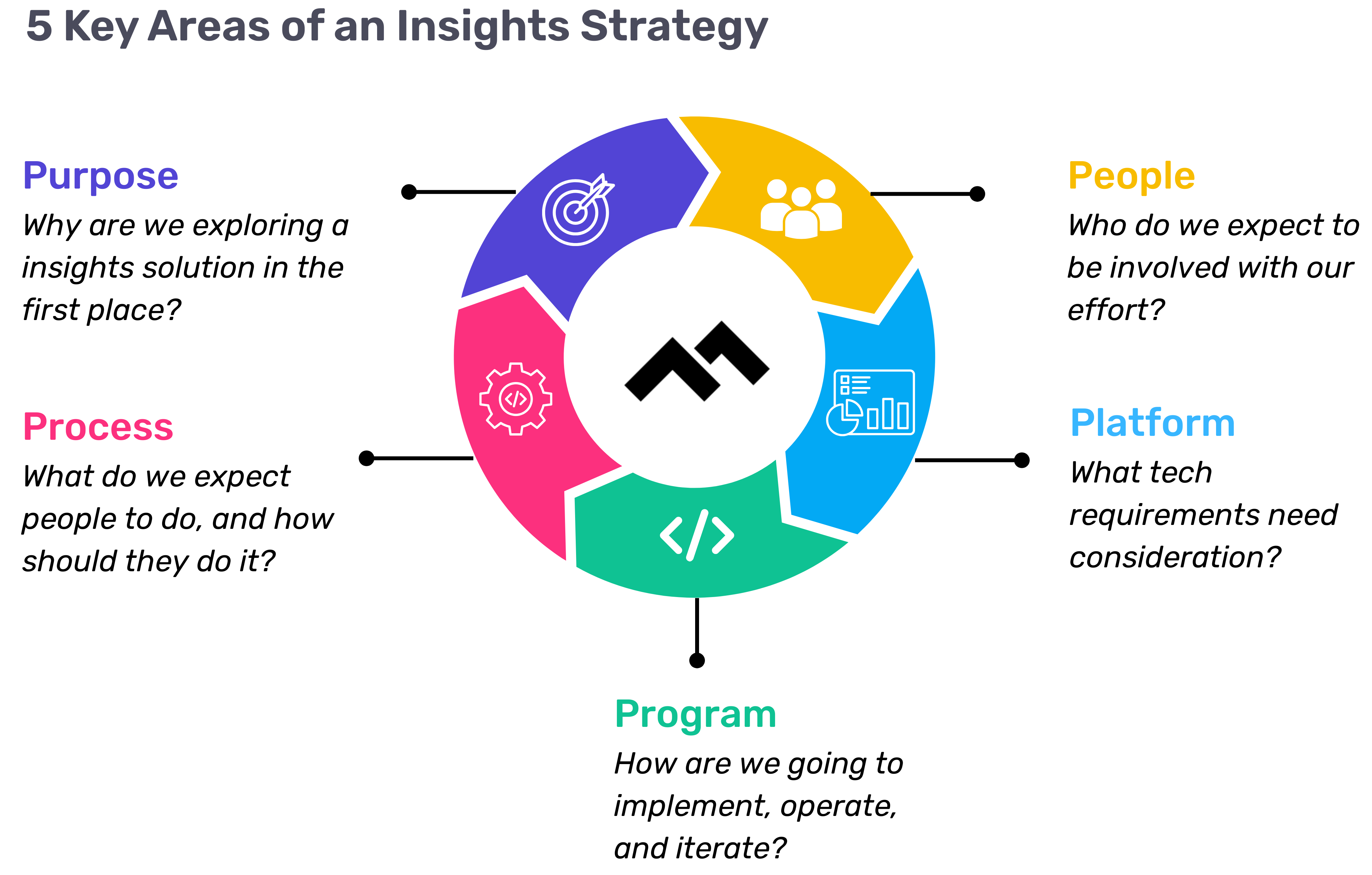
Sign up for a free, expert-led insights strategy workshop for your enterprise org.
Step 1: Define Your Purpose
The first step in any successful engineering insights strategy is defining why you're doing this in the first place. If you're rolling out developer productivity metrics or an insights platform, you need to make sure there’s alignment on the purpose across the board.
Too often, organizations dive into this journey without answering the crucial question: Why do we need this data? If you ask five different leaders in your organization, are you going to get five answers, or will they all point to the same objective? If you can’t answer this clearly, you risk chasing a vague, unhelpful path.
One way I recommend approaching this is through the "Five Whys" technique. Ask why you're doing this, and then keep asking "why" until you get to the core of the problem. For example, if your initial answer is, “We need engineering metrics,” ask why. The next answer might be, “Because we're missing deliverables.” Keep going until you identify the true purpose behind the initiative. Understanding that purpose helps avoid unnecessary distractions and lets you focus on solving the real issue.
Step 2: Understand Your People
Once the purpose is clear, the next step is to think about who will be involved in this journey. You have to consider the following:
- Who will be using the developer productivity tool/insights platform?
- Are these hands-on developers or executives looking for high-level insights?
- Who else in the organization might need access to the data, like finance or operations teams?
It’s also crucial to account for organizational changes. Reorgs are common in the enterprise world, and as your organization evolves, so too must your insights platform. If the people responsible for the platform’s maintenance change, who will ensure the data remains relevant to the new structure? Too often, teams stop using insights platforms because the data no longer reflects the current state of the organization. You need to have the right people in place to ensure continuous alignment and relevance.
Step 3: Define Your Process
The next key component is process—a step that many organizations overlook. It's easy to say, "We have the data now," but then what happens? What do you expect people to do with the data once it’s available? And how do you track if those actions are leading to improvement?
A common mistake I see is organizations focusing on metrics without a clear action plan. Instead of just looking at a metric like PR cycle times, the goal should be to first identify the problem you're trying to solve. If the problem is poor code quality, then improving the review cycle times might help, but only because it’s part of a larger process of improving quality, not just for the sake of improving the metric.
It’s also essential to approach this with an experimentation mindset. For example, start by identifying an area for improvement, make a hypothesis about how to improve it, then test it and use engineering insights data to see if your hypothesis is correct. Starting with a metric and trying to manipulate it is a quick way to lose sight of your larger purpose.
Step 4: Program and Rollout Strategy
The next piece of the puzzle is your program and rollout strategy. It’s easy to roll out an engineering insights platform and expect people to just log in and start using it, but that’s not enough. You need to think about how you'll introduce this new tool to the various stakeholders across different teams and business units.
The key here is to design a value loop within a smaller team or department first. Get a team to go through the full cycle of seeing the insights, taking action, and then quantifying the impact of that action. Once you've done this on a smaller scale, you can share success stories and roll it out more broadly across the organization. It’s not about whether people are logging into the platform—it’s about whether they’re driving meaningful change based on the insights.
Step 5: Choose Your Platform Wisely
And finally, we come to the platform itself. It’s the shiny object that many organizations focus on first, but as I’ve said before, it’s the last piece of the puzzle, not the first. Engineering insights platforms like Code Climate are powerful tools, but they can’t solve the problem of a poorly defined strategy.
I’ve seen organizations spend months evaluating these platforms, only to realize they didn't even know what they needed. One company in the telecom industry realized that no available platform suited their needs, so they chose to build their own. The key takeaway here is that your platform should align with your strategy—not the other way around. You should understand your purpose, people, and process before you even begin evaluating platforms.
Looking Ahead
To build a successful engineering insights strategy, you need to go beyond just installing a tool. An insights platform can only work if it’s supported by a clear purpose, the right people, a well-defined process, and a program that rolls it out effectively. The combination of these elements will ensure that your insights platform isn’t just a dashboard—it becomes a powerful driver of change and improvement in your organization.
Remember, a successful software engineering insights strategy isn’t just about the tool. It’s about building a culture of data-driven decision-making, fostering continuous improvement, and aligning all your teams toward achieving business outcomes. When you get that right, the value of engineering insights becomes clear.
Want to build a tailored engineering insights strategy for your enterprise organization? Get expert recommendations at our free insights strategy workshop. Register here.Register here.
Andrew Gassen has guided Fortune 500 companies and large government agencies through complex digital transformations. He specializes in embedding data-driven, experiment-led approaches within enterprise environments, helping organizations build a culture of continuous improvement and thrive in a rapidly evolving world.

Navigating the world of software engineering or developer productivity insights can feel like trying to solve a complex puzzle, especially for large-scale organizations. It's one of those areas where having a cohesive strategy can make all the difference between success and frustration. Over the years, as I’ve worked with enterprise-level organizations, I’ve seen countless instances where a lack of strategy caused initiatives to fail or fizzle out.
In my latest webinar, I breakdown the key components engineering leaders need to consider when building an insights strategy.
Why a Strategy Matters
At the heart of every successful software engineering team is a drive for three things:
- A culture of continuous improvement
- The ability to move from idea to impact quickly, frequently, and with confidence
- A software organization delivering meaningful value
These goals sound simple enough, but in reality, achieving them requires more than just wishing for better performance. It takes data, action, and, most importantly, a cultural shift. And here's the catch: those three things don't come together by accident.
In my experience, whenever a large-scale change fails, there's one common denominator: a lack of a cohesive strategy. Every time I’ve witnessed a failed attempt at implementing new technology or making a big shift, the missing piece was always that strategic foundation. Without a clear, aligned strategy, you're not just wasting resources—you’re creating frustration across the entire organization.
Sign up for a free, expert-led insights strategy workshop for your enterprise org.
Step 1: Define Your Purpose
The first step in any successful engineering insights strategy is defining why you're doing this in the first place. If you're rolling out developer productivity metrics or an insights platform, you need to make sure there’s alignment on the purpose across the board.
Too often, organizations dive into this journey without answering the crucial question: Why do we need this data? If you ask five different leaders in your organization, are you going to get five answers, or will they all point to the same objective? If you can’t answer this clearly, you risk chasing a vague, unhelpful path.
One way I recommend approaching this is through the "Five Whys" technique. Ask why you're doing this, and then keep asking "why" until you get to the core of the problem. For example, if your initial answer is, “We need engineering metrics,” ask why. The next answer might be, “Because we're missing deliverables.” Keep going until you identify the true purpose behind the initiative. Understanding that purpose helps avoid unnecessary distractions and lets you focus on solving the real issue.
Step 2: Understand Your People
Once the purpose is clear, the next step is to think about who will be involved in this journey. You have to consider the following:
- Who will be using the developer productivity tool/insights platform?
- Are these hands-on developers or executives looking for high-level insights?
- Who else in the organization might need access to the data, like finance or operations teams?
It’s also crucial to account for organizational changes. Reorgs are common in the enterprise world, and as your organization evolves, so too must your insights platform. If the people responsible for the platform’s maintenance change, who will ensure the data remains relevant to the new structure? Too often, teams stop using insights platforms because the data no longer reflects the current state of the organization. You need to have the right people in place to ensure continuous alignment and relevance.
Step 3: Define Your Process
The next key component is process—a step that many organizations overlook. It's easy to say, "We have the data now," but then what happens? What do you expect people to do with the data once it’s available? And how do you track if those actions are leading to improvement?
A common mistake I see is organizations focusing on metrics without a clear action plan. Instead of just looking at a metric like PR cycle times, the goal should be to first identify the problem you're trying to solve. If the problem is poor code quality, then improving the review cycle times might help, but only because it’s part of a larger process of improving quality, not just for the sake of improving the metric.
It’s also essential to approach this with an experimentation mindset. For example, start by identifying an area for improvement, make a hypothesis about how to improve it, then test it and use engineering insights data to see if your hypothesis is correct. Starting with a metric and trying to manipulate it is a quick way to lose sight of your larger purpose.
Step 4: Program and Rollout Strategy
The next piece of the puzzle is your program and rollout strategy. It’s easy to roll out an engineering insights platform and expect people to just log in and start using it, but that’s not enough. You need to think about how you'll introduce this new tool to the various stakeholders across different teams and business units.
The key here is to design a value loop within a smaller team or department first. Get a team to go through the full cycle of seeing the insights, taking action, and then quantifying the impact of that action. Once you've done this on a smaller scale, you can share success stories and roll it out more broadly across the organization. It’s not about whether people are logging into the platform—it’s about whether they’re driving meaningful change based on the insights.
Step 5: Choose Your Platform Wisely
And finally, we come to the platform itself. It’s the shiny object that many organizations focus on first, but as I’ve said before, it’s the last piece of the puzzle, not the first. Engineering insights platforms like Code Climate are powerful tools, but they can’t solve the problem of a poorly defined strategy.
I’ve seen organizations spend months evaluating these platforms, only to realize they didn't even know what they needed. One company in the telecom industry realized that no available platform suited their needs, so they chose to build their own. The key takeaway here is that your platform should align with your strategy—not the other way around. You should understand your purpose, people, and process before you even begin evaluating platforms.
Looking Ahead
To build a successful engineering insights strategy, you need to go beyond just installing a tool. An insights platform can only work if it’s supported by a clear purpose, the right people, a well-defined process, and a program that rolls it out effectively. The combination of these elements will ensure that your insights platform isn’t just a dashboard—it becomes a powerful driver of change and improvement in your organization.
Remember, a successful software engineering insights strategy isn’t just about the tool. It’s about building a culture of data-driven decision-making, fostering continuous improvement, and aligning all your teams toward achieving business outcomes. When you get that right, the value of engineering insights becomes clear.
Want to build a tailored engineering insights strategy for your enterprise organization? Get expert recommendations at our free insights strategy workshop. Register here.Register here.
Andrew Gassen has guided Fortune 500 companies and large government agencies through complex digital transformations. He specializes in embedding data-driven, experiment-led approaches within enterprise environments, helping organizations build a culture of continuous improvement and thrive in a rapidly evolving world.
All Articles

Engineering teams know that technical debt, or “tech debt,” is an inevitable, and often necessary, part of software development. Yet, it can be difficult to explain the significance of tech debt to stakeholders and C-suite leadership. While stakeholders might want to prioritize constant innovation over paying down tech debt, letting tech debt build up can ultimately slow down an engineering team. When that happens, it can be challenging to prove that the resulting delays and complications don't fully reflect an engineering team's adeptness.
What are the reasons an engineering team might accrue tech debt, and how can they overcome it before it impacts delivery?
What is technical debt?
Technical debt is a term used to describe the implications of immature code being pushed through the software development pipeline to expedite delivery. Because the code was merged prematurely, or was a quick fix to a complex problem, it often needs to be refactored or redone, resulting in a backlog of work that will need to be taken on at some point in the future.
The term "technical debt" was first coined by Ward Cunningham, who posited that "a little debt speeds development so long as it is paid back promptly with refactoring. The danger occurs when the debt is not repaid."
Tech debt can be thought of similar to financial debt. Taking out a loan for a larger purchase makes it possible to expedite the purchase, rather than waiting to save up a large sum of cash. In exchange, you must repay the loan plus interest, which builds up exponentially over time.
With technical debt, the interest is not only the extra developer time spent refactoring the code, but the consequences resulting from not addressing that refactoring early on. As the work builds up and other work is prioritized, going back to deal with the technical debt becomes increasingly costly and difficult. In this sense the time needed to address tech debt grows, similar to interest.
Reasons for accruing technical debt
First, it's important to note that technical debt is inevitable in order to remain competitive in the industry, and doesn't necessarily imply that an engineering team has done something "wrong."
Similar to financial debt, there are reasons for intentionally racking up technical debt. The marketplace today moves lightning fast and, to stay afloat, you might opt for shortcuts that lead to technical debt in order to ship new features quickly and bring in revenue.
The associated tech debt you take on might be worth it when you compare it against the downsides of waiting to bring your features to the market. This is completely normal — the danger arises when, as Cunningham said, the debt isn't properly repaid.
Why should you care about technical debt?
Instead of working on developing new features, engineers are often left to work through technical debt, further slowing innovation and impacting a slew of business outcomes.
Even while there are good reasons why organizations accrue tech debt, the earlier it’s addressed, the better. It’s vital for engineering leaders to pay attention to tech debt and be aware of the issues it can pose to the organization:
- Tech debt can curtail developer productivity; one study estimates that developers spend 23% of their working time on tech debt.
- Poorly maintained code can be complex for new developers to navigate. When developers take time to improve this code, it can contribute to the overall technical debt.
- Tech debt snowballs over time.
- The longer tech debt goes unaddressed, the more expensive it will be to resolve.
Overcome technical debt by getting curious
To minimize or overcome tech debt, start by investigating the source.
Engineering leaders can take a cue from one Code Climate customer, and use a Software Engineering Intelligence (SEI) platform — sometimes known as an Engineering Management Platform (EMP) — to demonstrate how tech debt can limit deployment. The engineering team at a popular crowdsourcing platform often worked with legacy code, and had nearly a decade’s worth of tech debt.
The company’s VP of Engineering had a relatively easy time getting developers on board to prioritize the backlog of tech debt. When it came to getting executive buy-in, however, the VP of Engineering needed concrete data to present to stakeholders in order to justify dedicating resources to refactoring the legacy code.
Using Code Climate's solutions, the engineering leader was able to demonstrate, in real time, how many Pull Requests (PRs) were left open for longer than is ideal while authors and reviewers sent comments back and forth. Code Climate's insights showed this as a lasting trend with high-risk PRs stacking up. They used this as evidence to executives that legacy code was significantly impacting deployment.
Once you outline how to tackle your current tech debt, think about how you can manage new debt going forward. Team leaders might decide to be mindful of high-risk PRs and monitor them over time to ensure that tech debt does not become insurmountable; or, you may have developers take turns refactoring legacy code while others put their efforts towards innovation. Use concrete evidence from an SEI platform to request additional resources. Once you find what works, you can scale those best practices across the organization.
Adopt a holistic approach to managing technical debt
Technical debt is inevitable, and even mature engineering teams will need a strategy for mitigating the debt they’ve accrued. Communicate with your company leadership about tech debt and its implications, work to find the root cause within your teams, and adopt a slow-but-steady approach towards a resolution.
You will never be able to address and solve all technical debt at once, but you can prioritize what to tackle first and move toward a more efficient future.
A Software Engineering Intelligence platform can provide the visibility leaders need to refine engineering processes. Request a consultation to learn more. Request a consultation to learn more.

Read on for highlights from the conversation, and watch the full webinar on demand here.
In an effort to understand the markers of a productive engineering team, the DORA (DevOps Research and Assessment) group, founded by Dr. Nicole Forsgren, Jez Humble, and Gene Kim, designed their research to answer core questions about DevOps:
Does technology matter for organizations? If so, how can we improve software delivery and engineering performance?
Through rigorous academic and analytical research, the group was able to demonstrate that improving software delivery and engineering performance leads to increased profitability and customer satisfaction. They identified four key metrics, now known as the DORA metrics, which address the areas of engineering most closely associated with success, and established benchmarks, enabling engineering teams to improve performance and balance the speed and stability of their software delivery.
How can organizations get started with DORA metrics and turn those insights into action? Code Climate’s Director of GTM Strategy and Intelligence, Francesca Gottardo, sat down with DORA expert Nathen Harvey to discuss how leaders leverage DORA metrics to improve engineering team health and truly drive change in their organization.
Francesca Gottardo: How did the DORA team choose between metrics that measure the quality of software versus how quickly it was getting shipped?
Nathen Harvey: Delivering technology can enable and accelerate any business. We all want to accelerate the delivery of that technology to enable great customer experiences.
So we look at two metrics: Deployment Frequency, how frequently are you pushing changes out to your users? And Lead Time for Changes, how long does it take for code to go from committed to actually in the hands of your users? The challenge there is that moving fast is good, but not enough, so we also have two stability metrics that complement that. The stability metrics are your Change Failure Rate, what I like to call the ‘Oh, Expletive’ rate — when you push a change to production and someone shouts out an expletive – and Time to Restore, how do we as a team quickly respond and recover when there is an incident or an outage that impacts our users?
That traditional thinking leads us to believe that these two are trade-offs of one another: we can either be fast or we can be stable. But what the data shows us over almost a decade now, is that these two ideas move together in lockstep. There are teams that are good, are good at all four metrics and the teams that are performing poorly are performing poorly across all four metrics as well.
Francesca: Who are DORA metrics for? Are they best suited for a specific type or size of company?
Nathen: We've seen teams of all shapes and sizes using DORA and insights from it successfully. But there were also some challenges there. First, measuring those metrics at an organizational level doesn't really give you a whole lot of value. How frequently does Google deploy? A lot, but what are we going to learn from that?
We really want to look at an application or a service, a particular set of capabilities, if you will, that we deliver to our customers, so first we have to measure at that level. And let's also make sure that we're using or getting insights across the entirety of the team that's responsible for prioritizing, building, deploying, and operating that application or service — it often takes a cross-functional team focused on one application or service.
The technology really doesn't matter. You can use those four metrics to look at how you’re doing with the custom application that you’re building for customers, but you could also do that for the commercial off-the-shelf software that you're using to deliver to your customers, or a SaaS that you're using.
Francesca: Is there a specific type of view or a few specific metrics that a leader of a few teams should look at?
Nathen: From a leadership perspective, I think the best insights you can get from the DORA metrics are just really to understand how your teams are doing. But here's the pitfall there: you're not using this to weigh teams against one another. Instead, what DORA really tries to get at is embracing a practice and a mindset of continuous improvement.
You might want to look across your teams to understand how each team is doing, find those teams that are doing really well, and identify what lessons you can learn from that team. Of course, the context is so important here. If you're shipping a mobile application or if you're working on the mainframe, we can use those same four measurements, but we don't expect the values are going to be the same across those teams. As a leader, I think that there are really good ways to have insight into what sort of investments you need to make in the team, and what sort of support each of your teams need.
Francesca: What are some other common pitfalls you find when people start using DORA metrics?
Nathen: The biggest one is this idea that we have to reach peak performance. Really, the goal is improvement. Don't worry about how other teams are doing. It's nice to have a benchmark to understand where you sort of fit, but the more important thing is, how do you get better? In fact, looking at the four metrics, it's difficult to say, ‘How do I get better? My Deployment Frequency isn't what I want, so I need to get better.’ You don't get better just by mashing the deploy button more frequently. That's not the right approach. The research actually goes a little bit deeper beyond those four key metrics into some capabilities — practices or tools or things that your team does regularly.
The capabilities that the research investigates are technical capabilities like version control, continuous integration, and continuous testing. There are also process capabilities: How much work do you have in-flight at any given time? Maybe shrink down your amount of work-in-progress. What does that change approval look like? Focusing on that change approval process is maybe the thing that's going to unlock value.
Most important of the capabilities are the cultural capabilities. How do the people in your team show up? How do they communicate and collaborate with one another? How are they rewarded? What's incentivized? All of these things really matter, and DORA is really about taking that comprehensive view of what capabilities a team needs to improve in order to drive those four metrics.
Francesca: What is the starting point that you recommend leaders look at?
Nathen: One of the beautiful things about these four metrics is thinking about them holistically. You may want to improve Deployment Frequency, but do you know how you're going to get there? You're going to make your lead times shorter. You're going to make your Change Failure Rate go down and you're going to restore service faster. It doesn't matter which one you focus on; changes are likely going to have good impacts across all four, and we really encourage you to look at all four as a whole.
How do you get started from there? You really then need to go deeper into the capabilities. Start with the capabilities where your teams have a lot of opportunity for growth. It's really about finding your constraint and making improvements there.
Francesca: And you would say as you're measuring that opportunity for growth, it's really relative to the benchmark, correct?
Nathen: Oh, absolutely. Let's say that continuous integration popped up as the thing that you should focus on. Now we have to figure out how we get better at continuous integration. Let's go put some new things in place. Those new things might be new measures, so we can test how well we're doing with continuous integration. There's certainly going to be new practices, maybe even new technologies, but after you've made some of that investment, you have to go back to those four key metrics, back to the benchmarks. Did this investment actually move those metrics in the way that we expected it to?
Francesca: Sometimes leaders can have a hard time getting buy-in for new forms of measurement, or the individual developers on a team have seen a lot of flawed measurement and can be skeptical. How do you suggest that leaders get their teams on board to be measured like this?
Nathen: Yeah, I don't like to be measured either. I get it. I think honestly, the best way to help teams get on board with this is for leaders to share the idea of these metrics and then step out of the way and give the teams the autonomy that they need to make the right choices. If a leader comes to me and says, ‘I'm going to measure your team's performance based on these four metrics,’ that's fine, but what I don't want that leader to do is tell me exactly how to improve those four metrics, because the leader isn't attached to the daily work of our team. But if that same leader says, ‘These are the metrics by which you'll be measured and we want to improve these metrics, what can we do?’ Now, as a team, we’ve been given that trust and the autonomy to select where we should invest and what we should do. A leader's job really is to support that investment, support that learning of the team.
Francesca: How could you ensure that you're comparing kind of apples to apples as you're looking at DORA metrics for teams that may be looking or working in different platforms?
Nathen: You are in fact comparing apples to oranges, and so the thing that I encourage folks to do is celebrate the teams that make the most progress. Maybe you can get to a derivative: This team increased their Deployment Frequency by 10%, this team increased their Deployment Frequency by 50%. Maybe that 50% team went from annual deployments to twice a year, but that's still a 50% improvement, and that's worthy of celebration. I think really looking at the progress that you're making instead of the raw numbers or that sort of benchmark data is the best way to go.
Francesca: One thing I've heard is that it's really important for teams to improve to a higher performance bucket, rather than stay within that bucket.
Nathen: We put out an annual report and people are hungry for benchmarks, and they really want those benchmarks and want to understand how they measure up to peers, to others in the industry. And each year, we do a cluster analysis of those four key measures, and these clusters emerge from the data. We don't set in advance what it means to be a low performer or medium performer. We let the data answer that question for us, but then we have to put labels on those clusters to make them consumable by a leader and by teams, and unfortunately, we use labels like low or medium or high or elite.
Nobody wants to be a low performer. It's not very encouraging to show up to work as a low performer. But I try to encourage folks to recognize that this is not a judgment and maybe just discard the label; it's about that improvement. How are you making progress against that? As you're making changes, you're likely to have some setbacks as well.
In 2020, we did an investigation into reliability practices, and we saw that some teams, as they began their journey changing some of their reliability practices, the reliability of their systems dropped. But over time, as they stayed committed and got more of their teams involved and more of the practices honed within their team, they saw this J curve illustrating impact across the team. So I think the important takeaway there is that this requires commitment. We're asking people to change process and technology. It's going to take some commitment.
Francesca: DORA metrics have had a huge impact in this space and are a popular starting point for taking a data-driven approach. What are your thoughts on how popular they’ve become?
Nathen: It's really exciting for me and for my team, and of course for the researchers, to see that it's had such a lasting and big and expanding impact on the industry. I think that it is important, though, to remember that the research is focused on that process of software delivery and operations. Oftentimes people ask about developer productivity or developer experience. This isn't particularly measuring that, although I would say that a developer is going to have a much better experience knowing that the code that they wrote is actually in the hands of users.
So it's not a direct measure there, it is an outcome of that process. When it comes to any sort of metric that we are looking at, it is important to remember which of these measures are inputs, which of these measures are outcomes. Even something like software delivery as an outcome is an input to organizational performance. It's really important just to understand the full context of the system, which of course includes the people in the system.
Francesca: If you're looking at DORA metrics in a tool like ours, there's also the context available so that you can have those conversations upward and people aren't going to be using that data in the ways that it wasn't intended.
Nathen: Absolutely. And with tools like Code Climate, you can go beyond those four keys. What are the inputs that are driving that? As an example, what is the quality of the code that's been written? Is it following the practices that we've set within our team? How long does a peer review of this code take? All of these things are really, really important and drive those overall metrics.
Francesca: We've seen that Deployment Frequency really is closely related to PR Size. So that's a great place to look first.
Nathen: Yeah, I think that one in particular is interesting because those four measures really, I think what the researchers really wanted to measure were batch sizes.
But how do we ask you, ‘What's the size of your batch?’ Smaller for you might be a medium for me. So those four metrics can really be used as a proxy to get at batch size and you're going to improve if you make that batch size smaller.
What is the size of our PRs? We can actually look across teams and say, ‘This team that has large PRs, lots and lots of code changes, they tend to go out slower.’ We could also start to look at things like from the time the change is committed, that lead time, what does it do for our Change Failure Rate? We've worked with customers who can pull out data and show us on a dashboard that the longer this change takes to get to production, the higher chance it's going to fail when it reaches production.
Francesca: Can you talk a little bit more about the importance of having metrics be standardized or making sure that Deploy Frequency, for example, means the same thing to everybody in the organization?
Nathen: I think it can be a real challenge, and I think that one of the values of DORA is that it gives us a shared language that we're communicating with one another. Deployment Frequency is a really interesting one. Of course, it's just how frequently you’re pushing changes out to your customers, but then there can be a lot of nuance.
The most important thing there is that you have consistency over time within a team. And then the second most important thing is across an organization as you're looking across teams, even if you can't get to a consistent definition, at least you can publish or write down and probably store in version control, how are we measuring this thing so that it's clearly communicated across those teams?
Francesca: So how do people connect something like Deployment Frequency and Lead Time to higher levels of work? For example, a story, a project, or business feature where you're really delivering that end-user value.
Nathen: DORA metrics are really focused on this idea of software delivery. We are looking only at code commit through to code deploy, but of course there's a lot of stuff that happens before we even get to code commit. Teams want to know things like feature velocity. How fast am I able to ship a feature? That's a different question than ‘How fast am I able to ship a change?’ because a feature is likely multiple changes that get rolled up together. This is where other metrics frameworks, like the flow metrics, might start to come in, where we look at a broader view of that entire value chain. And I think that it can be very difficult. Is a feature brand new thing that we're launching from fresh, or is a feature changing the location of this particular button? They're both features, they both have very different scales. One of the reasons that the DORA research really focuses on that software delivery process is it gives us a little bit more sort of continuity. A change, is a change, is a change, is a change. If we're shipping a change, it should follow the same process. There should be less variability in the size of that or in the duration of how frequent or how long that takes.
Francesca: A lot of the questions that we've been getting from the audience are more about digging deeper into the context of each of these metrics because they're very big picture outcomes. So let's take Mean Time to Recovery, for example. How do you suggest digging into this one?
Nathen: I think the best thing to do is look at something that just happened. So let's say you just had an incident or an outage, something that you recovered from. First and foremost, make sure you're recovered, make sure your users are happy again. Now that we're there, let's take some time to learn from that incident or from that outage. And that's where the investment really starts to take place.
One of the first things we have to do is go talk to people. We have to understand your mindset during this incident or outage, and really try to unwind what led to this, not in a way that we're looking for what things we should blame, but instead just to get a better understanding of the system overall. Let's ask really good questions, and involve the right people in those conversations.
Francesca: Your research is in the abstract, but when you’re seeing DORA metrics practices in actuality, what were some surprises?
Nathen: What I so often see is a thing that you mentioned earlier: it really comes down to the process and the people. The people really matter.
The truth is that as we're trying to change culture and the way that teams and people show up at work, it is oftentimes the case that you have to change how they work to change how they think. Technology and culture are kind of stuck together. You can't just change out a tech and expect that the culture's going to change, nor can you just change the culture and expect that the technology's going to follow. These two amplify and reinforce one another. I think that we're reminded again and again and again that there is not a magic wand. There are no silver bullets. This takes consistent practice. It takes commitment and it takes looking at the entire system if you want to improve.
Francesca: If the need and desire for measuring DORA isn't coming from leadership, how do you suggest a team goes about implementing it?
Nathen: In my opinion, these measures matter for the teams that are building the software. And in fact, I don't mind if a leader isn't pushing me to measure DORA metrics. What I really want is for the team of engineers, the team of practitioners that come together to ship that software, to care about these metrics. Because at the end of the day, the other thing that we know is that these teams are more productive when they're able to hit those metrics. And a productive team is a happy team.
I often ask this question: is a happy team productive or is a productive team happy? I think the answer is yes, right? As an engineer, when I'm productive, when I'm able to be in the flow of my work and get fast feedback on the work that I'm doing, that makes me happier. I have better days at work. There's even research from GitHub that looks exactly at that. What does a good day look like? It's when that engineer, that developer is in the flow doing the work that they love to do, getting that fast feedback. So these metrics really matter for the team.
Francesca: It's what we see in how people use our tool as well, and that so often people or customers will come to us either wanting to fix some inefficiencies in their SDLC or wanting to improve team health, and they may be one and the same when you're really looking at the big picture.
Nathen: Absolutely. I don't know of any CEO who has come to a team and said, ‘Wow, you've deployed more frequently this year. Congratulations. Here's a big bonus.’ The CEO cares about the customer. These metrics can help reinforce that. As technologists, it's easy for us to get caught up in the latest, greatest new technology, this new microservices framework, this new stuff from AI. But at the end of the day, we're here to deliver value to our customers and really understand what they need out of this. That's what our CEO cares about. Frankly, that's what we should care about. We're using technology to further those goals and to keep our customers happy.
Francesca: In the polls, 26% of people said that they have philosophical or cultural barriers to implementing DORA. If leadership doesn't see it as a priority, how can managers still motivate the team?
Nathen: I think that one approach that is successful is to — and this pains me a little bit — stop using the word DORA. Stop using the word DevOps. Don't talk about those things, don't talk about those labels. Turn to a more curious mindset and a questioning mindset. What would it be like for our customers, for our organization, for our team, if we were able to deliver software faster? Imagine that world because we can do that. We can get there and do that in a safe way. Imagine or ask the question, ‘What happens if we don't improve? What happens if we stay stagnant and our practices aren't improving?’ And really start at digging into some of those questions to find that intrinsic motivation that we have. As an engineer, like I said, I want to ship more things. I want to get feedback from that faster. I want to do the right thing for my customers.
Francesca: What is the future of DORA? Are there additional metrics you think of exploring or avenues outside of stability, outside of speed, that you think are important to include in the future?
Nathen: Yeah, absolutely. I think this is really where we get back to those capabilities. Number one, we will continue this research and continue our ongoing commitment to that research being program and platform-agnostic, really trying to help teams understand what capabilities are required to drive those metrics forward. Number two, like you mentioned earlier, we're seeing more and more teams that are trying to use the DORA framework and the metrics and the research to drive those improvements. In fact, we've recently launched dora.dev as a place where the community can start to come together and learn from one another and collaborate with one another and answer these questions.
Don't ask Nathen, let's ask each other. Let's learn from each other and the lived experiences of everyone here. And then, of course, I mentioned that the research will continue. So stay tuned. In the next couple of months, we'll launch the 2023 state of DevOps survey. And the best thing about the survey is the questions that it asks. And I think that teams can really get a lot of value by carefully considering the questions that are posed in the survey. Just by looking at those questions, a team is going to start to identify places where they could make investments and improvements right now.
Francesca: Something that is going to stick with me from what you've said today is that the benchmarks that are standardized may not be what we should all be spending so much time on. It's really about how we compare to ourselves and where we can improve.
Nathen: It is that practice and mindset of continuous improvement. Now, look, the benchmarks are still important because we have to have dashboards, we have to have ways to report, we have to have ways to test that what we're doing is making things different. Whether that's good, better, or worse, at least these benchmarks give us a way to test that and prove out the theories that we have.
To learn how your engineering team can implement DORA metrics to drive improvement, request a consultation.

Code Climate is proud to have once again earned Leader and Leader Mid-Market badges from G2, the most trusted software software marketplace and the largest in the world.
In G2’s Best Results Spring 2023 ranking, Code Climate Velocity has been named #1 in with the highest overall Results rating for G2's Software Development Analytics Tools Results Index.
For the second quarter in a row, Code Climate Velocity ranked #1 for G2's Mid-Market Grid® Report for Software Development Analytics Tools, having been highly rated by G2 users and our customers, and earning substantial Satisfaction and Market Presence scores.
Velocity also ranked #2 for G2's Grid® Report for Software Development Analytics Tools for the second quarter in a row.
Who We Are
With Velocity, our flagship Software Engineering Intelligence (SEI) platform, Code Climate has helped thousands of engineering organizations improve their team health and DevOps, and align with the strategic priorities of their businesses.
Our platform provides the strongest process and team health insights of any tool on the market, including a year’s worth of historical data, resource allocation insights, benchmarks, and the ability to add context to key reports.
Our customers are prominent and visionary organizations, and our enterprise-ready platform has the scaling and security features required by startups and Fortune 500 companies alike.
What engineers are saying about Velocity
“I use Velocity every sprint. I can track my own performance; it's great for my own reviews when it comes to being able to track what I've done and how I'm compared against my prior attempts." — Andrew Brown, Software Engineer II, EverQuote
What leaders are saying about Velocity
“The cost of extracting and crunching software engineering metrics is sometimes prohibitive. Tools like Code Climate Velocity provide you with this ability with a small configuration effort and a very flexible reporting and analytics tool for a fair price. Furthermore, Code Climate Velocity helps you educate your management team with metrics important for managing software engineering teams.” — Thiago R., Director of Engineering, RD Station
“Code Climate Velocity has been a great addition to our software development process. It has helped us identify and address potential issues early on, saving us time and resources in the long run. The ability to enforce coding standards and best practices has also been crucial in maintaining a maintainable and easy-to-work-with codebase. The user-friendly interface and customization options have made it easy for us to track our progress and tailor the experience to our needs. While there is always room for improvement, we have found that Code Climate Velocity is a valuable tool for managers looking to optimize their team's productivity and success.” — Pedro C., Engineering Lead
For more testimonials or to leave your own review of Velocity, visit our G2 page.

Delivering software is a complex and often fragmented process, requiring countless dependencies, tools, and teams. A value stream management (VSM) solution aims to bring order to that chaos, mapping the process of delivery from idea to market.
Engineering leaders who oversee product roadmaps, operations, and the development of applications, can benefit from investing in value stream management.
What is value stream management?
Value stream management is the practice of tracking the efficiency, cost, and speed of an organization’s software delivery. As organizations focus on delivering even more value to customers, many are adopting value stream management tools to fully optimize their processes from end to end.
Value stream management provides layers of visibility into the DevOps pipeline and helps improve the flow of software delivery to ensure that maximum value is being delivered to customers.
What is a value stream management platform?
Value stream management platforms (VSMPs) are tools that assist software organizations in managing their DevOps processes. These platforms pull data from your existing tools and create visualizations so that software engineering leaders can gather sophisticated insights about their organization’s software delivery processes.
VSMPs surface engineering metrics and analytics related to the delivery processes, such as allocation of resources, progress towards key goals, and granular insight into software development lifecycle (SDLC) stages, to help engineering leaders spot potential bottlenecks or issues.
What does a value stream management platform do?
Companies can use VSMPs to understand their progress towards delivery commitments, the overall efficiency of their engineering processes, and the impact of their allocation of time and resources.
VSMPs help engineering leaders and teams align engineering activities with business objectives, ultimately helping to strengthen business outcomes.
How do value stream management platforms work?
VSMPs connect to other software development tools to surface software delivery data all in one place, allowing engineering leaders to identify where their teams can improve processes.
Value stream management can help leaders answer specific questions about their processes and delivery, such as:
- Are they spending the right amount of time and resources on specific products and features? VSMPs can illustrate where developers or teams are spending their time, giving leaders detailed visibility into how resources are distributed, and allowing them to investigate whether processes need to be altered, improved, or even scaled and applied across the organization.
- Are engineering and business OKRs aligned? Engineering metrics and business metrics should be complementary, but if they are siloed, it can be difficult to see how they affect one another. If organizations use a VSMP, it’s easier to visualize business and engineering alignment by surfacing software delivery alongside product roadmaps, for example.
- Are teams meeting their delivery goals? By setting targets within a VSMP, engineering teams can better track progress towards meeting delivery deadlines.
- Are their processes efficient? With a comprehensive tool that offers insight into every part of the SDLC, engineering leaders can drill down into units of work and understand how long certain processes, like code review or deploys, are taking, and make adjustments if necessary.
- Are their opportunities to automate best practices? Rules for automation can be built into the value stream to free up engineering resources. Automation of specific tasks can minimize risk, enforce quality, and speed up software delivery.
- Is process data being captured and normalized? VSMPs integrate with existing SDLC tools in order to capture DORA metrics, flow metrics, and lean metrics like process and wait time. With actual process data, teams can optimize processes and increase the rate of innovation.
- Are customers satisfied with the product? VSMPs can help leaders foster a culture of continuous delivery, so that new features or updates can be delivered to customers more quickly, allowing organizations to get feedback on their products more often.
What are value stream metrics?
Value stream metrics incorporate data for an organization’s entire software development life cycle (SDLC) process. They include:
Business metrics: These track performance and customer satisfaction, and can include ROI, indicators of product value, and product quality.
Product delivery metrics: These measure indicators of product development and can include productivity metrics like DORA metrics and efficiency and flow metrics.
Technical metrics: These metrics assess your code quality, delivery speed, refactoring, and technical debt.
Reliability metrics: These help measure the digital experience of your customers, and can include service-level objectives (SLOs) and Mean Time to Recovery from incidents.
Code Climate adds value to the value stream
A Software Engineering Intelligence (SEI) platform like Code Climate offers solutions that overlap with the capabilities of a value stream management platform. SEI platforms offer end-to-end insight into the SDLC by allowing engineering teams to track and improve efficiency, resource allocation, and speed of software delivery. Additionally, like value stream management platforms, SEI platforms can help leaders communicate the business impact of engineering to non-technical stakeholders.
As an SEI platform and solution, Code Climate offers additional insights outside the bounds of value stream management. Code Climate gives leaders a more holistic view of the software delivery process, including team health and performance. We encourage engineering leaders to look not only at the SDLC, but to also focus on the teams that make it run. Spending time on identifying factors that could affect engineers’ experience is critical to business success.
To learn more about the actionable insights provided by Code Climate, request a consultation.

The four DORA Metrics — Deployment Frequency, Change Failure Rate, Mean Time to Recovery, and Mean Lead Time for Changes — were identified by the DevOps Research and Assessment group as the metrics most strongly correlated to a software organization’s performance.
These metrics are a critical starting point for engineering leaders looking to improve or scale DevOps processes in their organizations. DORA metrics measure incidents and deployments, which can help you balance speed and stability. When viewed in isolation, however, they only tell part of the story about your engineering practices.
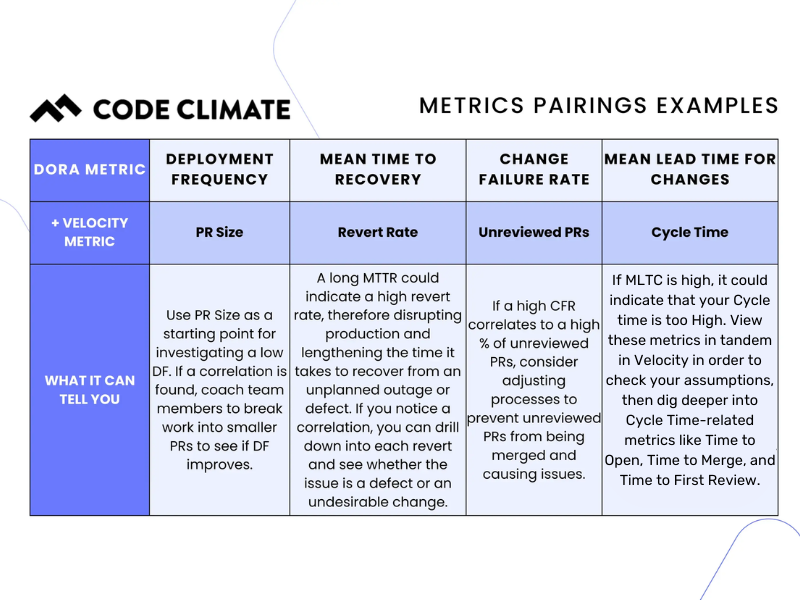
To begin to identify how to make the highest-impact adjustments, we recommend viewing these DORA metrics in tandem with their non-DORA counterparts, which can be done through Velocity’s Analytics module. These close correlations will help are a great starting point if you're looking for opportunities to make improvements, or might highlight teams that are doing well and might have best practices that could scale across the organization.
While there is no one-size-fits-all solution to optimizing your DevOps processes, certain pairings of metrics are logical places to start.
DORA Metric: Change Failure Rate
Velocity Metric: Unreviewed Pull Requests
Change Failure Rate is the percentage of deployments causing a failure in production, while Unreviewed Pull Requests (PRs) refers to the percentage of PRs merged without review (either comments or approval).
How can you identify the possible causes of high rates of failures in production? One area to investigate is Unreviewed PRs. Code review is the last line of defense to prevent mistakes from making it into production. When PRs are merged without comments or approval, you’re at a higher risk of introducing errors into the codebase.
In Velocity’s Analytics module, choose Unreviewed PRs and Change Failure Rate to see the relationship between the two metrics. If you notice a high Change Failure Rate correlates to a high percentage of Unreviewed PRs, you have a basis for adjusting processes to prevent Unreviewed PRs from being merged.
Engineering leaders may start by coaching teams to improve on the importance of code review so that they make it a priority, and if necessary, setting up a process that assigns reviews or otherwise makes it more automatic. If you’re using Velocity, you can note the date of this change right in Velocity in order to observe its impact over time. You can take this data to your team to celebrate successes and motivate further improvements.
For reference, according to the State of DevOps report for 2022, high-performing teams typically maintain a CFR between 0-15%.
DORA Metric: Deployment Frequency
Velocity Metric: PR Size
Deployment Frequency measures how frequently the engineering team is successfully deploying code to production, and PR Size is the number of lines of code added, changed, or removed.
Our research shows that smaller PRs pass more quickly through the development pipeline, which means that teams with smaller PRs are likely to deploy more frequently. If you’re looking to increase Deployment Frequency, PR size is a good place to start your investigation.
If you view these two metrics in tandem and notice a correlation, i.e. that a larger PR Size correlates to a lower Deployment Frequency, encourage your team to break units of work into smaller chunks.
While this may not be the definitive solution for improving Deployment Frequency in all situations, it is the first place you might want to look. It’s important to note this change and observe its impact over time. If Deployment Frequency is still trending low, you can look at other metrics to see what is causing a slowdown. Within Velocity’s Analytics module, you also have the ability to drill down into each deploy to investigate further.
DORA Metric: Mean Time to Recovery
Velocity Metric(s): Revert Rate or Defect Rate
Mean Time to Recovery (also referred to as Time to Restore Service) measures how long it takes an engineering team to restore service by recovering from an incident or defect that impacts customers.
Debugging could account for a significant amount of the engineering team’s time. Figuring out specifically which areas in the codebase take the longest time to recover could help improve your MTTR.
In Analytics, you can view MTTR and Revert Rate or Defect Rate by Application or Team. Revert Rate is the total percentage of PRs that are “reverts”— changes that made it through the software development process before being reversed — which can be disruptive to production. These reverts could represent defects or wasted efforts (undesirable changes). Defect Rate represents the percentage of merged pull requests that are addressing defects.
By viewing these metrics side by side in the module, you can see which parts of the codebase have the most defects or reverts, and if those correlate to long MTTRs (low-performing teams experience an MTTR of between one week and one month).
If you notice a correlation, you can drill down into each revert, speak to the team, and see whether the issue is a defect or an undesirable change. To prevent defects in the future, consider implementing automated testing and/or code review. To prevent wasted efforts, the solution may lie further upstream. This can be improved by focusing on communication and planning from the top down.
DORA Metric: Mean Lead Time for Changes
Velocity Metric: Cycle Time
Mean Lead Time for Changes is the time it takes from when code is committed to when that code is successfully running in production, while Cycle Time is the time between a commit being authored to a PR being merged. Both are speed metrics, and can offer insight into the efficiency of your engineering processes.
Low performing teams have an MLTC between one and six months, while high-performing teams can go from code committed, to code running in production in between one day and one week.
If your team is on the lower-performing scale for MLTC, it could indicate that your Cycle Time is too high or that you have issues in QA and testing. View these metrics in tandem in Velocity in order to check your assumptions. If your Cycle Time is high, you can dig deeper into that metric by investigating corresponding metrics, like Time to Open, Time to Merge, and Time to First Review.
Conversely, if your Cycle Time is satisfactory, the problem could lie with deployments. You should investigate whether there are bottlenecks in the QA process, or with your Deploy Frequency. If your organization only deploys every few weeks, for example, your team’s PRs could be merged but are not being deployed for a long time.
The power of DORA metrics in Analytics
DORA metrics are outcome-based metrics which help engineering teams identify areas for improvement, yet no single metric can tell the whole story of a team’s performance. It’s important to view DORA metrics with engineering metrics to gain actionable insights about your DevOps processes.
To learn more about using DORA metrics in Velocity, talk to a product specialist.

Today, businesses across all industries are powered by software. In order to remain relevant and competitive in their fields, companies need to ensure their engineering organizations are the best they can be. Customers and clients expect a positive, painless experience when interacting with a service or product, putting pressure on engineering teams and leadership to deliver value more efficiently and frequently than ever before.
There is no replacement for the expertise of an engineering leader or the talent of experienced software developers. Yet to maximize the impact of leaders and teams, data-driven insights are imperative. A Software Engineering Intelligence (SEI) platform, sometimes known as an Engineering Management Platform (EMP), can provide these insights, helping engineering leaders align with business goals, communicate the impact of engineering on the business, focus on the areas of the organization that need the most attention, and make informed operational decisions.
What is a Software Engineering Intelligence platform?
A Software Engineering Intelligence platform is a comprehensive tool that helps leaders and teams deliver quality software efficiently by providing data-driven visibility into the engineering team’s health, investment of resources, operational efficiency, and progress towards key goals.
While engineering decisions have historically been reliant on gut feel or highly manual solutions, like error-prone spreadsheets, SEI platforms enable engineering leaders to make data-informed decisions that will drive positive business outcomes, and foster consistent collaboration between teams throughout the CI/CD process.
What does a Software Engineering Intelligence platform do?
SEI platforms enable engineering leaders to:
- Gain critical visibility into the SDLC to unblock work and deliver quality tech more predictably. Software Engineering Intelligence platforms help organizations identify and remove bottlenecks, leading to more predictable software delivery and increased value for customers. Getting a true understanding of in-flight work, including your coding balance and work in progress PRs, can help you ensure continuous delivery. An SEI platform also provides real-time alerts when work is not progressing as expected.
- Improve team health. An SEI platform helps illustrate how work is distributed among developers to help leaders prevent burnout, identify opportunities for collaboration, and have specific, actionable coaching conversations based on the work itself rather than the individual.
In terms of team health and developer retention, SEI platforms can help leaders spot opportunities for developer and team growth, and make it easier to identify and celebrate team successes. They can also provide benchmarks for team performance compared with others in the industry or within the organization. - Communicate engineering value to your business. To advocate for their team and maintain alignment with the rest of the business, engineering managers and leaders need to translate engineering investments and features into business value. An SEI platform makes it easier to demonstrate impact by illuminating progress towards key goals and illustrating the ROI of the engineering organization.
- Simplify manual and incomplete data collection processes. An SEI platform connects with the VCS and project management tools that teams are already using in order to collect and share data.
- Allocate resources to maximize impact. SEI platforms can inform leaders of actual cost and capacity allocation across engineering work so that they can assign resources to maximize business impact.
How does an SEI platform use data to offer actionable insights?
The best SEI platforms synthesize data from tools that engineering teams are already using daily. This can alleviate the burden of manually bringing together data from a variety of platforms and homegrown solutions.
SEI platforms do this by integrating with tools like Version Control Systems, Project Management platforms, and communication tools like Slack.
Through data integrations and automations, an SEI platform:
- Cleans and analyzes data. An SEI platform allows users to automatically ingest, clean, and link data. With an SEI platform, you can exclude data either manually or by rule so that insights aren’t skewed by outliers or irrelevant information
- Understand and improve quality of work. Specific metrics found in an SEI platform allow users to understand the quality of their team's work. By examining aspects of the software delivery lifecycle (SDLC) like how much code is refactored versus how much is new, as how many PRs are unreviewed or inactive, leaders can evaluate whether code review best practices are being followed and if stability and efficiency of delivery are balanced.
- Creates visualizations of trends, patterns, and correlations. SEI platforms allow engineering leaders to surface data all in one place. Some SEI platforms, show users up to one year of historical data so you can identify past and current trends.
- Offers opportunities to add necessary context to your data. SEI Platforms allow users to note when an organizational change has been made, so you can observe how those changes impact software delivery.
Additional support
More than just a repository tool, the benefits of using an SEI platform include customer support and documentation to help with introducing metrics to the team, and how to support a culture of psychological safety and continuous delivery. Additionally, Code Climate offers expert guidance and advisory services to turn insights into customized action plans.
Data that engineering leaders can get from an SEI platform can be tailored specifically to the organization, including insights at scale, and reports that address your top concerns as an organization.
Are SEI platforms secure?
The security of your team’s data is critical — the best SEI platforms will not store sensitive data, and will allow you to determine who within your organization can access what information.
Enterprise-ready SEI platforms, like what Code Climate offers, are SOC 2 Type 2 compliant, as verified by a third party, meaning they’ve ensured the security, availability, and processing integrity of users’ data.
Why do you need a Software Engineering Intelligence platform now?
In the past, engineering measurements have been largely subjective and nebulous, but the pressures of the software industry require an analytical solution to measure engineering outcomes.
Nearly every department in an organization utilizes some form of measurement and documentation to track the efficacy of their processes. In finance, spending and revenue are closely examined; in marketing, web traffic and conversions are assessed regularly.
Engineering leaders have never before had comprehensive tools to measure objective engineering metrics all in one place, giving them necessary data to improve practices. Concrete data from an SEI platform makes it easier to identify bottlenecks, demonstrate ROI to stakeholders, and establish and reach goals within an engineering team.
This is especially important as many software organizations are up against delivery, budget, and personnel challenges.
The challenges, in numbers:
- According to the Standish Group’s 2020 CHAOS report, which reports on outcomes for their database of 50,000 projects, only 35% of those software projects were fully successful (delivered on time and within the allocated budget).
- In the US, firms spend more than $260 billion on unsuccessful software projects, according to a report by the Consortium for Information & Software Quality (CISQ).
- An extensive study by Korn Ferry estimates that a global skills shortage will result in $8.5 trillion in unrealized annual revenues in 2030.
How do you address engineering challenges?
To remain competitive in the fast-paced software industry, organizations will want to optimize their engineering practices. Demonstrating the impact of an engineering team on the business is critical in a time when resources are scarce.
The only way to fully understand your engineering processes, team health, and the stability and innovation of your product is by investing in a Software Engineering Intelligence platform.
Interested in learning what an Software Engineering Intelligence platform can and should offer? Speak with a Code Climate expert.
HealthSherpa is the largest marketplace for private health insurance in the U.S., with millions of customers enrolled each year. HealthSherpa offers affordable coverage provided by 40-plus insurance carriers and more than 45,000 agents nationwide. Their online platform is designed to simplify the insurance enrollment process for consumers.
As a software company, the engineering department at HealthSherpa plays a critical role in achieving business outcomes. HealthSherpa's VP of Engineering, Joseph Gefroh, believes data-driven processes are the key to healthy, high-performing teams. When he joined HealthSherpa in 2021, the company was still operating as a startup — innovative and agile, but not actively evaluating its practices to ensure repeatable success.
In working to mature the company’s DevOps practices, Gefroh said his initial assessments were intuition-based. He drew from more than a decade of experience in software engineering to implement best practices to streamline processes and align his teams with business goals. However, he quickly moved on to tackling more significant opportunities for improvement, but gathering data to perform proper evaluation proved cumbersome and time-consuming.
“I was building lists and spreadsheets using the minimal resources I had, but this consumed dozens of hours each month,” Gefroh said. “And I was still only gathering basic metrics like Cycle Time. I couldn’t even get data like Time to Merge, which would help us actually improve some of the bottlenecks in our process.”
Actionable Insights From Day One
HealthSherpa needed a better way to get accurate, actionable insights to drive improvements to their DevOps processes, and Code Climate’s Velocity platform delivered immediate value.
“Other tools for measuring engineering performance are complicated. Many of them use their own scoring system for what it means to be productive with a lot of data that isn’t relevant for my team and not based on industry standards,” said Gefroh. “Velocity has a user-friendly interface. It provides the metrics I actually want, and it’s easy to make correlations immediately.”
With access to accurate metrics, HealthSherpa was able to identify bottlenecks and surface trends that opened up opportunities for improvement. Within the first year, they were able to decrease Cycle Time by 31% and Time to Merge by 41%. As a result, PR Throughput increased 48%, Commit Volume went up 54%, and Pushes increased by 94%. They also saw a 62% improvement year over year in Time to First Review.
Gefroh said Time to Merge is a key metric, as it helps it identify issues that slow down development processes. HealthSherpa saw this data trending upward, which led them to investigate further. By viewing correlations between metrics within Velocity, they were able to find that their new, more rigid code review process had impacted their Time to Merge. Ultimately, that the team was more carefully considering code quality and non-functional requirements during reviews was a necessary, beneficial change, even if it meant an increased Time to Merge.
Comprehensive visibility has been essential to planning for the seasonal changes that are inherent to the health insurance industry. Seeing the immediate impact as seasons shift — and correlating that data with historical trends — enables them to intentionally plan for changes in the risk profile and increased demand, and intervene more quickly when issues arise.
HealthSherpa has also gained value from Code Climate’s continuous innovation efforts, particularly the recent introduction of DORA metrics into the Velocity Analytics module.
“Code Climate’s Velocity platform already played a critical role in improving the health of our engineering organization. With the insights provided, we could remove bottlenecks and reduce our Cycle Time from 120 hours to less than 48 hours,” said Joseph Gefroh, Vice President of Engineering at HealthSherpa. “Now, we can view DORA metrics in the context of the other Velocity data, which saves substantial time and provides a clear picture of our team's performance.”
Fostering a Healthy Culture of Ownership and Collaboration
Beyond the obvious performance benefits, Gefroh said that Code Climate helps to facilitate a more collaborative, healthy team culture in which engineering teams have what they need to make informed decisions. Engineering managers can see real-time impact, positive or negative, from process changes, and better evaluate their long-term strategy.
“Our teams know that the actual numbers matter less than what those numbers mean,” Gefroh explained. “Code Climate allows us to look deeper to understand the context behind changes.”
With ownership over performance, engineering managers are empowered to drive process changes, identify coaching opportunities, and foster a culture of collaboration. The result is less friction, happier teams, and better engineering outcomes.
“With less engineering pain, teams have more confidence in the processes and the work they are doing, which leads to better quality software, faster deployments, and more successful results. To achieve this, we need comprehensive, actionable metrics in real-time, and the only way to get those is with Code Climate Velocity.”
Learn more about day one impact with Velocity by booking a demo.
The four DORA Metrics — Deployment Frequency, Change Failure Rate, Mean Time to Recovery, and Mean Lead Time for Changes — were identified by the DevOps Research and Assessment group as the metrics most strongly correlated to a software organization’s performance.
These metrics are a critical starting point for engineering leaders looking to improve or scale DevOps processes in their organizations. DORA metrics measure incidents and deployments, which can help you balance speed and stability. When viewed in isolation, however, they only tell part of the story about your engineering practices.
To begin to identify how to make the highest-impact adjustments, we recommend viewing these DORA metrics in tandem with their non-DORA counterparts, which can be done through Velocity’s Analytics module. These close correlations will help are a great starting point if you're looking for opportunities to make improvements, or might highlight teams that are doing well and might have best practices that could scale across the organization.
While there is no one-size-fits-all solution to optimizing your DevOps processes, certain pairings of metrics are logical places to start.
DORA Metric: Change Failure Rate
Velocity Metric: Unreviewed Pull Requests
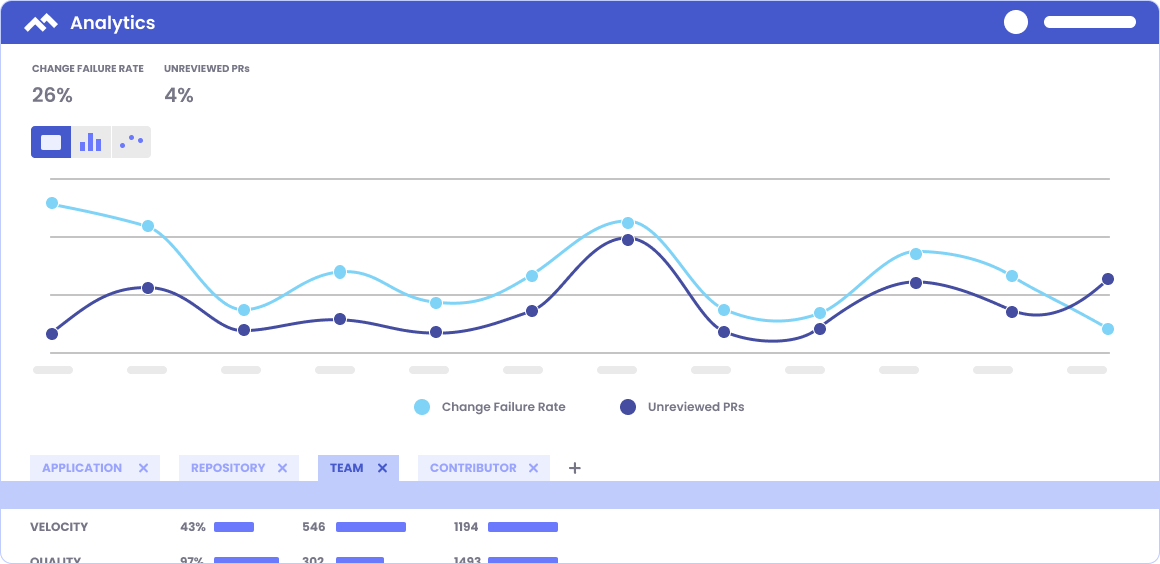
Change Failure Rate is the percentage of deployments causing a failure in production, while Unreviewed Pull Requests (PRs) refers to the percentage of PRs merged without review (either comments or approval).
How can you identify the possible causes of high rates of failures in production? One area to investigate is Unreviewed PRs. Code review is the last line of defense to prevent mistakes from making it into production. When PRs are merged without comments or approval, you’re at a higher risk of introducing errors into the codebase.
In Velocity’s Analytics module, choose Unreviewed PRs and Change Failure Rate to see the relationship between the two metrics. If you notice a high Change Failure Rate correlates to a high percentage of Unreviewed PRs, you have a basis for adjusting processes to prevent Unreviewed PRs from being merged.
Engineering leaders may start by coaching teams to improve on the importance of code review so that they make it a priority, and if necessary, setting up a process that assigns reviews or otherwise makes it more automatic. If you’re using Velocity, you can note the date of this change right in Velocity in order to observe its impact over time. You can take this data to your team to celebrate successes and motivate further improvements.
For reference, according to the State of DevOps report for 2022, high-performing teams typically maintain a CFR between 0-15%.
DORA Metric: Deployment Frequency
Velocity Metric: PR Size
Deployment Frequency measures how frequently the engineering team is successfully deploying code to production, and PR Size is the number of lines of code added, changed, or removed.
Our research shows that smaller PRs pass more quickly through the development pipeline, which means that teams with smaller PRs are likely to deploy more frequently. If you’re looking to increase Deployment Frequency, PR size is a good place to start your investigation.
If you view these two metrics in tandem and notice a correlation, i.e. that a larger PR Size correlates to a lower Deployment Frequency, encourage your team to break units of work into smaller chunks.
While this may not be the definitive solution for improving Deployment Frequency in all situations, it is the first place you might want to look. It’s important to note this change and observe its impact over time. If Deployment Frequency is still trending low, you can look at other metrics to see what is causing a slowdown. Within Velocity’s Analytics module, you also have the ability to drill down into each deploy to investigate further.
DORA Metric: Mean Time to Recovery
Velocity Metric(s): Revert Rate or Defect Rate
Mean Time to Recovery (also referred to as Time to Restore Service) measures how long it takes an engineering team to restore service by recovering from an incident or defect that impacts customers.
Debugging could account for a significant amount of the engineering team’s time. Figuring out specifically which areas in the codebase take the longest time to recover could help improve your MTTR.
In Analytics, you can view MTTR and Revert Rate or Defect Rate by Application or Team. Revert Rate is the total percentage of PRs that are “reverts”— changes that made it through the software development process before being reversed — which can be disruptive to production. These reverts could represent defects or wasted efforts (undesirable changes). Defect Rate represents the percentage of merged pull requests that are addressing defects.
By viewing these metrics side by side in the module, you can see which parts of the codebase have the most defects or reverts, and if those correlate to long MTTRs (low-performing teams experience an MTTR of between one week and one month).
If you notice a correlation, you can drill down into each revert, speak to the team, and see whether the issue is a defect or an undesirable change. To prevent defects in the future, consider implementing automated testing and/or code review. To prevent wasted efforts, the solution may lie further upstream. This can be improved by focusing on communication and planning from the top down.
DORA Metric: Mean Lead Time for Changes
Velocity Metric: Cycle Time
Mean Lead Time for Changes is the time it takes from when code is committed to when that code is successfully running in production, while Cycle Time is the time between a commit being authored to a PR being merged. Both are speed metrics, and can offer insight into the efficiency of your engineering processes.
Low performing teams have an MLTC between one and six months, while high-performing teams can go from code committed, to code running in production in between one day and one week.
If your team is on the lower-performing scale for MLTC, it could indicate that your Cycle Time is too high or that you have issues in QA and testing. View these metrics in tandem in Velocity in order to check your assumptions. If your Cycle Time is high, you can dig deeper into that metric by investigating corresponding metrics, like Time to Open, Time to Merge, and Time to First Review.
Conversely, if your Cycle Time is satisfactory, the problem could lie with deployments. You should investigate whether there are bottlenecks in the QA process, or with your Deploy Frequency. If your organization only deploys every few weeks, for example, your team’s PRs could be merged but are not being deployed for a long time.
The power of DORA metrics in Analytics
DORA metrics are outcome-based metrics which help engineering teams identify areas for improvement, yet no single metric can tell the whole story of a team’s performance. It’s important to view DORA metrics with engineering metrics to gain actionable insights about your DevOps processes.
To learn more about using DORA metrics in Velocity, talk to a product specialist.
DORA, or DevOps Research and Assessment, is a research group formed by Nicole Forsgren, Gene Kim, and Jez Humble. Acquired by Google Cloud in 2019, the DORA team established four key metrics to measure critical areas of engineering team performance. The framework also offers benchmarks for different stages of production, so that teams can check their performance against others in the industry.
DORA metrics are one tool engineering leaders can use to gain a high level understanding of outcomes, and hone in on areas of their software delivery process that need improvement. With these insights, leaders can stay up to date on SDLC (software development lifecycle) best practices, which can have a significant impact on the success of the business.
One of the four DORA metrics is Deployment Frequency, a measure of throughput that can be a starting point for examining one aspect of your engineering practices.
What is the Deployment Frequency metric?
Deployment Frequency is a measure of how often engineering teams successfully deploy code to production. As with all DORA metrics, Deployment Frequency can help leaders understand their team’s throughput and quantify how much value is being delivered to customers.
TIP: For Velocity users: use Velocity’s Deploy API to ingest data from your CI/CD tool to automate the calculation of Deployment Frequency.
Velocity uses your actual deployment data, rather than proxy data which can be error-prone, for a more accurate measurement of how often your team is successfully deploying code.
Why is Deployment Frequency important?
Deployment Frequency tracks how quickly teams can release new features or fixes, helping engineering leadership benchmark how often the team is able to get work out and receive actionable feedback from end-users.
Innovating quickly is the key to maintaining a competitive edge over other organizations. Deployment Frequency gives engineering leaders a clearer understanding of how often their customers are receiving updates to the products on offer.
Tip: For Velocity users: Use our Application functionality to associate repositories and teams to an Application. This allows users to filter and group deploys by Application and Team, making it easier to identify areas of improvement within your organization.
How to improve Deployment Frequency
If your team is deploying less than multiple times per day, it’s time to focus on improving your Deployment Frequency metric. Look for opportunities to release smaller changes or new components in isolation. An ideal time to identify this is during refinement sessions or planning sessions for a sprint. You can even set the goal of a sprint to be a smaller unit of the overall functionality.
Low Deployment Frequency can indicate that PRs, or units of work, are too large. To improve this, leaders can look at the PR Size metric. If PR Size is too large, leaders can coach teams to practice good coding hygiene and break work into smaller units. Top performing engineering organizations keep PRs to less than 140 lines of code.
Low Deployment Frequency could also indicate unnecessary or complex barriers to releasing to a production environment, like inefficiencies in the CI/CD pipeline, or requiring sign-off from a team member who’s unavailable. To attempt to remove these blockers, start by running focused retrospectives with the engineering teams to identify areas that could be improved or blockers that could be removed entirely. Improvements to automatic testing and validation of new code can also help to increase Deployment Frequency.
Lack of confidence in the stability of the functionality being produced could also be a barrier to deployment. To build confidence in new deliveries, engineering leaders can push for higher test coverage and improve Mean Time to Recovery, a DORA metric that focuses on the team’s ability to recover from incidents in production environments.
What is a good Deployment Frequency?
According to benchmarks determined by DORA through surveys of over 35,000 organizations (varying in size and industry) high-performing teams are able to deploy on-demand, meaning they deploy multiple times per day. The higher your Deployment Frequency, the more often code is going out to end users. Teams are considered medium-performing if they deploy between 1 week and one month.
Using this rubric, engineering leaders can determine where they fall among competitors. Engineering leaders can use Deployment Frequency to figure out which software teams are excelling within the organization, and apply their best practices across other teams. You can also benchmark your team against itself to measure progress over time, and see whether changes you’re implementing have the desired effect on your Deployment Frequency.
Putting Deployment Frequency into Context
As with all metrics, Deployment Frequency should be considered in the context of other data. Other DORA metrics, like Change Failure Rate, can tell you about the quality of your team’s deployments, while Mean Lead Time for Changes offers insight into your team’s efficiency. It’s important not to optimize for a single metric, but instead to strike a balance between speed metrics and stability metrics.
With Velocity’s Analytics module, engineering leaders can view multiple metrics in tandem to see how they affect one another in real time. To gain even more actionable insights, you can view DORA metrics with key, non-DORA engineering metrics.
For example, if your Deployment Frequency is low, you might want to start by viewing it alongside PR Size, which is the number of lines of code added, changed, or removed.
You might notice that the larger the PR Size, the lower a team’s Deployment Frequency, which offers concrete reasoning for developers to submit smaller PRs. While a correlation between these metrics is not diagnostic, it does offer engineering leaders a starting point to investigate a low Deployment Frequency, and identify necessary changes to processes.
If an engineering team demonstrates a favorable correlation between Deployment Frequency and PR Size, or another metric, engineering leaders have incentive to scale that team’s best practices across the organization.
Communication is Key
Engineering leaders should use objective data like DORA metrics as a starting point to identify opportunities for improvement. Only by talking with developers and looking at data holistically can you make lasting improvements to your delivery and processes.
DORA metrics can also be shared to communicate progress towards goals with broader leadership; they are great introductory metrics to share with technical and non-technical executives.
To learn more about how DORA metrics can help your team streamline and enhance delivery, speak with a Velocity Product Specialist.